
Nation
THE STATES

Benue
The Peoples Democratic Party (PDP) in Benue State said
that 33 aspirants had indicated interest to contest the governorship election on the platform of the party in 2015.
The Benue State Chairman of PDP, Dr Emmanuel Agbo, told newsmen in Makurdi that the party’s primaries must be free and fair.
Agbo said that all members of the State Working Committee (SWC) of the party had resolved to ensure that all candidates were given equal opportunities.
“33 aspirants have so far indicated their interest to contest the party’s governorship ticket in the forthcoming election.
Ekiti
No fewer than 21 political parties will participate in the
Ekiti State governorship election coming up on June 21.
The Ekiti State office of the Independent National Electoral Commission,(INEC) announced this in a statement in Ado-Ekiti recently.
Speaking to newsmen on the list, the spokesman of the Commission in the state Taiwo Gbadegesin said the list might not be final as some more might still show interest while some that had already indicated interest might choose to opt out.
He said INEC would not give special preference to any of the political parties, saying a level playing ground would be accorded all of them in every of its activities and actions.
FCT
The National Agency for Food and Drugs Administra
tion and Control (NAFDAC) has warned the public against indiscriminate consumption of energy drink for health reasons.
The Director, Pharmacovigilance and Post Market Surveillance Directorate of the agency, Mrs Adeline Osakwe, gave the warning in an interview with newsmen in Abuja.
According to her, energy drinks are supplements that contained high caffeine and carbohydrate which are made to make a person hyper active.
“The effect of the caffeine in energy drink makes people to get high, to be stimulated and of course, it makes the person’s heart to beat faster”, he said.
“It can have adverse effects, especially when the person over uses them and it accumulates in the system. The caffeine in it can lead to increase in blood pressure.
Jigawa
The National Agency for Food And Drug Administra
tion and Control (NAFDAC) has threatened to close down any packaged water factory that failed to comply with water quality standard.
The state Director of the agency in Jigawa State, Mr Olaniran Olakunle, gave the warning at a meeting with members of the Association of Table Water Producers (ATWAP) in Dutse.
Olakunle said that NAFDAC would not spare any manufacturer of packaged water who produced unclean water.
”The penalty for not complying is closure of the factory and withdrawal of NAFDAC licence,” he said.
He explained that the agency had introduced Annual Monitoring of Water Quality Standard and Compliance for all water manufacturing facilities across the country.
Kaduna
No fewer than 50 journalists with different eye diseases
have benefited from free eye screening in Kaduna State.
The free eye screening was organised by the Kaduna state chapter of Nigeria Association of Women Journalist (NAWOJ) recently.
The screening was to assist journalists overcome challenges associated with sight to enable them discharge their duties more effectively.
Mrs Juliana Oyoyo, the state chairperson of NAWOJ, said the free screening was to help journalists who used computers daily in the course of their work to correct whatever challenges they might have with their eyes.
Kebbi
The Millennium Development Goals (MDGs) Office
in Kebbi State says it has executed 152 projects in 21 local government areas in the state.
The Consultant of the projects, Dr Balarabe Isah, made this known to newsmen in Aleiro Local Government Area when he inspected the projects.
He said that 122 projects were newly constructed while 30 were rehabilitated.
“The projects comprised solar-powered boreholes for water supply to rural communities and construction of staff quarters for staff at the Maternal and Child Health (MCH) centres.”
Isah said that the projects were 100 per cent completed, especially, water supply projects, adding that 90 per cent completion was recorded in the provision of staff quarters that had yet to be furnished.
Kwara
The Landmark University, Omu-Aran in Kwara State
is to partner with the British Council for educational development, Mrs Ngozi Osueke, the institution’s Corporate Affairs Officer, has said.
Osueke told newsmen in Omu-Aran that discussions on modalities and platform for the partnership was almost concluded.
According to her, the partnership became necessary for the institution to expand the scope of its academics and more importantly its agrarian revolution initiative.
“The university, in order to expand its major focus on its agrarian revolution, is currently working out the modalities for an all encompassing partnership with the British Council.
Lagos
The Lagos State Internal Revenue Service (LIRS)
said it sealed 15 companies in the last two weeks for failing to remit N34.7 million personal income taxes of their workers.
The Head, Distrain Unit, of LIRS, Mrs Folasade Coker-Afolayan, said this last Sunday in an interview with newsmen in Lagos.
She said that the tax liabilities were for period ranging from one year to three years.
Coker-Afolayan reiterated that tax payment was a civic responsibility of citizens whose proceeds were being used by government to provide the infrastructure.
“Tax is a major source of government revenue. It enables government to provide infrastructure and improve citizens’ standard of living,” she said.
Ondo
The police have arraigned a 52-year-old man, Osagbeue
Chuks, in an Akure Magistrates’ Court for impersonation, unlawful possession and theft of books from Ondo State High Court library.
The prosecutor, Insp. Martins Olowofeso, alleged that the accused stole the books on March 12 from the library in Akure.
“The accused stole 12 copies of different volumes of the Nigeria Supreme Court case books valued N400,000, property of Ondo State High Court of Justice.
He said that the accused impersonated a lawyer in order to gain access to the library.
Ogun
Ogun State Government has begun the distribution of
Long Lasting Insecticidal Nets (LLINs) to residents across the state.
The state’s Commissioner for Health, Dr Olaokun Soyinka, said that community members had been given net cards during a nine-day household mobilisation held between February 21 and March 1.
He said that the collection of nets would be between March 15 and 19 at respective distribution points across the 20 Local Councils Areas of the state.
Our correspondent reports from some distribution points that residents thronged the venues in large number queuing to collect the nets.
Oyo
The Group Managing Director, Odu’a Investment Com
pany Ltd., Mr Adebayo Jimoh, has called for the adoption of “we-can-do-it” mind-set of the Koreans as a means of developing the nation’s human capital.
Jimoh made the call, while delivering the Distinguished Alumnus Lecture organised by the University of Ibadan Alumni Association, Ibadan.
Our correspondent reports that the lecture was entitled: “Challenges of Human Capital Development”.
He said that in addition to educating the people, the promotion of an entrepreneurship culture would assist the nation in becoming a technological base driven nation.
Plateau
President Goodluck Jonathan has commended Governor
Jonah Jang, for his strides in transforming Plateau.
Jonathan, represented by Vice President Nnamdi Sambo, gave the commendation in a thanksgiving service to mark the 70th birthday of Jang in Du, Jos South Local Government Area recently.
He said that the achievements of Jang had impacted positively on the lives of the people of Plateau.
“Jang has transformed the state through various projects in the health, agricultural, education and in the construction of roads, and in the construction of the very first flyover in the state”, he said.
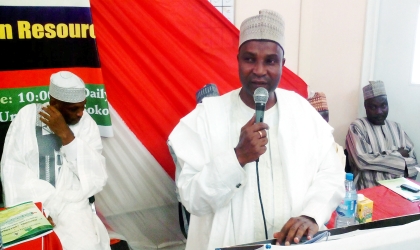
Speaker, Sokoto State House of Assembly, Alhaji Lawalli Zayyana, speaking at the opening of a conference organized by the Faculty of Science, Sokoto State University, in Sokoto, last Monday.



Rivers State University and the Otonti Nduka Foundation for Values Education jointly hosted a two-day National Conference on 8 and 9 May 2026 to examine the state of values in Nigeria.
The two days conference held at Rivers State University convocation arena brought together academics, policymakers, legal experts and education leaders under the theme _“Trends and Challenges in Upholding Values in Nigeria.”_
The gathering focused on policy gaps, curriculum reform, and the role of ethics in public service and education.
The event opened on Friday with remarks from Vice Chancellor Prof. Chief Isaac Zeb-Obipi, who stressed the need to address declining moral and civic values across Nigeria’s education and public sectors. A book of abstracts for the plenary sessions was also presented to participants.
Key speakers included former Attorney General Chief Dr Kanu Agabi, SAN; NERDC Executive Secretary Prof. Shehu Salisu; Prof. Hauwa Imam, FNAE, of the University of Abuja; former Rivers SUBEB Chairman Ven Dr Fyneface Akah, ; former NIMASA DG Dr Hon. Dakuku Adol-Peterside; and RSU Director of ICT Prof. Sunny Orike.
Discussions centered on integrating values education into schools, tertiary institutions and public institutions, alongside the impact of technology on moral development among young Nigerians. Panel and plenary sessions produced practical recommendations for curriculum and policy reform.
On Saturday, the foundation marked its centenary with the unveiling of the book _Otonti Nduka in History_, launched by Chief Engr. Grant Offor, FNSE. The Nigerian Academy of Education held a ceremonial procession led by its President Prof. Olu Jegede and the Ikwerre Professors Forum.
In a communiqué, participants called for stronger collaboration between government, civil society and academia to mainstream values education nationwide. They recommended reviewing teacher training curricula and expanding digital platforms to promote ethical civic engagement, with the foundation pledging to share the outcomes with education authorities for implementation.
Dignitaries present included Ogbakor Ikwerre Worldwide as Chief Host, Prof. Emeritus Chief T. Uzodimma Nwala, the Ikenga 1 of Mbaise and first philosophy student of Prof. Otonti Nduka, alongside scholars and community leaders.
Amadi Akujobi

The Shell Nigeria Gas Limited, in partnership with the Manufacturers Association of Nigeria, has reaffirmed support for efforts to expand gas distribution infrastructure in Rivers State as part of initiatives aimed at improving access to affordable, cleaner and more reliable energy for industries across the South-South region.
The commitment was highlighted during the SNG–MAN Business Forum held in Port Harcourt, where stakeholders from the industrial and public sectors examined the role of natural gas in driving industrialisation, boosting local production and strengthening energy security.
Speaking at the forum on behalf of the Managing Director of Shell Nigeria Gas Limited, the company’s Head of Gas Distribution, Mr. Chukwuka Amos Ejesi, described natural gas as a critical component of Nigeria’s energy mix and a key driver of sustainable industrial growth.
According to him, Nigeria’s gas development agenda has reached a stage where policy direction must be matched with practical implementation capable of addressing the energy challenges confronting manufacturers.
He noted that pipeline gas offers industries a cleaner, more dependable and cost-effective energy alternative capable of supporting uninterrupted operations, reducing emissions and improving production efficiency.
“Gas is the backbone of manufacturing, and we are encouraged by the growing recognition among stakeholders of the need for cleaner and more reliable energy solutions,” he said.
Ejesi stressed the need for sustained collaboration among energy providers, government institutions and industrial stakeholders to maximise the country’s gas resources for economic development.
He added that improved gas infrastructure would strengthen manufacturing value chains, enhance productivity and promote more competitive industrial operations across Rivers State and the wider South-South region.
Participants at the forum also emphasised the importance of expanding energy infrastructure as a pathway to unlocking industrial capacity, reducing operating costs and promoting sustainable industrial development.
Representing Governor Siminalayi Fubara, the Director-General of the Rivers State Investment Promotion Agency, Dr. Chamberlain Peterside, reaffirmed the state government’s commitment to partnering with private sector investors to revitalise industrial activities in the state.
He identified key projects targeted under the initiative to include the revival of the Ahoada Industrial Park, the New Port City project and the proposed Bonny Industrial Park, all aimed at stimulating economic growth and expanding industrial opportunities along the Bonny corridor.
According to the governor, the long-term vision is to position Rivers State as a leading manufacturing hub in Southern Nigeria through strategic public-private partnerships.
Governor Fubara also commended Shell Nigeria Gas and MAN for sustaining engagements geared towards improving industrial energy access, noting that gas infrastructure development remains central to the state’s economic recovery plans.
He further observed that the gas sector presents enormous opportunities for economic growth, especially as global energy systems continue to shift towards cleaner energy sources.
The governor called on stakeholders to work collectively towards developing a practical and sustainable gas framework capable of supporting the state’s industrial and energy development objectives.
Chairman of MAN, Rivers and Bayelsa Branch, Elder Vincent Okuku, described gas as indispensable to industrial operations, noting that many manufacturers continue to struggle with the high cost of alternative energy sources.
Similarly, President of the Port Harcourt Chamber of Commerce, Industry, Mines and Agriculture, Dr. Chinyere Ngozi Nwoga, said the transition to natural gas had become increasingly necessary for businesses seeking stable and cost-efficient operations.
“Pipeline natural gas provides a more cost-effective and reliable source of energy for industries,” she stated.
Also speaking, former Chairman of MAN in Rivers and Bayelsa States, Mrs. Emilia Akpan, stressed the need to align energy infrastructure development with investment in human capacity.
She maintained that rebuilding the state’s economy would require not only reliable energy supply but also the development of technical skills needed to support long-term industrial growth.
By Kevin Nengia

The City Boy Movement in Etche Local Government Area of Rivers state has commended Senator Allwell Onyesoh on his victory in the APC primary election for Rivers East Senatorial District.
Chairman of the group in Etche, Dr. Fortune Uchenna Obi, spoke to journalists in Okehi Ward after participating in Monday’s direct primary. He described Onyesoh’s emergence as the party’s candidate for the 2027 senatorial election as a reflection of the people’s will.
Dr. Obi said the senator has performed well during his first term and deserves re-election. He also thanked FCT Minister Nyesom Wike, leader of the Renewed Hope Agenda and Rainbow Coalition in Rivers State, for supporting Onyesoh’s candidacy. According to him, Wike’s backing was instrumental to the senator’s nomination, clearance, and victory at the primary.
He further praised voters in Etche and across Rivers East for turning out in large numbers at ward centers and urged them to sustain the support to ensure Onyesoh’s success in the January 2027 general election.
-

 News10 hours ago
Court Sentences Seven To Death Over Murder Of Cleric In Rivers
-

 Politics7 hours ago
APC PRIMARIES: FUBARA’S WITHDRAWAL, HISTORIC SACRIFICE FOR NATIONAL STABILITY ……. GROUP
-

 News18 hours ago
Group Hails Tinubu, Chinda Emergence
-

 Politics7 hours ago
IPAC Flays INEC Over Election Guidelines Judgement
-

 Comment10 hours ago
Rivers @59: Progress Through Tough Times
-

 Sports7 hours ago
NPFL: Rivers United Finishes Second, Secures Continental Ticket
-

 Politics7 hours ago
NDC To Adopt Electronic Voting For Future Primaries
-

 Sports7 hours ago
Stakeholders Laud GTI On NPFL Partnership