Connect with us

Business

‘NNPC Spends $1.8bn On Fuel Import Per Quarter’

Published

on

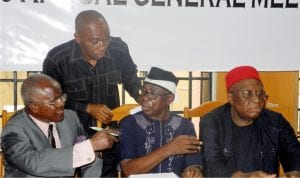
L-R: Secretary, Agro-Industrial Settlements Development Association of Nigeria (ASDAN), Mr Maxwell Onyeukwu, Publicity Secretary, Mr Tony Nwosu, Chairman of ASDAN, Mr Rockson Essien and the chairman of the occasion, Chief Guy Okechukwu, at the 1st AGM of ASDAN in Abuja recent.

L-R: Secretary, Agro-Industrial Settlements Development Association of Nigeria (ASDAN), Mr Maxwell Onyeukwu, Publicity Secretary, Mr Tony Nwosu, Chairman of ASDAN, Mr Rockson Essien and the chairman of the occasion, Chief Guy Okechukwu, at the 1st AGM of ASDAN in Abuja recent.

The Nigeria National Petro
leum Corporation (NNPC) has said  that it spends $1.8 billion in 90 days to import fuel.
The Group Executive Director Upstream of NNPC, Mr Bello Rabiu, stated this while addressing State House Correspondents, on Thursday.
According to him, the organisation spends between $16 million and $20 million on imports daily totaling about $1.8 billion per quarter.
Rabiu was reacting to the inability of the nation’s refineries to provide the local needs of consumers. He said that the organization had to rely on importation to satisfy local consumption.
He said that import bill depended on both volume and the price adding that a cargo of product, about 40 million litres, as at today costs about $13 million to $14 million dollars.
He said that the country produced about 2.2 million barrels of crude per day but only about one million belonged to NNPC through 60 per cent equity in the Joint Venture.
“The average equity crude for sale is not up to one million barrels which means that the total amount of money we can get is about $40 million dollars’’, he said.
According to him, if half of the amount is used to import products, it leaves a lot of implications for the economy.
He said that the organisation also spent money to produce which reduced the accruals. “We spend about $30 million to produce.
“We try to maximise what is available’’ he said, adding that over 90 per cent of other imports were financed by the oil sector.
“That is why we said we need to diversify, export more and import less’’, he noted.
He said that more countries now produced oil and that some producers that came out of crisis such as Libya had joined in the crude market.
He said it was unfortunate that most of the oil producing countries were import- dependent.
He said that for the local refineries the nation could not get more than 15 million to 20 million litres of PMS out of them but could produce enough kerosene (DPK) and diesel (AGO) if they operated at 90 percent installation.
The Group Executive Director, Refinery, Mr Anibor Kragha, said the operators were focused on increasing fuel supply to markets outside Lagos and Abuja.
On the pipelines, he said most of them were on pressure testing to ensure safety before pumping through them.
He said that the Enugu depot would take some time to be revived but added that Aba depot was ready to service the entire East.


Continue Reading

Business

CBN Revises Cash Withdrawal Rules January 2026, Ends Special Authorisation

Published

on

The Central Bank of Nigeria (CBN) has revised its cash withdrawal rules, discontinuing the special authorisation previously permitting individuals to withdraw N5 million and corporates N10 million once monthly, with effect from January 2026.

In a circular released Tuesday, December 2, 2025, and signed by the Director, Financial Policy & Regulation Department, FIRS, Dr. Rita I. Sike, the apex bank explained that previous cash policies had been introduced over the years in response to evolving circumstances.

However, with time, the need has arisen to streamline these provisions to reflect present-day realities.

The statement said the new set of cash-related policies is designed to reduce the cost of cash management, strengthen security, and curb money laundering risks associated with the economy’s heavy reliance on physical currency.

“These policies, issued over the years in response to evolving circumstances in cash management, sought to reduce cash usage and encourage accelerated adoption of other payment options, particularly electronic payment channels.

“With the effluxion of time, the need has arisen to streamline the provisions of these policies to reflect present-day realities,”

“Effective January 1, 2026, individuals will be allowed to withdraw up to N500,000 weekly across all channels, while corporate entities will be limited to N5 million”, it said.

According to the statement, withdrawals above these thresholds would attract excess withdrawal fees of three percent for individuals and five percent for corporates, with the charges shared between the CBN and the financial institutions.

Daily withdrawals from Automated Teller Machines (ATMs) would be capped at N100,000 per customer, subject to a maximum of N500,000 weekly stating that these transactions would count toward the cumulative weekly withdrawal limit.
The special authorisation previously permitting individuals to withdraw N5 million and corporates N10 million once monthly has been discontinued.

The CBN also confirmed that all currency denominations may now be loaded in ATMs, while the over-the-counter encashment limit for third-party cheques remains at N100,000. Such withdrawals will also form part of the weekly withdrawal limit.

Deposit Money Banks are required to submit monthly reports on cash withdrawals above the specified limits, as well as on cash deposits, to the relevant supervisory departments.

They must also create separate accounts to warehouse processing charges collected on excess withdrawals.

Exemptions and superseding provisions
Revenue-generating accounts of federal, state, and local governments, along with accounts of microfinance banks and primary mortgage banks with commercial and non-interest banks, are exempted from the new withdrawal limits and excess withdrawal fees.

However, exemptions previously granted to embassies, diplomatic missions, and aid-donor agencies have been withdrawn.

The CBN clarified that the circular is without prejudice to the provisions of certain earlier directives but supersedes others, as detailed in its appendices.

Continue Reading

Business

Shippers Council Vows Commitment To Security At Nigerian Ports

Published

on

The Nigerian Shippers Council (NSC)has restated its commitment towards ensuring security at Nigerian seaports.
Executive Secretary/Chief Executive Officer of the Council, Dr Pius Akuta, said this in Port Harcourt, while declaring open a one day workshop organized by the Nigerian Shippers Council in collaboration with the Nigerian police( Marin Division).
Theme for the workshop was ‘Facilitating Port Efficiency; The strategic Role of Maritime police “
Akuta who was represented by the Director, Regulatory Services, Nigerian Shippers Council, Mrs Margeret Ogbonnah, said the workshop was to seek areas of collaboration with security agencies at the Ports with a view to facilitating trade
Akuta said the theme of the workshop reflects the desire of the council and the Nigerian police to build capacity of police officers for better understanding and administration of their statutory roles in the Maritime environment.
He said Nigerian seaports has constantly been reputed as one of the Port with the longest cargo dwell in the world, adding,”This is so, because while it takes only six hours to clear a containerized cargo in Singapore Port, seven days in Lome Port, it takes an average of 21 days or more in Nigerian Ports” stressing that this situation which has affected the global perception index on Ease of Doing Business in Nigerian seaports must be addressed.
Akuta said NSC which is the economic regulator of the Ports has the responsibility of ensuring that efficiency is established in the Ports inorder to attract patronages.
“Pursuant to its regulatory mandate, the NSC has been collaborating with several agencies to ensure the facilitation of trade and ease of movement of cargo outside the Ports to avoid congestion”he said.
Also speaking the commissioner of police, Eastern Port Command, Port Harcourt, CP Tijani Fakai, said Maritime police has played some roles in facilitating Ports efficiency.
He listed some of the roles to include ensuring security and crime prevention at the Ports, checking of illegal fishing activities at the Ports, checking of human trafficking and drug smuggling and prevention of fire incident at the Ports.
Represented by ACP, Rufina Ukadike, the CP said police at the Ports have also helped in the decongestion and prevention of unauthorized Anchorage.
He commended the Nigerian Shippers Council for the workshop and assured of continuous collaboration.
Speaking on the dynamics of cargo handling, Deputy Controller of customs, Muhydeen Ayinla Ayoola, said the launching of electronic tracking system and dissolution of controller General Taskforce has helped to ensure efficiency at the Ports.
Ayoola who represented the custom Area Controller Port Harcourt 1 Area command, however raised concerned over rising national security threat , which according to him has affected efficiency at the Ports.
John Bibor
Continue Reading

Business

Nigeria Risks Talents Exodus In Oil And Gas Sector – PENGASSAN

Published

on

The Petroleum and Natural Gas Senior Staff Association of Nigeria (PENGASSAN) says Nigeria risks massive brain drain in the oil and gas sector due to poor remuneration.

Mr Festus Osifo, President of PENGASSAN, said this while briefing newsmen at the end of the National Executive Council (NEC) meeting of the union on Thursday in Abuja.

He said the sector was facing challenges arising from Naira devaluation and inflation, noting that, oil and gas skills remained globally competitive.

“A drilling engineer in Nigeria does the same job as one in the U.S. or Abu Dhabi,” he said.

Osifo said the union must take steps to bridge the wage gap to prevent members from leaving the country for better opportunities abroad.

“If we don’t act, the brain drain seen in other sectors will be child’s play,” he said.

He said PENGASSAN had recorded significant gains through collective bargaining across oil and gas branches.

“We signed numerous agreements across government agencies, IOCs, service and marketing sectors,” he said.

He said the agreements brought relief to members facing rising costs of living, adding that,  the association’s duty is to protect members’ jobs and enhance their pay.

Osifo urged companies delaying salary reviews and those foot-dragging as a result of the prevailing economic realities, to do the needful.

He said the industry employed some of the nation’s best talents, making competitive pay critical to retaining skilled workers.

“This industry recruits the best. Companies must provide the best conditions,” he said.

On insecurity, Osifo urged government to take decisive action against terrorism and kidnappings across the country.

“We are tired of condemnations. government must expose sponsors and protect citizens,” he said.

He urged government at all levels to prioritise tackling insecurity through better funding and equipment for security agencies.

Osifo said PENGASSAN supported calls for state police to improve local security response, adding that decentralising policing will protect citizens better than rhetoric.

He also said economic indicators meant little, if food prices remained high and farmers could not return to farms due to insecurity.

“Nigerians want to see food on the table, not macroeconomic figures,” he said.

He urged government to coordinate fiscal and monetary policies to ensure economic gains reach households.

“Translate macro results to food on the table,” he said.


Continue Reading

Trending