
Business
Transport Infrastructure To Gulp N3.15trn – ICRC

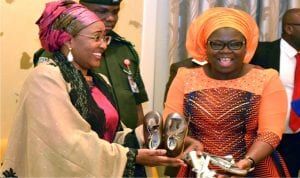
Wife of the President, Mrs Aisha Buhari (left) receiving Aba made-in-Nigeria products from wife of the Governor of Abia State, Mrs Nkechi Ikpeazu, during a courtesy call on the wife of the president by Abia State women in Abuja on Wednesday.
The Director-General,
Infrasture Concession Regulatory Commission (ICRC) Mr Aminu Dikko, has said that the Federal Government would require N3.15trillion in the next five years to address the challenges of infrastructure in the transport sector.
Dikko, made this assertion during a capacity building programme for officials in the Ministry of Transport at Abuja,.
The ICRC boss stated that of this amount, N985 billion would be required in the aviation sector, while N2.17 trillion would be needed to bridge the infrastructure gap in the rail and other transport segments.
He noted that in view of the breakdown , there was a need for capacity building development programme for government officials, particularity those who function in the Public Private Partnership section, saying that it was necessary to attract funding from the private sector.
He said, “if we look at our airports in the country, they need improvement and this can be done through PPP, whether it is operating and managing them or expanding them. Also, we have been struggling to do a second runway at the Nnamdi Azikiwe Airport, Abuja, and this is something that the private sectors can do without all bottlenecks that traditional procurement can bring.”
Dikko, who was represented by the Director, Support Service Department, ICRC, Mr Mohammed Bamali, further said the training would prepare officials of the ministry for the number of projects billed for concession under its supervision.
He said as part of measures to boost commerce and industry, the Federal Government would concession the parts in Lekki and Budagry, among others.
The ICRC boss urged participants at the training to champion the cause of infrastructure in the country using the tools learnt at the training.



Business
Jonathan, Diri, Others Laud Firm’s Milestone in Bayelsa …Says Project Will Drive Industrialisation, Create Jobs



-

 News2 days ago
RSG Targets Nine Million Residents in Mosquito Net Distribution Campaign
-

 Oil & Energy2 days ago
Aiyedatiwa Signs New Electricity Bill
-

 Oil & Energy2 days ago
NLNG Commissions Research And Innovation Centre In RSU
-

 Maritime2 days ago
Marine Minister Commends President Tinubu On NPERA Bill Assent
-

 News2 days ago
KenPoly Holds Eight Convocations, August 29
-

 News2 days ago
RSG Begins Another Phase of Projects Commissioning Today
-

 News2 days ago
RMAFC Completes Revenue Sharing Review, Proposes New Pay
-

 Maritime2 days ago
NAGAFF Petitions IGP Over Alleged Maritime Police Harassment