
Politics
INEC: Preparing For March 19 In Rivers

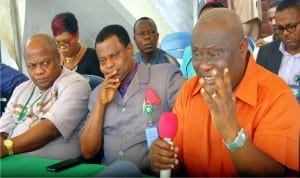
L-R: Head of Departement,Voters Education, INEC, Rivers, Mr Godfrey Achebe; Administrative Secretary, Rivers, Mr Tom Ongele and Rivers Resident Electoral Commissioner, Elder Aniedi Ikoiwak, during a meeting with Rivers INEC Staff in preparations for the March 19 re-run Election in Port Harcourt, recently
From Abua to Andoni,
Opobo/Nkoro to Ogba/Egbema/Ndoni, from Khana to Akuku Toru, Etche to Eleme, they converged on the state headquarters of the Independent National Electoral Commission, Aba Road Port Harcourt. The date was Tuesday, March 8, 2016.
They said their gathering was to have a family meeting and when the roll call was taken, not one of the Electoral Officers (EOS) of the 23 Local Government Areas of Rivers State was missing. They came in their full number. They came in their full strength with an appreciable compliment of their staff at the local government offices.
This was not the first time the premises of the INEC Office on Aba Road was hosting critical stakeholders in the electoral process in Rivers State in preparation for this week’s re-run legislative elections in the state. A meeting of all the political parties and their candidates for the elections with the management of INEC had held earlier.
Ditto for security agencies and their operations, and civil society groups in those meetings, INEC engaged with the stakeholders as the one of the helm of affairs, to acquaint them once again with the guiding rules and regulations of process and to extract from them a commitment to abide by the rules of engagement for a free, fair and credible exercise . In talking about expectations from the stakeholders, the commission was also mindful to make commitments with regard to its own expectations.
The meeting of March 8, was therefore part of the commission’s own strategy of equipping and organising itself to face the challenges of delivering its own side of the bargain to achieve a successful outcome of the March 19 outing. To underline the importance of the meeting, all offices were ordered to be closed and all officers surmounted to be part of the gathering. Little time was spared for any protocol except a brief praise, worship, and prayer session to invite the Spirit of God for direction and divine enablement for the enormous task shead.
Like a responsible head of the family who has a firm grasp of the issues confronting the group, the Resident Electoral Commissioner, Elder Aniedi Ikoiwak, did not only resolve to speak the truth with his members but to render it bare and undecorated.
Indeed, he spoke like one with the conviction that only the acquaintance with the truth of how far they had deviated and thereby put themselves in much jeopardy could bring them back to the path of rectitude and redemption.
In no uncertain terms, the REC told his staff that they had strayed from their core values of independence and non-partisanship. He said it was unacceplable that division along political lines had been allowed to creep into the commission thereby weakening the commission and making it vulnerable to the intrusion and manipulation of politicians.
Elder Ikoiwak said elections will remain a mirage if INEC personnel find it difficult to distance themselves from politicians and desist from aiding and abetting them to corrupt the system, noting that it was no longer hidden that staff of the commission sometimes engage in delivering electoral materials to politicians in hotel rooms and such other unlawful places to their shame and damnation.
The INEC boss charged them to derobe themselves of all vestiges of bias and allegiance to any other interest and work as officers who are proud of their job and worthy of their engagement by the commission. He said that, beginning from the coming elections, staffers of the commission will continually be under surveillance by independent monitors whose reports will determine their fate.
He emphasized that he will not hesitate to deal decisively with any recalcitrant personnel whose conduct or misconduct compromises the responsibility of the electoral umpire, adding that sanctions will include but not hinted to, dismissal from office of such staff.
“At the end of this election, I hope nobody will come to my office and roll on the ground begging for forgiveness because I will personally see to it that any staff who engages in anything unlawful to embarrass the commission and compromise the fidelity of the electoral process is taken out of the system,” he warned.
To demonstrate the commission’s resolve to strictly adhere to its guiding rules, Elder Ikoiwak said the old practice of receiving application from intending adhoc staff had been jettisoned.
In its place, he said, requests had been made to the heads of federal institutions including the NYSC, University of Port Harcourt, Federal College of Education, Otuoke, and the Federal University. Otuoke, Bayelsa State for personnel to undertake the assignment.
He explained that even though INEC was not involved in the direct recruitment of the adhoc, staff, the commission retains the responsibility of protecting and being accountable for its materials and charged his staff to rise up to the challenge of safe keeping of the materials and ensuring that they are delivered only to those whose duty it is to handle them.
He assured the staff that everything necessary and needful was being done to enhance their effective and efficient performance and implored them to also prepare themselves to make necessary sacrifices to achieve success. The REC urged them to take no satisfaction in any other than the pride of delivering on the mandate of the commission to superintend over a free, fair and credible poll.
At the end of his address, there was total agreement and endorsement of all he had said. Ass it were, the REC did not only succeed in correctly identifying the gaps that exist within the electoral body and how to bridge them, he also succeeded in bringing the staff to making a commitment to turning a brand new leaf towards achieving the overall goal of a transparent, open, and acceptable conduct of the March 19, 2016 re-run legislative polls in Rivers State in particular.
Speaking on the development, the Rivers State Director of the National Orientation Agency, NOA, Mr Oliver Wolugbom, expressed the view that the March 19, re-run elections present INEC with a golden opportunity to redeem its badly smeared image in the state.
Mr Wolugbom said it was encouraging that INEC was talking to itself and reviewing its activities and performances in the past with a view to making amends and rededicating itself to delivering on its core mandate.
“INEC must stand its ground and take responsibility and charge over this election,” he said adding that to this end, the commission should have only its personnel as collation officers in all the 319 electoral wards in the state.
For the purpose of accountability, the NOA boss proffers that the bulk of the adhoc staff should be staffers of INEC so that the commission can have a greater grip of the activities and performance of the personnel. To achieve this objective, he said, it would not be out of place for the electoral body to empty itself into Rivers State from Surrounding states.
According to Mr Wolugbom, the more non-staffers of the commission are engaged in the exercise the greater the chances of comprise in the system, insisting that whosever is engaged must be impressed upon to do only that which is fit and proper to deliver a desirable outcome.
The NOA Director reiterated that the groundswell of misgivings against the commission has aggravated the need for it to acquit itself creditably and enjoined the electoral umpire to adequately equip and educate all its personnel to be deployed for duty.
In truth, the eventual outcome of the March 19, re-run elections in Rivers State is a shared responsibility among the stakeholders including the security agencies, civil society organizations, the political parties and their candidates and the Independent National Electoral Commission. However, it cannot be gainsaid that no one singular role or function is as vital as that of the umpire whose statutory responsibility is to coordinate all others to achieve the desired end.
It is worthy of commendation that the Resident Electoral Commissioner and his staff realise and appreciate this fact. But just being aware and appreciating the task in only the half of the job. The other and the most important part is the practical demonstration of the rhetoric. Nigerians are watching and Rivers people cannot wait for INEC to either redeem itself and shame its critics or to disappoint itself and prove the critics right and earn the damnation of condemnation of the people.
Opaka Dokubo



The Independent National Electoral Commission (INEC) has extended the deadline for political parties to submit the list of candidates for the 2027 governorship and state Houses of Assembly elections from Saturday, August 8, to Tuesday, August 11, 2026.
The commission announced the extension in a statement issued on Saturday and signed by the National Commissioner and Chairman of its Information and Voter Education Committee, Mohammed Haruna.
According to INEC, the decision followed appeals by political parties for additional time to complete the submission process through the dedicated online portal.
“The submission window, which according to the revised Timetable and Schedule of Activities for the General Election was originally scheduled to close on Saturday, 8th August, 2026, has been extended to Tuesday, 11th August, 2026,” the commission said.
In a a related development, INEC announced the suspension of PVC collection in Osun State ahead of the August 15 governorship election.
The commission said voters who applied for replacement of lost, damaged or defaced Permanent Voter Cards would have until midnight on Sunday, August 9, to print downloadable copies of their cards.
The electoral body explained that the deadline was necessary to enable it compile data on downloaded PVCs and produce final statistics on the total number of cards collected ahead of the election.
INEC said PVC collection in Osun commenced at the Registration Area level from July 22 to 28, 2026, but was extended to July 31 following complaints about large crowds and difficulties experienced by voters at collection centres.
The exercise subsequently moved to the local government level and ran from August 1 to 7.
The commission also disclosed that replacement downloadable PVCs had been made available to voters in Odo-Otin and Ife Central Local Government Areas following the theft of cards during attacks on the two collection centres.
It stressed that the stolen cards could not be used to vote.
INEC reassured Osun residents of its preparedness for the August 15 governorship election.
“The commission reiterates that the stolen cards cannot be used to vote.
“INEC reassures the people of Osun State of its readiness to conduct a free, fair, credible and inclusive governorship election on 15th August, 2026,” the statement said.
The commission said the deadline, initially set for Saturday, 8 August, has been extended to Tuesday, 11 August 2026, following appeals from political parties for more time.
INEC also announced that the window for voters who applied to replace lost, damaged or defaced PVCs to download their replacement cards will close at midnight on Sunday, 9 August.
The move is to enable the commission compile final PVC collection figures ahead of the 15 August Osun governorship election.
INEC said replacement downloadable PVCs have also been provided to affected voters in Odo-Otin and Ife Central Local Government Areas after hoodlums carted away cards from two collection centres, stressing that the stolen cards cannot be used to vote.
The commission reaffirmed its readiness to conduct a free, fair, credible and inclusive election in Osun State.
Gov. Kefas made the remarks over the weekend at the Federal Medical Centre (FMC), Jalingo, during the flag-off of the second phase of the Renewed Hope Medical Outreach in Taraba State, organised as part of activities marking Prof. Yilwatda’s 58th birthday.
The governor commended Prof. Yilwatda for choosing to mark his birthday by providing medical care to people in need.
“What Professor Nentawe did is a powerful demonstration of what leadership should be,” Gov. Kefas said.
He assured that his administration would continue to support initiatives that complement government efforts to improve healthcare delivery and the wellbeing of residents.
Speaking at the event, Prof. Yilwatda called on Nigerian leaders to embrace the culture of giving and use their positions to touch the lives of the less privileged.
He said his decision to celebrate his 58th birthday in Taraba State was deliberate and informed by the needs of underserved communities, particularly people who face difficulties accessing healthcare because of distance and financial constraints.
According to him, the intervention followed a needs assessment and was extended across the three senatorial districts of the state.
He said the exercise commenced on August 3 at Takum General Hospital and covered the Federal University Teaching Hospital, Wukari; First Referral Hospital, Sunkani, Ardo-Kola Local Government Area; General Hospital, Bali; General Hospital, Gembu; and FMC Jalingo.
Prof. Yilwatda said the intervention provided medical services to thousands of beneficiaries, including people who required surgical procedures.
He said sustainable national development could only be achieved when strong institutions placed Nigerians at the centre of development.
“Leadership is about service,” he said, urging political and public leaders to make giving back to society an important part of their responsibilities.
He reaffirmed his commitment to serving Nigeria and its people, saying his personal vision was to make every day of his life useful to humanity.
“Every day that I live, the vision is: let it be useful to humanity,” he said.
The Taraba State Commissioner for Health, Dr. Bordiya Buma, commended the initiative, saying it was consistent with the Renewed Hope agenda and efforts to strengthen healthcare delivery in the state.
Dr Buma said the second phase followed the successful completion of the first phase, which was conducted simultaneously in six local government areas, with two LGAs selected from each of the three senatorial districts.
According to him, more than 10,000 patients were attended to during the first phase, including people with medical and surgical conditions.
He disclosed that 327 general surgeries, 71 eye surgeries and 575 dental procedures were carried out during the exercise.
The commissioner expressed appreciation to President Bola Tinubu for the Renewed Hope Medical Outreach and thanked Prof. Yilwatda for supporting the initiative and choosing Taraba State as a beneficiary.
The Minister of Health and Social Welfare, Prof. Muhammad Ali Pate, also commended Prof. Yilwatda for choosing Taraba State to mark his 58th birthday through a medical outreach.
Prof. Pate said making healthcare the centrepiece of the birthday celebration was significant because health affects everyone.
-

 News2 days ago
RSG Targets Nine Million Residents in Mosquito Net Distribution Campaign
-

 Oil & Energy2 days ago
Aiyedatiwa Signs New Electricity Bill
-

 Maritime2 days ago
Marine Minister Commends President Tinubu On NPERA Bill Assent
-

 Oil & Energy2 days ago
NLNG Commissions Research And Innovation Centre In RSU
-

 News2 days ago
KenPoly Holds Eight Convocations, August 29
-

 News2 days ago
RSG Begins Another Phase of Projects Commissioning Today
-

 News2 days ago
RMAFC Completes Revenue Sharing Review, Proposes New Pay
-

 Maritime2 days ago
NAGAFF Petitions IGP Over Alleged Maritime Police Harassment