
News
66 Soldiers On Death Row Over Mutiny, Saved

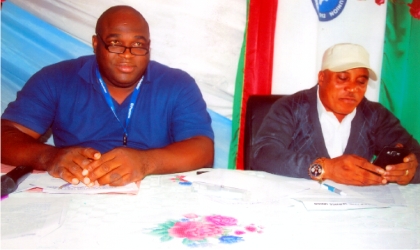
Rivers State Chairman, Nigeria Civil Service Union (NCSU), Comrade O. T. Lilly-West (right), with the State Secretary, Comrade Dan Otakpo, during the inauguration of the executives of the Women Committee of the union in Port Harcourt on Thursday.
For the 66 soldiers sentenced to death for mutiny and other offences in the fight against Boko Haram terrorists in the North-East, the good news is that they will no longer face the firing squad.
The Army authorities announced, yesterday, that their death sentences had been commuted to terms of 10 years imprisonment.
“The death sentences by firing squad, passed on 66 soldiers in January and March, 2015, by separate General Court Martials (GCMs), have been commuted to 10 years imprisonment each”, the Acting Director, Army Public Relations, Colonel Usman Sani, said yesterday.
After the sentencing of 12 soldiers to death for shooting at a vehicle conveying the General Officer Commanding (GOC), 7 Division of the Nigerian Army, Maiduguri, Borno State, Major-General Ahmed Mohammed, the Army authorities, on October 2, 2014, at the Defence Headquarters (DHQ) Garrison, inaugurated another nine-man GCM to try about 100 soldiers.
The soldiers were charged with offences ranging from mutiny to assault, misconduct and tampering with military property.
Of the lot, 77 were accused of committing mutiny, punishable by death.
The charge said the soldiers attached to the 7 Division, conspired to commit mutiny, saying they refused to join 111 Special Forces Battalion, led by Colonel E.A. Aladeniyi, to the Maimalari Barracks for an operation (against Boko Haram fighters).
The mutinous soldiers had blamed the GOC and other officers for the death of four of their colleagues allegedly ambushed while on a special operation against Boko Haram in Kalabalge LGA, near Chibok, Borno State; where over 200 school girls were abducted by terrorists in April, last year.
One of the CGMs was headed by Brigadier General Chukwuemeka Okonkwo.
The Army spokesperson, Sani, in a statement announcing the reversal of the death sentences handed to the 66 soldiers, yesterday, to 10 years imprisonment, said: “It will be recalled that 71 soldiers were arraigned on several charges in joint trials. The soldiers were arraigned on several count charges that included Criminal Conspiracy, Conspiracy to commit mutiny and Mutiny.
“Others were Attempt to Commit an Offence (Murder), Disobedience to Particular Orders, Insubordinate Behaviour and False Accusation, amongst others.
“They (soldiers) were tried, discharged on some charges but found guilty and convicted on other charges which included mutiny.
“Out of the number, 66 were found guilty on some of the charges and sentenced to death, while 5 were discharged and acquitted and one was given 28 days Imprisonment with Hard Labour (IHL).
“However, following series of petitions, the Chief of Army Staff Lieutenant General Tukur Yusufu Buratai, ordered a legal review of the cases. The directive was carried out to examine the merit of each case.
“It was on the basis of the review and recommendations that the Chief of Army Staff commuted the death sentences of the 66 soldiers to 10 years jail terms. The sentences are to run concurrently.
“The cases of other soldiers are being reviewed and will be made public once the appropriate reviews are completed.”
The reprieve for the convicted soldiers, yesterday, elicited jubilation from their families.
Family members of some of the convicts, who spoke newsmen on phone, were full of praises for the Army authorities and the Chief of the Army Staff (COAS), but would have preferred that their kinsmen were outrightly pardoned and possibly reabsorbed into the military.
Meanwhile, the Conference of Nigerian Political Parties has asked President Muhammadu Buhari to use his powers of prerogative order of mercy to pardon and reinstate the soldiers convicted over the fight against Boko Haram insurgents in the North East zone of the country.
The Nigerian Army had commuted the death sentences passed on 66 soldiers by separate court martial to 10 years imprisonment.
A statement by the Acting Director of Army Public Relations, Sani Usman, a colonel, said 71 soldiers were arraigned on several charges in joint trials in January and March.
The soldiers were arraigned on several count charges that include Criminal Conspiracy, Conspiracy to commit mutiny, Mutiny, Attempt to Commit an Offence (Murder), Disobedience to Particular Orders, Insubordinate Behaviour and False Accusation, amongst others.
While thanking the army authorities for squashing the death sentences, the CNPP, in a statement by its spokesperson, Osita Okechukwu, said soldiers convicted over the fight against insurgents had been vindicated by the revelation from ongoing trial of the former National Security Adviser, Sambo Dasuki, and others and should be reinstated.
“In addition to the review of some of the sentences by the Chief of Army Staff, we still appeal to Mr President and Commander-in-Chief to as a matter of urgent national importance to pardon and reinstate the mutinied soldiers,” it said.
“Our appeal is anchored on the premise that they were starved of equipment as evidenced by their pleadings in the court martial that they were ill-equipped. Indeed the only allegation charge proved against them at the trial was that they had the temerity to ask for equipment to combat the insurgency.
“Fortunately or unfortunately, the reasons for the sordid scenario of dearth of equipment which led to the mutiny are clearly gazetted by the unpatriotic, callous, unconscionable and utter greed of Col Sambo Dasuki (rtd), erstwhile National Security Adviser and his clan.
The group said the Federal Government should urgently commence the trial of Mr. Dasuki and others for criminal conspiracy, murder and subversion of the Nigeria State, for allegedly “engaging in crass primitive accumulation and unpatriotic diversion of arms fund to private pockets”.
It argued that their trial should not only be done on the basis of alleged money laundering and other quasi charges, but also treason.
It said, “They declared state of emergency serially yet paid deaf ears to the wanton killing of soldiers and the Maiduguri Barack protest march of the wives of soldiers.
“A protest some pundits posit could have been a wakeup call to the kleptomaniacs. The soldiers’ wives protest is rated to be the first and only one in the history of the Nigeria Army.”
The CNPP said it recalled that after a meeting with former President Goodluck Jonathan at the Presidential Villa sometime ago, Governor Ibrahim Shettima of Borno State shouted at the top of his voice that Boko Haram was better equipped and better motivated more than the Nigeria Army, but that the governor “was called all sorts of unprintable names by the cash and carry clique”.
It added, “Similarly, the then Chief of Defense Staff, Air Marshal Alex Barde (rtd), also testified like Pontus Pilate to the truism that the soldiers were ill-equipped and ill-motivated. Though medicine after death from a Defence Overall Boss who looked the other way, while the Bazaar was going on.
“In spite of our collective amnesia, we cannot forget easily how the erstwhile Jonathan’s regime botched the covert negotiations of Dr Steve Davies with Boko Haram, and chased him away. He was an innocent Australian clergy who took the risk and volunteered to negotiate with Boko Haram.
“Your Excellency, for God’s sake, how else or better evidence can we assemble to convince that the military mutineers were vindicated given the avalanche of evidence on the ground?”



The Rivers State chapter of the All Progressives Congress Christian Leaders Forum has expressed strong confidence in the capacity of All Progressives Congress (All Progressives Congress) candidates in the state to deliver effective governance if elected into office in the coming elections.
The State Coordinator of the forum, Archbishop Lucky Aroh, made this known during a breakfast and thanksgiving meeting held in Port Harcourt, where leaders gathered to pray for the stability of the party and the safety of its candidates ahead of the 2027 general elections.According to him, the meeting was convened to seek divine intervention for peace, unity, and security among APC candidates across Rivers State.
“Today we are praying for APC stability in Rivers State and the security of our candidates that have been elected to contest the 2027 elections. It is a breakfast meeting,” Aroh said.
He further expressed optimism that the party’s candidates would not disappoint the people if entrusted with leadership responsibilities.
“They will not fail when elected into office. We are here as fathers of the land to let them know, and I must tell you the truth that these are the authentic people that will do well in Rivers State,” he added.
Speaking earlier, the National Chairman of the forum, Professor Olanrewaju Abraham, commended the Rivers State chapter for organizing the programme, noting that the national body of the forum believes strongly in the power of prayer.
He stated that political leadership provides an opportunity to influence society positively, including advancing moral and spiritual values, while expressing confidence that APC candidates at all levels would emerge victorious in the upcoming elections.
Also speaking, the Rivers State Women Leader of the APC, Hon. Darling Amadi, praised the forum for its commitment to prayers for peace, stability, and the protection of party candidates.
Represented by the Deputy Women Leader of the party in the state, she described the initiative as commendable and urged other political and support groups within the party to emulate the gesture in promoting unity and stability.
By: John Bibor, Menebe Emmanuel & Fortune Paibi
Prominent businessman and philanthropist, Elder Anthony Osagwe-Ogo, was celebrated in grand style as he marked his 70th birthday anniversary, with distinguished Nigerians, business leaders, and golf enthusiasts gathering to honour his remarkable contributions to society.
The colourful celebration took place at the Port Harcourt Golf Club, where friends, associates, and well-wishers converged to pay tribute to the revered elder statesman.
Chairman of the occasion, High Chief (Dr.) Ikenna Okafor, described the celebrant as a detribalised Nigerian whose generosity, humility, and commitment to humanity have earned him admiration across different communities and backgrounds.
According to Dr. Okafor, Pa Osagwe-Ogo’s impact on society and the development of his community remains unparalleled. He noted that members of the golfing community are proud to be associated with a father figure who consistently promotes the welfare and well-being of those around him.
He further stated that the history and growth of the Port Harcourt Golf Club cannot be told without acknowledging the significant role played by the celebrant, whose wisdom, encouragement, and leadership have helped sustain the club over the years.
“We are here to celebrate a man who has impacted humanity positively, a peace-loving individual and an epitome of hope for the younger generation. We pray to emulate his virtues. Today, we celebrate a bridge-builder, a trailblazer, and an iconic leader whose life continues to inspire many,” Dr. Okafor said.
He expressed delight at the large turnout of guests from various walks of life, describing it as a testament to the respect and affection Pa Osagwe-Ogo commands within and beyond Rivers State.
In his response, the celebrant, Pa Anthony Osagwe-Ogo, expressed profound gratitude to God for preserving his life and granting him the privilege of attaining the milestone age of 70.
He also thanked members of the Port Harcourt Golf Club, family members, friends, and associates for identifying with him during the celebration and for their unwavering support over the years.
The event featured the cutting of the birthday cake, presentation of awards to deserving members of the club, goodwill messages, and moments of celebration among guests.
The ceremony was attended by notable personalities from the business community, the golfing fraternity, and other sectors, all of whom joined in celebrating the life and legacy of the respected elder statesman.
Rivers State Governor, Sir Siminalayi Fubara, and the Permanent Secretary of the Rivers State Ministry of Information and Communications, Dr. Honour Kuru Sirawoo, have been honoured with awards of recognition in connection with the 2026 Democracy Day celebrations held in Port Harcourt.
The awards, which formed part of activities marking Nigeria’s Democracy Day on June 12, were formally presented on Tuesday at the Ministry of Information and Communications in Port Harcourt.
Presenting the awards was Hon. Abdul Hameed Oladipupo Alli, popularly known as “Mr. Nigeria,” Publisher of Asiwaju Trumpet Magazine and Achievers World International Magazine.
Governor Fubara was recognised for his efforts in sustaining peace, stability, and a conducive political atmospherJohn Bibor / Menebe Emmanuel / Fortune Paibie in Rivers State. The organisers noted that his administration has fostered harmony and strengthened civic participation across the state.
Dr. Sirawoo, on the other hand, was honoured for his exemplary administrative leadership and significant contributions to effective information management within the Ministry of Information and Communications.
Representing Dr. Sirawoo at the presentation ceremony, Dr. Christian Davies received the award on his behalf and expressed gratitude for the recognition. He described the honour as a reflection of Dr. Sirawoo’s unwavering commitment to professionalism, excellence, and dedicated public service.
Dr. Davies assured the organisers that the award would be formally conveyed to the Permanent Secretary.
The event also featured the presentation of commemorative publications highlighting major governance and civic milestones in Rivers State, including Easter celebrations, Workers’ Day activities, the Governor’s third anniversary in office, and Democracy Day programmes.
Organisers of the awards commended the Rivers State administration for what they described as sustained peace, political stability, and improved civic engagement, noting that these achievements have contributed significantly to the state’s continued development.
By: Jessica Sambol