
Nation
THE STATES

Adamawa
The Adamawa State Emergency Management Agency
(ADSEMA) says no fewer than 2,000 school-aged children of Internally Displaced Persons, have enrolled into the Safe School programme in the state.
The Executive Secretary of the agency, Mr. Haruna Furo, who disclosed this to newsmen in Yola, said the initiative was part of the Federal Government’s special education package for the children of IDPs nationwide.
According to him, the programme is a collaboration between State Universal Basic Education Board, National Emergency Management Agency, and UNICEF.
He disclosed that the main objective of the programme was to ensure that the education of the affected children did not suffer any setback while living in the camps.
“Presently, the Safe School programme for children of IDPs in both primary and secondary schools had commenced in six designated camps across the state.
“Over 2000 children have enrolled in the programme and about 165 of them, already admitted into various Unity Schools and Colleges across the country.” Furo said.
Bauchi
The Christian Association of Nigeria (CAN) in the North
East Zone has called on President Muhammadu Buhari to be fair to all Nigerians without religious prejudice or ethnic sentiment.
The Chairman of the association in the zone, Rev. Shuaibu Byal, made the call in an interview with newsmen in Bauchi.
Byal said that the generality of Nigerians from different walks of life and without prejudice to religion and ethnicity voted for the president.
He said that it would be fair for the Buhari administration to consider every part of the country for appointment into the various political offices irrespective of religion, regional or ethnic differences.
“Appointments into political offices have always been based on ethnicity and religion in this country.
“Now that the long awaited change has come, Nigerians expect a shift from such predispositions.
“As Nigerians, we expect fairness and equity in appointments into political offices, particularly by ensuring a balance between the two major religions, to strengthen trust and confidence among us,’’ he said.
Ekiti
Former Speaker of the Ekiti State House of Assembly, Mr.
Olufemi Bamitile, said the new administration of President Muhammadu Buhari would restore Nigeria’s lost glory.
Bamitile said this in his country home, Kuta in Ekiti East Local Government Area of Ekiti State when he addressed a gathering of party faithful to celebrate the inauguration of President Buhari.
He commended the courage of APC supporters in the state and urged them to continue working for the success of the party.
FCT
Human Rights Writers Association of Nigeria
(HURIWA), an NGO, has urged President Muhammadu Buhari to pay attention to police reforms and to wage total war against corruption and mass poverty.
National coordinator, HURIWA, Mr Emmanuel Onwubiko, made this call in a signed statement made available to journalists in Abuja.
Onwubiko described the smooth civilian -to-civilian transition programme that took place on May 29 as unprecedented and successful.
He urged the new Federal Government to begin without further delay the comprehensive overhaul of the anti-graft machinery by appointing tested, trusted, fearless, incorruptible and competent persons to his cabinet.
The HURIWA boss stressed the need to appoint competent and qualified persons to head the Economic and Financial Crimes Commission (EFCC) and the Independent Corrupt Practices and other Offences Commission (ICPC).
He said HURIWA believed that the current leadership of the two anti corruption agencies have compromised in very unpleasant dimension.
Gombe
Governor Ibrahim Dankwambo of Gombe State has
pledged to continue to pursue probity, transparency and accountability in running the affairs of the state.
He spoke while taking oath of office for a second term in office in Gombe administered by the State Chief Judge, Justice Akila Heman at the Pantami Stadium Gombe.
The governor promised to carry all stakeholders along to give them a sense of belonging.
He said the sporadic attacks from insurgents and the hosting of internally displaced persons from the neighbouring states affected by the crisis had negative impact on the lean resources of the state.
The governor, however, said his commitment and stringent fiscal management had led to the transformation of the state into a modern metropolis for other states to emulate.
Jigawa
Some persons displaced as a result of the Boko Haram
insurgency, have resorted to begging in major streets of Hadejia town in Jigawa, to fend for themselves.
Sources said that the Internally Displaced Persons (IDPs), comprising of women and children, roam the streets, offices, market places and other strategic locations, to beg for alms.
According to sources some of the IDPs were taking refuge in unoccupied stalls at Hadejia market, due to lack of approved camp in the area, while others, who migrated from Yobe and Borno states, as well as Niger Republic, were staying with relations in Hadejia town.
Hauwa Bakari, one of the displaced persons, said she was forced to beg to fend for herself and her three children.
Kano
Kano State Governor, Abdullahi Ganduje, said that his
administration would employ female sanitary Inspectors to strengthen personal hygiene in many homes in the state.
Ganduje announced this in Kano while launching a campaign on “Keep Kano Clean” at the Gyadi-Gyadi dumping site in Tarauni Local Government Area of the state.
He said that the present administration would focus more on strengthening personal and environmental hygiene with seriousness, to keep Kano clean.
The female inspectors, he said, would go into houses to ensure that children and everyone in the house observed personal and environmental cleanliness, as it used to be.
He further said that sanitary inspectors would be posted to all markets and slaughter houses in the state, to oversee their activities, stressing that the new administration would not tolerate negligence in sanitation issues.
Kwara
An economist, Mr. Babatunde Salami, has blamed poor
economic management and unjustifiable high debt profile for the country’s failing economy.
Salami made the remark while speaking with newsmen in Ilorin.
According to him, it is pitiable that it may take about four or more years to offset the over N14 trillion loan borrowed by government.
He stressed that it was unimaginable that the level of development was not commensurate with the country’s debt profile.
Lagos
The Women Advocates Research and Documentation
Centre (WARDC) has urged the Federal Government to establish an Independent Electoral Offences Tribunal to address issues of electoral violence in the country.
The Executive Director of the centre, Dr Abiola Akiyode-Afolabi, made the call at a joint media briefing with the International Foundation for Electoral System and the European Union on “Issues and Challenges of Post 2015 Election’’.
Plateau
Elder statesman and All Progressives Congress (APC)
chieftain in Plateau, Alhaji Yahaya Kwande, has urged President Muhammadu Buhari to resort to the use of internal mechanisms in fighting corruption.
He told newsmen in Jos last Saturday that corruption was not a new thing in Nigeria as it predated the colonial era.
Kwande however said that the scourge of corruption escalated because institutional mechanisms for fighting it such as checks and balances in the various Ministry’s Departments and Agencies (MDAs) were relegated to the background.
He lamented that, in recent time, even commissioners and deputy governors were mere figures heads who acted on issues, including corruption among their staff, only on the directives of either the president or the governors.
Sokoto
Former VC Usman Danfodio University, Sokoto, Prof. Shehu
Riskuwa, has expressed confidence that the present administration would weed out Boko Haram insurgency.
Riskuwa told newsmen in Sokoto that President Muhammadu Buhari, being an army general, would come out with stringent security measures that would end the killings of innocent souls.
He said that Buhari had the political will to end the activities of the insurgents, hence the decision to relocate the military central command to Maiduguri showed that the administration was committed to tackling the insurgency.
He explained that ‘’ it has been part of his campaign to bring to an end the activities of the insurgents.
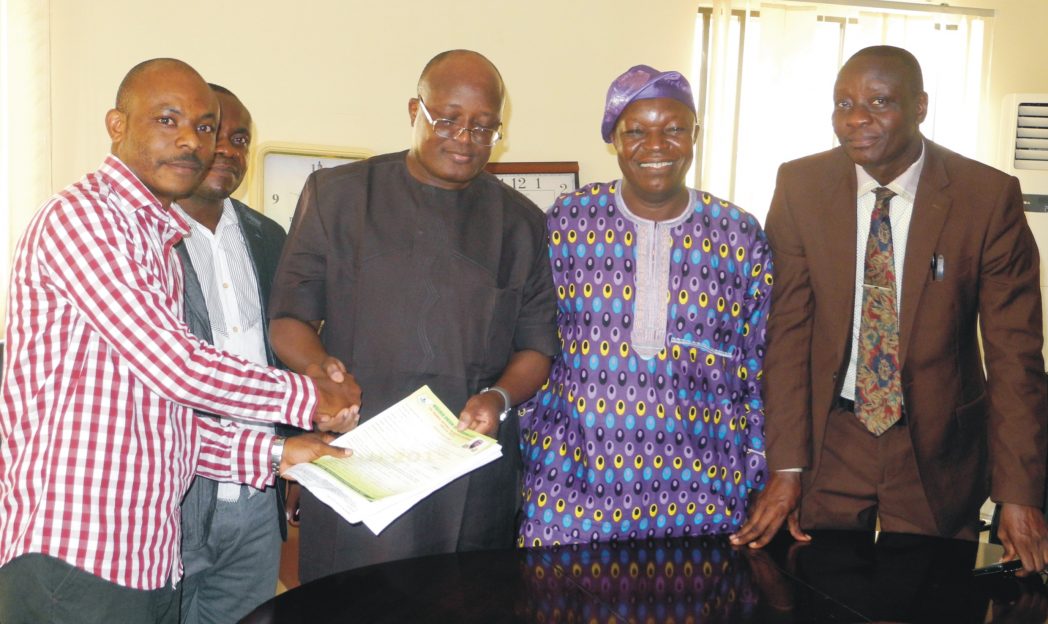
Secretary, Nuj, Fct, Mr Emmanuel Ogbeche (left), presenting a nomination form for the post of the Nuj President to the National Secretary of the union, Mr Shu’Aibu Leman, on behalf of Mustapha Lamidi of the News Agency of Nigeria (Nan), during the submission of the form for Nuj Election in Abuja recently. With them are the contestant, Mr Mustapha Lamidi (2nd-right) and Chairman, Nan Chapel, Mr Felix Ajide.

Nation
Rumuaholu Community Denies Land Grabbing Allegations, Accuses Obio/Akpor Chairman of Interference in Land Dispute


The Rivers State Commissioner for Education, Dr. Peters Nwagor, has commended the orderly conduct of the ongoing 2026 West African Senior School Certificate Examination in the state and urged schools to sustain the standard.
Dr. Nwagor gave the commendation on Tuesday during a monitoring tour of selected secondary schools in Port Harcourt and environs where the WAEC exam is ongoing.
The commissioner, who was accompanied by directors and monitors from the Ministry of Education, said he was impressed with the peaceful atmosphere at the centres visited.
“The students conducted themselves properly and wrote their papers under conducive conditions. Invigilators and supervisors also performed their duties professionally,” he stated.

Nwagor noted that the Rivers State Government had invested heavily to ensure the smooth and credible conduct of the examination across the state
He urged candidates to reciprocate government’s effort by shunning all forms of examination malpractice and focusing on their studies.
“Government has done so much to ensure successful examinations in our schools. Students should take advantage of it by remaining focused,” the commissioner said.
While no case of malpractice was recorded in the centres inspected, Dr. Nwagor warned that any principal, teacher, invigilator, or official caught aiding malpractice would face strict sanctions in line with regulations.
He also commended school administrators, teachers, WAEC officials, and security personnel for upholding the integrity of the process.
Centres visited included County Grammar School, Ikwerre/Etche; Government Comprehensive Secondary School, Borokiri; Government Secondary School, Borokiri; and Pabod Model Secondary School.
-

 Niger Delta2 days ago
Warri Airport Manager Disputes Air Peace Bird Strike Claim
-

 News3 days ago
Nigeria Won’t Surrender Any Territory To Criminals -Tinubu
-

 News3 days ago
FG Begins Trial Of Over 600 Terrorism Suspects
-

 Rivers2 days ago
79th IAUE Inaugural Lecture: Prof Anero Advoctes Tuition-Free Education For Children
-

 Politics2 days ago
Parties’ Deregistration: How Justice Lifu Overruled Appeal Court Justices
-

 Politics2 days ago
ADC: Okonkwo Rejects Amaechi As Presidential Running Mate, Withdraws Support
-

 News3 days ago
Rivers Judges Commence Annual Vacation, July 20
-

 Politics2 days ago
2027: Tinubu’s Projects Give APC Edge In South East – Yilwatda