
Politics
As PDP, APC Battle Over LG Polls In Rivers

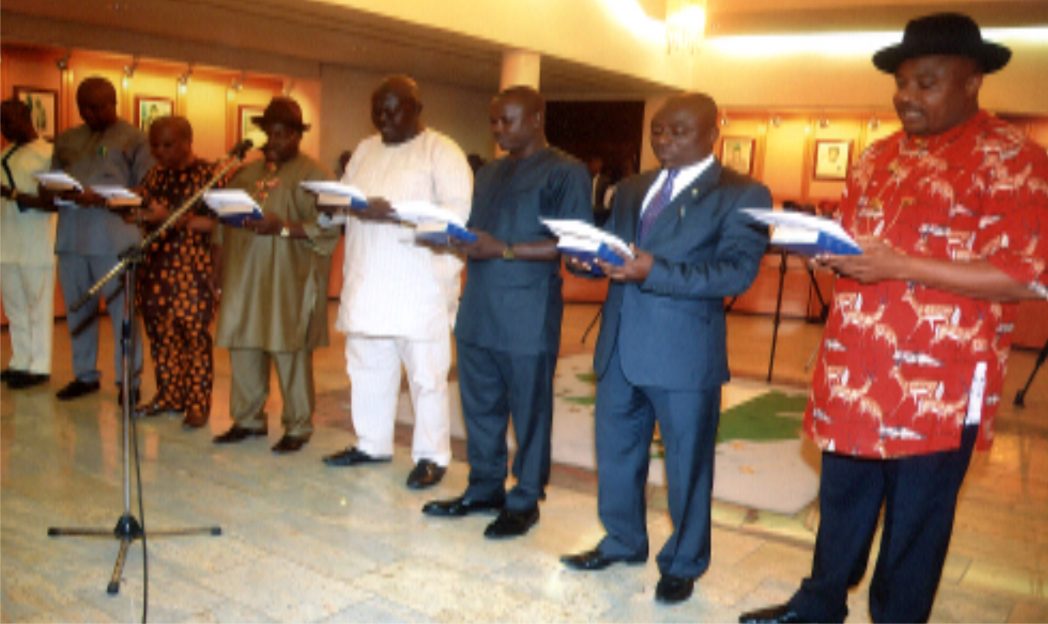
Cross section of Chairmen Caretaker Committees taking their oath of office at the swearing-in at Government House, Port Harcourt recently. Photo: Chris Monyanaga
Tuesday, September 16,
2014, Governor Chibuike Rotimi Amaechi inaugurated caretaker committee chairmen of 21 local government councils in Rivers State at Government House with an assurance that democratically-elected officials will run the councils in Rivers State next year. This is the second time caretaker committees would be made to oversee the affairs of the local government councils since the tenure of the democratically-elected council officials expired in June.
Out of the former CTC chairmen, seven of them including those of Opobo/Nkoro, Oyigbo, Obio/Akpor, Omuma, Bonny and Emohua local government areas were retained, while new CTC chairmen were appointed into 14 councils Only Degema and Ogba/Egbema/Ndoni local government areas were exempted as the tenure of their chairmen is still running.
While inaugurating the CTC chairmen, Governor Amaechi said the State would organise LG elections immediately after the national elections. While charging the new CTC chairmen to serve the interest of the grassroot, the State Chief Executive sounded a note of warning that any of them found wanting will risk removal.
The newly inaugurated CTC have since begun work in their respective councils, but the Peoples Democratic Party (PDP) in Rivers State is crying foul and not happy that caretaker committees are still holding forth in the LGAs about three months after the tenure of the democratically-elected council officials expired. The party is equally worried that there are no hope of conducting polls at the third tier of government in the State before 2014 runs out.
Rivers PDP disagreed with Amaechi’s decision to conduct council polls next year immediately after the 2015 national elections. The PDP attributed Governor Amaechi’s decision to use caretaker committees instead of conducting council elections to the fear of defeat at the local government polls.
In a statement signed by the Special Adviser on Media to the party chairman, Jerry Needam, the Rivers PDP, challenged the state governor to a popularity contest through the conduct of council elections.
PDP had been the ruling party in Rivers State since 1999, but with the defection of Governor Amaechi, his executive and majority of the lawmakers at the State House of Assembly to the All Progressives Congress (APC), the PDP lost its ruling status. Providing a critical searchlight on the activities of now APC-led government in the State is seen by PDP as a better instrument to position and launch itself back to political reckoning.
If there are doubts about the worry of Rivers PDP and what it plans to do in feasible future, the following statements said it all.
“The PDP regrets that it is the local government councils and the people that are at loss for not getting the leadership they deserve and by extension, are underdeveloped. We are on ground and ever prepared to engage Governor Amaechi and his All Progressives Congress in a free and fair electoral contest any day and are sure of coasting home in a landslide victory because we are genuine, caring, articulate and purposeful,” the statement added.
While PDP may be celebrating for taking APC and the Amaechi administration to task, Dr Davies Ibiamu Ikanya-led APC in Rivers State, fired back at the PDP.
In a statement in Port Harcourt, Ikanya blamed the Minister of State for Education, Chief Nyesome Wike and the lingering political crisis in the State for the delay in the conduct of local government elections in the state.
Apart from alleging that Wike engineered the political crisis in the state which has made it impossible for the Rivers State Independent Electoral Commission (RSIEC) to conduct council polls, Ikanya insists that “the non-conduct of the council elections in the State is not out of the fear of anybody or out of the fear of losing to PDP but for the sake of peace.”
Ikanya said the clarification has become necessary to correct the propaganda by Rivers PDP that Governor Amaechi did not conduct local government elections because he was afraid of defeat. Many may wonder why APC involved. The State APC Chairman alleged that Wike’s unseen hand manipulated the National Judicial Council (NJC) to favour the choice of Justice Daisy Okocha as the State Chief Judge instead of allowing the governor to exercise his constitutional powers to appoint a chief judge in the State in line with the constitution of the Federal Republic of Nigeria.
“That was the genesis of the crisis in the Judiciary in Rivers State. This has incapacitated judicial activities in the State. The fact remains that you cannot conduct elections without the judiciary because without a chief judge of the State who is expected to constitute an election tribunal to handle petitions that may arise after the elections, such polls would be an exercise in futility,” the APC chairman said.
Ikanya added that “if the PDP is actually serious about meeting its waterloo in the council elections in the state, it should prevail on Wike to stop the judicial crisis in the State by asking the NJC to allow the governor to exercise his constitutional powers to appoint the most qualified judge as the Chief Judge of the State.”
Like PDP, the APC also boasted that “if election is conducted today, the PDP would not win any councillorship position in any of the local government areas of the State.”
Justifying why Governor Amaechi cannot succumb to PDP’s challenge of conducting LG polls, this year Ikanya said “the governor, as a man who has great respect for the laws of the land, cannot engage in an exercise that would be stalled halfway just because he wants to satisfy a non-existing party like PDP in the State.”
Beyond the issue of the council polls that have engaged both PDP and APc in war of words, the issue of who takes over from incumbent Governor Amaechi lies the intense agitation in the politics of Rivers State.
While the concern of Rivers men and women is raging without measure about who gets the governorship ticket of PDP, the same cannot be said of who becomes the State APC gubernatorial flagbearer. Right now, no fewer than 10 aspirants with posters are known to be jostling for the PDP governorship ticket, but nobody has formally declared governorship interest under the APC platform.
But the body languages of two APC Rivers members at the National Assembly, however, indicate that they may be eyeing the Rivers Brick House.
Whether PDP is “sure of coasting home in a landslide victory when election is conducted in Rivers State” or the APC believes that “the PDP cannot win councillorship seat in any of the local government areas,” the factor remains that tomorrow’s political race has begun in earnest and it takes the runner on the fast lane to arrive the destination point with good results. Which party gets the good result and picks the political crown of glory – PDP or APC? Only time will tell.
Samuel Eleonu
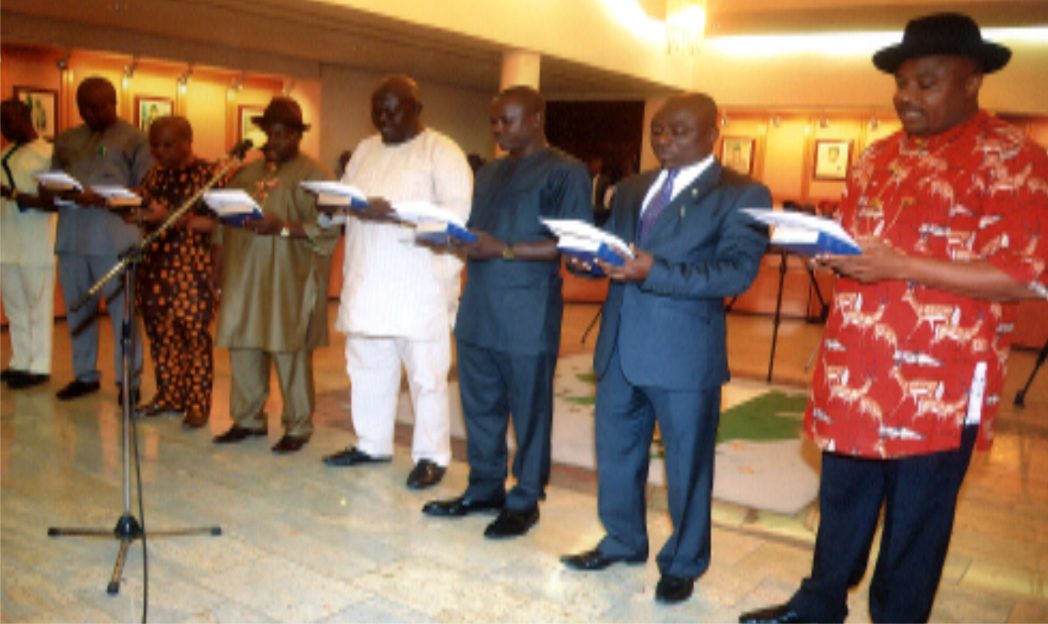
Cross section of Chairmen Caretaker Committees taking their oath of office at the swearing-in at Government House, Port Harcourt recently. Photo: Chris Monyanaga



The Independent National Electoral Commission (INEC) has extended the deadline for political parties to submit the list of candidates for the 2027 governorship and state Houses of Assembly elections from Saturday, August 8, to Tuesday, August 11, 2026.
The commission announced the extension in a statement issued on Saturday and signed by the National Commissioner and Chairman of its Information and Voter Education Committee, Mohammed Haruna.
According to INEC, the decision followed appeals by political parties for additional time to complete the submission process through the dedicated online portal.
“The submission window, which according to the revised Timetable and Schedule of Activities for the General Election was originally scheduled to close on Saturday, 8th August, 2026, has been extended to Tuesday, 11th August, 2026,” the commission said.
In a a related development, INEC announced the suspension of PVC collection in Osun State ahead of the August 15 governorship election.
The commission said voters who applied for replacement of lost, damaged or defaced Permanent Voter Cards would have until midnight on Sunday, August 9, to print downloadable copies of their cards.
The electoral body explained that the deadline was necessary to enable it compile data on downloaded PVCs and produce final statistics on the total number of cards collected ahead of the election.
INEC said PVC collection in Osun commenced at the Registration Area level from July 22 to 28, 2026, but was extended to July 31 following complaints about large crowds and difficulties experienced by voters at collection centres.
The exercise subsequently moved to the local government level and ran from August 1 to 7.
The commission also disclosed that replacement downloadable PVCs had been made available to voters in Odo-Otin and Ife Central Local Government Areas following the theft of cards during attacks on the two collection centres.
It stressed that the stolen cards could not be used to vote.
INEC reassured Osun residents of its preparedness for the August 15 governorship election.
“The commission reiterates that the stolen cards cannot be used to vote.
“INEC reassures the people of Osun State of its readiness to conduct a free, fair, credible and inclusive governorship election on 15th August, 2026,” the statement said.
The commission said the deadline, initially set for Saturday, 8 August, has been extended to Tuesday, 11 August 2026, following appeals from political parties for more time.
INEC also announced that the window for voters who applied to replace lost, damaged or defaced PVCs to download their replacement cards will close at midnight on Sunday, 9 August.
The move is to enable the commission compile final PVC collection figures ahead of the 15 August Osun governorship election.
INEC said replacement downloadable PVCs have also been provided to affected voters in Odo-Otin and Ife Central Local Government Areas after hoodlums carted away cards from two collection centres, stressing that the stolen cards cannot be used to vote.
The commission reaffirmed its readiness to conduct a free, fair, credible and inclusive election in Osun State.
Gov. Kefas made the remarks over the weekend at the Federal Medical Centre (FMC), Jalingo, during the flag-off of the second phase of the Renewed Hope Medical Outreach in Taraba State, organised as part of activities marking Prof. Yilwatda’s 58th birthday.
The governor commended Prof. Yilwatda for choosing to mark his birthday by providing medical care to people in need.
“What Professor Nentawe did is a powerful demonstration of what leadership should be,” Gov. Kefas said.
He assured that his administration would continue to support initiatives that complement government efforts to improve healthcare delivery and the wellbeing of residents.
Speaking at the event, Prof. Yilwatda called on Nigerian leaders to embrace the culture of giving and use their positions to touch the lives of the less privileged.
He said his decision to celebrate his 58th birthday in Taraba State was deliberate and informed by the needs of underserved communities, particularly people who face difficulties accessing healthcare because of distance and financial constraints.
According to him, the intervention followed a needs assessment and was extended across the three senatorial districts of the state.
He said the exercise commenced on August 3 at Takum General Hospital and covered the Federal University Teaching Hospital, Wukari; First Referral Hospital, Sunkani, Ardo-Kola Local Government Area; General Hospital, Bali; General Hospital, Gembu; and FMC Jalingo.
Prof. Yilwatda said the intervention provided medical services to thousands of beneficiaries, including people who required surgical procedures.
He said sustainable national development could only be achieved when strong institutions placed Nigerians at the centre of development.
“Leadership is about service,” he said, urging political and public leaders to make giving back to society an important part of their responsibilities.
He reaffirmed his commitment to serving Nigeria and its people, saying his personal vision was to make every day of his life useful to humanity.
“Every day that I live, the vision is: let it be useful to humanity,” he said.
The Taraba State Commissioner for Health, Dr. Bordiya Buma, commended the initiative, saying it was consistent with the Renewed Hope agenda and efforts to strengthen healthcare delivery in the state.
Dr Buma said the second phase followed the successful completion of the first phase, which was conducted simultaneously in six local government areas, with two LGAs selected from each of the three senatorial districts.
According to him, more than 10,000 patients were attended to during the first phase, including people with medical and surgical conditions.
He disclosed that 327 general surgeries, 71 eye surgeries and 575 dental procedures were carried out during the exercise.
The commissioner expressed appreciation to President Bola Tinubu for the Renewed Hope Medical Outreach and thanked Prof. Yilwatda for supporting the initiative and choosing Taraba State as a beneficiary.
The Minister of Health and Social Welfare, Prof. Muhammad Ali Pate, also commended Prof. Yilwatda for choosing Taraba State to mark his 58th birthday through a medical outreach.
Prof. Pate said making healthcare the centrepiece of the birthday celebration was significant because health affects everyone.
-
 Editorial4 days ago
That Oshiomhole’s Call On FG’s Road Projects
-
Education4 days ago
Environmental Education Remains Critical Tool To Address Environmental Challenges Says Experts
-
 City Crime3 days ago
Tinubu Appoints Ex-Tide Staff Registrar Of Chartered Chemists
-
Education4 days ago
UNIPORT VC Receives Probe Report on Student Union Crisis
-
 Sports4 days ago
Rivers-born Chess Player Clinches Third Position At World Amateur Rapid Chess Championship
-
Oil & Energy4 days ago
NCDMB, BOI Unveil $100m Nigerian Content Equity Fund …Set To Invest $5m In Oil Firms
-
News4 days ago
RIFF 2026: RIFF Takes Film Tourism To Bonny Island
-
Business4 days ago
PTDF Committed To Tinubu’s Development Plan – CEO