
Nation
THE STATES

Benue
A Makurdi Upper Area Court has sentenced a man, Salisu
Audu, 45, to three years imprisonment for house-breaking and stealing valuables.
In his judgment, the Magistrate, Ibrahim Mohammed, said that the convict failed to show any remorse to warrant the court being lenient.
“Having found you guilty of the charge of house breaking under Section 353 of the Penal Code, an offence which has no option of fine, you are hereby sentenced to 24 months imprisonment.
“For the offence of theft, you are to pay a fine of N5,000 or twelve months imprisonment in default.
“Both sentences shall run concurrently,” Mohammed said.
Borno
Senator Muhammad Ndume (PDP-Borno) last Tuesday
urged Nigerian political leaders to emulate late South African leader, Nelson Mandela, by playing positive roles in national development.
Ndume told newsmen in Maiduguri that Mandela was a hero, great man and a symbol of African pride.
“This is a man that showed commitment to the uplifting of human dignity with perseverance and integrity.
“People like Nelson Mandela should be in the first class seat if there is anything like that in heaven.
FCT
An Abuja-based lawyer, Mrs Maryam Uwais, has called
on Nigerians to adhere to the rule of law and protect the rights of citizens.
Uwais gave the advice in Abuja in an interview with newsmen on the sideline of an event to mark the International Human Rights Day.
According to her, adhering to the rule of law and protecting the fundamental rights of citizens is key to the growth of democratic governance.
“We must always respect the rights and dignity of other people, irrespective of their religion or ethnic background in the country.
Jigawa
The Nigeria Security and Civil Defence Corps (NSCDC)
in Jigawa State, said it rescued a newly-born baby girl abandoned on a roadside in Babura, near Dutse.
The NSCDC Commandant in the state, Mr Muhammad Gidado,told newsmen in Dutse that the abandoned baby was rescued in Babura local government area.
He said the baby was rescued on the outskirts of Babura town on Damu village road around 1.30 p.m.
The commandant said that the baby was in good health.
He said the baby had been handed over to the District Head of Babura for safe keeping while investigation continued.
Kaduna
Transmission Company of Nigeria (TCN) says it collects
over N1billion monthly from the N700 million it used to collect from the sale of electricity to consumers within Kaduna and its environs.
General Manager in charge of the Kaduna State region of the company, Mr John Obaluju, made this known when the National Good Governance Tour team inspected ongoing work at the Mando
He said the improvement in revenue resulted from the investments by government in both generation and transmission facilities.
Obajulu said after the expansion of the sub-station, electricity consumers would enjoy improved power supply at a much cheaper rate.
Katsina
The Chairman of the Malumfashi Local Government Tran
sition Council in Katsina State, Alhaji Mansur Banki, has advised youths in the area to embrace irrigation farming.
He gave the advice in Malumfashi lastMonday during the disbursement of N2 million interest-free loans to 200 youths.
Banki, who cautioned the beneficiaries to shun violence, urged them to go to their respective family farms during rainy season and engage in farming.
He said that the involvement of youths in agriculture would not only boost food production, but also enhance the efforts of the government to achieve food security.
Kebbi
The Minister of Women Affairs and Social Development,
Hajiya Zainab Maina, has launched Widows Empowerment Scheme in Kebbi State.
The minister, who was in Birnin Kebbi for a two-day advocacy visit, distributed 1,000 refrigerators and 400 grinding machines to some widows.
During the distribution ceremony, she urged the beneficiaries to utilise the facilities to improve their economic status and support their children.
Maina commended the state government for appointing women in political offices and called for the implementation of the affirmative action by placing more women in government.
Kwara
The Chairman of Patigi Local Government in Kwara State,
Alhaji Uthman Mohammed-Ndako, has called for the inclusion of Nupe language in the Nigerian education curriculum.
Mohammed-Ndako made the call in Patigi at the launch of some textbooks written in Nupe by the Etsu of Patigi, Alhaji Ibrahim Chatta-Umar.
He said Nupe language, “as one of the paramount indigenous languages, would surely promote the cultural heritage of the people.’’
The chairman, represented by his deputy, Alhaji Shuaib Muazu, said the books would boost the basic techniques required in the writing and speaking of Nupe language.
Lagos
The Lagos State House of Assembly says it would ini
tiate a bill to provide legal framework to enhance the operations of vigilance groups in the state.
The Speaker of the House, Mr Adeyemi Ikuforuji, said this while receiving members of the Vigilance Group of Nigeria, Lagos Chapter, who paid him a visit.
Ikuforuji said, “be rest-assured that the House will support you. Please continue to render your services without fear or favour. “We want to assure you that the house will support you which is a major reason for your visit.
Ogun
The Ogun State Government said it had earmarked N1.4
billion for payment of examination fees for students sitting for the West African School Certificate in 2014.
The Commissioner for Education, Science and Technology, Mr Segun Odubela, made the disclosure in Abeokuta while defending the 2014 budget proposal of the ministry at the House of Assembly.
Odubela said the money would take care of 54,944 final year senior secondary school students at the rate of N10,400 each.
“The money will also take care of the 70,000 final year Junior Secondary School students and the conduct of the Unified Examinations for secondary school students in the state.
Osun
An Ilesa Magistrate’s Court has remanded Abayomi
Ogundipe, 19, in prison custody for allegedly stabbing his friend, Itunu Folorunso, with a broken bottle.
The prosecutor, Sgt. Jimoh Mufutau, told the court that the accused committed the act on December 8, at 2.00 p.m. at Igbogi Street, Ilesa.
He said the accused was arraigned on a four-count charge of conspiracy to commit felony, breach of peace, unlawfully wounding Folounso and belonging to unlawful society.
Mufutau alleged that the accused conspired with others, now at large, to commit felony with the intention to cause the breach of peace.
Oyo
An Iyaganku Chief Magistrates’ Court in Ibadan has sentenced two hospital clerks, Elizabeth Adesokan, 34, and Olufemi Idowu, 39, to four years in prison for stealing N6.9 million.
The Chief Magistrate, Mrs Olusola Adetujoye, jailed Adesokan and Idowu after they were found guilty of conspiracy and stealing.
Adetujoye said the convicts were charged with conspiracy and theft of N6.9 million belonging to Ola Catholic Hospital, Oluyoro Oke-Ofa, Ibadan.
She said the prosecutor had proved his case beyond reasonable doubt, adding that the accused were guilty as charged.
Plateau
The Nigerian Security and Civil Defence Corps (NSCDC), Plateau State Command, said it had trained 320 officers in extensive weapons handling between January and November.
The Commandant, Mr Vincent Bature, told newsmen last in Jos Tuesday that the officers underwent extensive training in weapons handling, arms drills, combat craft, range classification and exercises. He said that out of the 320 officers, 20 were specially trained as Special Forces at the Nigeria Army Counter Terrorism Training School, Kachia in Kaduna State and the School of Armour, Kontagora in Niger State.
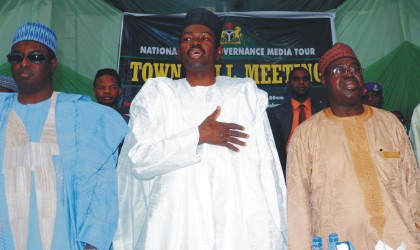
L-R: Governor Mukhtar Yero of Kaduna State, Minister of Information, Mr Labaran Maku and Deputy Governor, Amb. Nuhu Bajoga, during a town hall meeting as part of National Good Governance Tour in Kaduna last Tuesday. Photo: NAN



The Hydrocarbon Pollution Remediation Project (HYPREP) has commemorated the 15th anniversary of the release of the United Nations Environment Programme (UNEP) Environmental Assessment Report on Ogoniland, reaffirming its commitment to restoring the environment and improving the livelihoods of affected communities.
In a statement signed by the Project Coordinator, Prof Nenibarini Zabbey, to commemorate the anniversary, HYPREP described the anniversary as a significant milestone in Nigeria’s environmental restoration efforts, noting that the project has made remarkable progress in implementing the recommendations of the landmark UNEP report released on August 4, 2011.
The UNEP report had revealed extensive oil pollution across Ogoniland, severe environmental degradation, and serious public health risks resulting from decades of petroleum operations. It also recommended an initial $1 billion fund to commence the cleanup of the affected communities.
According to HYPREP, the Federal Government formally launched the Ogoni clean-up in 2016, while the Project Coordination Office was established in 2017 to drive the implementation of UNEP’s recommendations.
Zabbey said the current administration has continued to prioritise the project under the Renewed Hope Agenda.
Providing an update on the cleanup, the Project Coordinator disclosed that 30 of the 65 contaminated sites identified by UNEP have been fully remediated, while work is ongoing at several medium- and high-risk locations. It also stated that more than 1.5 million mangrove seedlings have been planted as part of what it described as the world’s largest restoration of oil-degraded mangroves, with over 1,000 hectares of shoreline already rehabilitated.
Zabbey further revealed that 49 Ogoni communities have been connected to potable water schemes through multiple water projects and booster stations aimed at providing safe drinking water across the region.
In the health sector, he said the 100-bed Ogoni Specialist Hospital in Kpite and the 43-bed Cottage Hospital in Buan are nearing completion, adding that several existing health facilities have been upgraded with modern medical equipment, while five ambulances have been donated to improve emergency healthcare services. The Project Coordinator also disclosed that a three-year human health biomonitoring study is being conducted in collaboration with the World Health Organization’s International Agency for Research on Cancer (IARC).
On economic empowerment, Zabbey stated that the Project has created more than 8,000 direct jobs and trained thousands of Ogoni youths and women in various vocational and technical skills, including software development, cybersecurity, aviation, commercial diving, seafaring, mechatronics, and creative arts. The project also reported awarding scholarships to more than 1,000 students, providing grants to small businesses, and supporting persons living with special needs through skills acquisition programmes.
The statement further highlighted ongoing legacy projects, including the Ogoni Power Project and the Centre of Excellence for Environmental Restoration, which it said is about 96 per cent complete. HYPREP also welcomed the recent designation of the Ogoni Wetland as a Ramsar Site of International Importance and pledged to continue promoting biodiversity conservation and sustainable management of the ecosystem.
Marking the anniversary, Zabbey said the progress achieved over the past 15 years demonstrates the collective commitment of government, development partners, stakeholders, and local communities to restoring Ogoniland. He called for renewed collaboration to sustain the cleanup effort, promote environmental sustainability, and support the long-term development of the region. 3
-

 News2 days ago
RSG Targets Nine Million Residents in Mosquito Net Distribution Campaign
-

 Oil & Energy2 days ago
Aiyedatiwa Signs New Electricity Bill
-

 Oil & Energy2 days ago
NLNG Commissions Research And Innovation Centre In RSU
-

 Maritime2 days ago
Marine Minister Commends President Tinubu On NPERA Bill Assent
-

 News2 days ago
KenPoly Holds Eight Convocations, August 29
-

 News2 days ago
RSG Begins Another Phase of Projects Commissioning Today
-

 News2 days ago
RMAFC Completes Revenue Sharing Review, Proposes New Pay
-

 Maritime2 days ago
NAGAFF Petitions IGP Over Alleged Maritime Police Harassment