
Editorial
Leveraging On 2016 World Food Day

Governor of Central Bank of Nigeria (CBN), Mr.
Godwin Emefiele last Thursday said the country spends N630 billion annually on food import, principally, Wheat, Rice, Flour, Fish, Tomato paste, Textile and Sugar. In a keynote address he presented at a training workshop on Innovative Agricultural Insurance products held in Lagos, Emefiele described the trend as suicidal.
In another forum, Executive Secretary, of the Agricultural Research Council of Nigeria (ARCN), Prof. Baba Abubaka had said massive importation of food, especially wheat, rice, sugar and fish alone, accounts for a whopping N1 trillion annually.
In spite of the conflicting figures, both Emefiele and Abubaka agreed that the trend was actuated by the fact that Nigeria’s agriculture is still largely depended on rural farmers, who contribute 70 percent of the food produced in Nigeria, through subsistence farming. Sadly, these farmers, with small land holdings of one to three hectares produce sub-optimally due to lack of adequate inputs, insufficient exposure to good agronomic practices and limited access to finance and credit. And that something drastic needs to be done.
With such limited capacity, caused by gross neglect of the agriculture sector, by successive Nigerian governments, in preference for oil and gas, the country is today, the largest importer of US hard red and white wheat worth N635 billion annually, world’s second largest importer of rice at N356 billion in-addition to spending N217 billion on sugar and N97 billion on fish annually.
According to Abubaka, applying the principle of Total Productivity Factor (TPF) of Nigeria’s 98 mha land, 74 mha, representing 75 percent, is good for farming but regretted that less than half is put to use. Worse still, farmers who utilise the said half have limited capacity and still use technics that adversely affect soil fertility, water and biodiversity and warned that unless farmers were empowered with biotechnology, the problem might linger into the future.
With an economy in tumoil as Nigeria’s, these are grim facts that should agitate policy makers, governments, the private sector and indeed all well-meaning Nigerians. The first step is to strive towards producing enough for local production as a means of checking the fortunes annually spent on food imports.
This, many think, is one of the problems the Agriculture Promotion Policy (APP) of the present Federal Government, (2016-2020) should address with the sincerity of purpose it deserves. It must not dwell on lip service and simply die-off, once the fortunes from oil and gas improve.
Interestingly, various governments have walked this path. There was once Operation Feed the Nation (OFN) and the Green Revolution, all of which became history, on account of the preference for crude oil earnings. To succeed therefore, a drastic departure with the past is imperative and urgent.
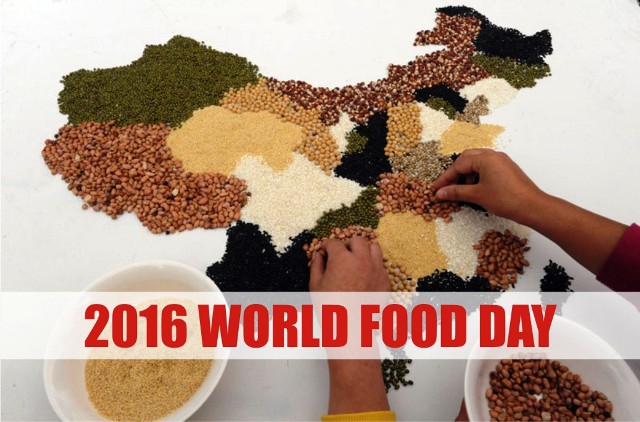
This is why this year’s World Food Day, Sunday, October 16 must rise above the familiar rhetoric and lip service of the past. As governments and other stakeholder-bodies celebrate the day today instead of yesterday, they must put into perspective the huge expectations of a nation in dire need of economic diversification, with agriculture as first option.
The World Food Day which is celebrated annually in over 150 countries, including Nigeria in honour of the date of the founding of the Food and Agriculture Organisation of the United Nations in 1945, has been concerned with food production and security and continues to encourage member nations to strive towards food independence.
In 2014, the day’s theme was ‘Feeding The World, Caring for the Earth’, last year, focus was on ‘Social Protection and Agriculture: Breaking he Circle of Rural Poverty.” This year’s theme is “Climate Is Changing, Food and Agriculture. Must Too”, apparently re-echoing the themes of 2008, 2002 and indeed 1989.
The question for Nigeria is: What impact has the annual World Food Day made since it was first celebrated in 1982? Obviously little, otherwise, the global fall in crude oil prices would not spell such devastation on the economy.
This is why this year’s event must be seen as a turning-point, a new beginning and a fresh opportunity to embrace whole-heartedly, the imperatives of diversification. The financial sector must be challenged to collaborate with the Government and invest more aggressively in agriculture through a deliberate risk-sharing insurance template that will encourage huge investment.
Also, a special capacity-building scheme must be fashioned to improve on the skills of subsistence farmers with a view to improving their yields, and at the same time address the recurring threats posed by killer herdsmen. Unless and until such far-reaching steps are taken, this year’s observance of World Food Day in Nigeria would end-up like the others before it – an annual jamboree for speech-making without valid plans and actions.
That is what is at stake, this year.



Nigeria stands at a critical juncture as the world marked World Press Freedom Day (WPFD) on May 3. This annual observance is a reminder that a free press is central to democratic life, good governance, and public accountability. For Nigeria, it is also a moment for sober reflection on how far the country has come and how far it still has to go in safeguarding the independence of its media.
World Press Freedom Day exists to highlight the fundamental importance of freedom of expression and to honour journalists who risk their lives in pursuit of truth. It underscores the idea that without a free press, societies cannot function transparently, nor can citizens make informed decisions. In countries like Nigeria, where democracy continues to evolve, the observance carries particular urgency.
This year’s theme, “Shaping a Future at Peace: Promoting Press Freedom for Human Rights, Development and Security”, places journalism at the heart of global stability. It emphasises that a peaceful society cannot be built on silence, fear, or manipulated information. Rather, it depends on the free flow of accurate, timely, and independent reporting.
At its core, the theme highlights the role of journalism in fostering accountability, dialogue, and trust. These are not abstract ideals. In Nigeria, where public confidence in institutions is often fragile, the media remains one of the few platforms through which citizens can question authority and demand transparency. When press freedom declines, so too does public trust.
Journalism serves as a foundation for peace, security, and economic recovery. Countries with robust media systems tend to attract greater investment, maintain stronger institutions, and resolve conflicts more effectively. Nigeria’s economic challenges, ranging from inflation to unemployment, require open scrutiny and informed debate, both of which depend on a free press.
However, the issue of information integrity has become increasingly complex in the digital age. Artificial Intelligence (AI) and online platforms have amplified the spread of misinformation and disinformation. In Nigeria, where internet penetration has grown rapidly, false narratives can travel faster than verified facts. This makes the role of credible journalism more vital than ever.
The challenge is not only technological but also ethical. AI-driven manipulation of information threatens to distort public discourse, influence elections, and deepen social divisions. In such an environment, professional journalism must act as a stabilising force, ensuring that truth prevails over sensationalism and propaganda.
Equally troubling is the safety of journalists. Across Nigeria, reporters face growing levels of online harassment, judicial intimidation, and physical threats. Self-censorship is becoming more common, as media practitioners weigh the risks of reporting sensitive issues. This trend undermines the very essence of journalism.
A particularly alarming incident involved a serving minister in the present administration, who openly threatened to shoot a journalist during a televised exchange. Such conduct, broadcast to the public, sends a dangerous signal that hostility towards the press is acceptable. It erodes the norms of democratic engagement and places journalists in harm’s way.
This year’s theme aligns closely with the United Nations Sustainable Development Goal (SDG)16, which promotes peace, justice, and strong institutions. Freedom of expression is a cornerstone of this goal. Without it, institutions weaken, corruption thrives, and justice becomes elusive. Nigeria’s commitment to SDG 16 must therefore include genuine protection for the media.
Historically, the Nigerian press has been a formidable force. From resisting colonial rule to challenging military dictatorships, our journalists have played a central role in shaping the nation’s political landscape. Today, however, that legacy appears to be under strain, as the media operates under what can best be described as a veneer of freedom.
Beneath this facade lies a troubling reality. Journalists are routinely harassed, detained, and prosecuted for performing their constitutional duties. Reports from media watchdogs indicate that dozens of Nigerian journalists face legal threats or arrest each year, often for exposing corruption or criticising those in power.
The Cybercrimes (Prohibition, Prevention, etc.) Act of 2015 has become a focal point of concern. Originally intended to combat cyber threats, it has increasingly been used to silence dissent. Sections 24 and 27(1)(b), in particular, have been invoked to target journalists, bloggers, and social commentators.
Although amendments introduced in February 2024 were meant to safeguard journalists, concerns persist. The law continues to be wielded in ways that stifle investigative reporting and restrict freedom of expression. Legal reforms must go beyond cosmetic changes to address the root causes of misuse.
To safeguard the future of journalism in Nigeria, decisive action is required. The Cybercrimes Act must be revisited to ensure it cannot be weaponised against the press. Law enforcement agencies must operate free from political influence, upholding the rule of law and protecting journalists’ rights. Civil society and international partners must also strengthen independent media through funding, training, and platforms for wider reach.
In this rapidly evolving world shaped by artificial intelligence and digital innovation, Nigeria faces a clear choice. It can either allow press freedom to erode under pressure, or it can champion a truly independent media landscape. The path it chooses will determine not only the future of journalism, but also the strength of its democracy and the peace it seeks to build.

-

 Featured4 days ago
WASSCE: RSG Distributes Science Materials To Secondary Schools
-
News4 days ago
Xenophobic Attacks: Nigerian Lives More Important Than Foreign Investment – Oshiomhole
-
Rivers4 days ago
MBA Forex Trial Adjourn To June 3, Amid Bereavement … As Court Declines Cost Application
-
News4 days ago
ActionAid Demands Probe Of Govs Using Public Funds For Campaign
-
Aviation4 days ago
Passengers Stranded As Delta Airline From Atlanta Route Back Eight Hours After
-
Business4 days ago
Customs Impound N2.35bn Cocaine, 15 Trailers of Rice
-
Politics4 days ago
2027: Bayelsa Senator Gets Critical Endorsement For Second Term
-

 Politics4 days ago
INEC Sets Rivers South-East Senatorial By-Election For June 20