
Politics
Lassa Fever: One Outbreak Too Many

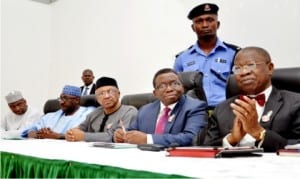
L-R: Executive Director, National Primary Health Care Development Agency, Dr Ado Muhammed, Director-General, National Orientation Agency, Mr Mike Omeri, Minister of State for Health, Dr Osagie Ehanire, Minister of Health, Prof. Isaac Adewole and Minister of Information and Culture, Alhaji Lai Mohammed, during a joint Ministerial news conference to give update on the outbreak of Lassa Fever in Nigeria, in Abuja, yesterday
Lassa fever, otherwise called
Lassa Hemorrhagic Fever (LHF), a deadly disease was first diagnosed in 1969 in the town of Lassa in Borno State, Nigeria. Since that discovery, the disease has spread to other West African states such as Liberia, Sierra Leone, Guinea and Central African Republic. Medical experts argue that the re-emergence of this outbreak appears to be spreading faster than the previous ones, and have advised that more effective surveillance and preventive measures should be taken to curb this deadly disease.
Cause
The Lassa virus is a zoonotic disease. It is transmitted from animals and spreads to humans from rodents which are the primary host of the Lassa virus, especially Natal Multimammate mouse (Mastomys natalensis), an animal found in most parts of sub-Saharan Africa popularly known as Rats (i.e animals with a very long mouth and long tail in this part of region).
Lassa Fever or Lassa Hemmorrhagic Fever is a member of Arenaviridae virus family which is an acute viral hemorrhagic fever. The virus is very hard to distinguish from other viral diseases caused by the Lassa virus, especially the Marburg and Ebola as well as such other more common febrile viruses that trigger malaria.
It usually infects people in West Africa, and is estimated to have resulted in 300,000 to 500,000 cases annually over the last few years. In fact, it has caused the death of about 5,000 persons each year. The fever accounts for up to one third of deaths in hospitals within the affected region.
Despite the disease outbreak, rat meat still remains an important source of protein and one of the most enjoyed delicacy by some people in Africa, particularly Nigeria. Yet, it is the carrier of the deadly disease called Lassa fever.
An important message for those that prepare rat meat delicacy, is that there is the need for them to know that infection takes place during the process of finding and preparing the rat for consumption. Experts say that the virus that causes the disease is excreted in urine and could stay for 3-9 weeks or in semen for three months.
This deadly disease has since 1969 been a cause of major deaths in Nigeria. In April, 2012, it caused the death of over 70 persons officially recorded from 19 out of the 36 states in the country. In 2014, the disease claimed 20 lives across the country. Now, the disease has re-emerged, claiming many more lives, and sending others to hospital beds.
With the present outbreak in Nigeria, citizens have been advised to ensure a high level of personal hygiene to avoid being infected by the virus. This means that the people must keep food stocks and environment clean as well as report as soon as possible any symptoms to the nearest healthcare centre or medical facility for early intervention and treatment.
As at the last count, the Federal Ministry of Health has confirmed the death of 41 people out of 93 reported cases of Lassa fever outbreak in 10 out of the 36 states in the country. According to the Minister of Health, Prof Isaac Adewole, the deaths were recorded in Bauchi, Nasarawa, Niger, Taraba, Kano, Rivers, Edo, Plateau, Oyo and Gombe states.
He said the ministry had ordered for the immediate release of adequate quantities of ‘ribavirin,’ the specific antiviral drug for Lassa fever, to the affected states for immediate treatment of patients. He also directed health facilities in the country to emphasise routine infection prevention and control measures, and ensure that all Lassa fever patients are treated free.
The minister, who said this in Abuja while briefing newsmen on the outbreak of the Lassa Hemorrhagic Fever (LHF), also advised citizens to improve on their personal hygiene, which he said includes food hygiene and food protection practices. He further advised people to avoid contact with rodents and rats as well as food contaminated with rat’s urine and excreta by covering all food while avoiding drying food in open spaces and along roadsides.
The Director, National Centre for Disease Control, Prof. Abdulsalam Nasidi, has also confirmed the death of 41 persons, saying that results of tests on some other cases are still being awaited. He described the fatality rate as high, nothing that the deaths so far were largely because the infected persons did not report early to the nearest healthcare centres for treatment. According to Nasidi, “We are still reviewing the preliminary reports. We have sent teams to Taraba State. We are already working on all the samples collected. We even sent some drugs already,” and described the situation as “really terrible.”
Already, the Federal Government has set up a four-man expert committee, headed by Prof Michael Asuzu to visit the most endemic states, such as Kano, Niger and Bauchi. “The committee will embark on a fact-finding mission, assess the current situation, document response experiences, identify gaps and proffer recommendations on how to prevent future occurrences”, the Health Minister, Prof Isaac Adewole, said. He assured that the committee was not to apportion blame but rather to document lessons learnt for better planning of an effective response, explaining that part of the long-term response is to establish an inter-ministerial committee to deliver a final blow on Lassa fever and other related diseases in the country.
Even as the Ministry of Health is working hard to contain the spread of the disease, and prevent further infections, the Senate yesterday, summoned the minister to appear before it to explain further what the government was doing to curb the epidemic, and save Nigeria from the Lassa fever shame.
Here in Rivers State, the Chairman, Nigeria Medical Association (NMA), Dr Briggs Furo, has confirmed the outbreak of Lassa fever, corroborating the statement by the state Commissioner for Health, Theophilus Ndagme that two persons have died as a result of the infection of Lassa virus in Rivers State.
Following that confirmation, the state Deputy Governor, Dr Ipalibo Harry Banigo, has called on residents of the state to maintain a high level of hygiene to check new cases and spread of the disease in the state. She charged the Ministry of Health in collaboration with the Ministry of Information and Communications, to embark on sensitization and enlightenment programmes to ensure that residents of the state are better prepared to battle the spread of the disease.
Indeed, there is no reason why residents of the state should not key into the appeal of the Chief Nyesom Wike-led Rivers State Government to exhibit high level of hygiene habits and be cautious of what they eat to avoid being caught in the web of the Lassa fever net. This same appeal goes to all Nigerians, especially those in states where some persons have already died as a result of the epidemic. Every Nigerian must exercise high level of caution in this matter.
Mode of Transmission
A fact sheet of the World Health Organisation (WHO), also says that: “Person-to-person transmission occurs through direct contact with the sick person. Laboratory transmission occurs as well, particularly in hospitals lacking adequate infection prevention and control measures.” This “Person-to-Person transmission occurs in both community and healthcare settings, where the virus may be spread by exposure to infected rodents, or contaminated medical equipment such as re-used needles. Sexual transmission of Lassa virus has been also reported.”
What Are Its Signs and Symptoms
According to WHO, “The incubation period of Lassa fever ranges from six to 21 days before an acute illness with multi-organ involvement can develop. The onset of the disease, when it is symptomatic, is usually gradual, starting with fever, general weakness, and malaise. After a few days, headache, sore throat, muscle pain, chest pain, nausea, vomiting, diarrhea, cough, and abdominal pain may follow.
“In severe cases facial swelling, fluid in the lung cavity, bleeding from the mouth, nose, vagina or gastrointestinal tract which include Nausea, Vomiting (bloody), Diarrhea (bloody), stomach ache, constipation, dysphagia (difficulty swallowing), hepatitis. Others are cardiovascular system which includes pericarditis, hypertension and tachycardic (abnormally high heartnrate). It also includes Respiratory tract which manifests in cough, chest pain, dysphoea, phyryngitis, and pleufitis. Within the same period, low blood pressure may develop. Low protein may also be noted in the urine.
Another is the Nervous system, which includes Encephalitis, meningitis, unilateral or bilateral hearing deficit shocks, seizures, tremor, disorientation, and coma. This may be seen in the later stages. Deafness occurs in 25 per cent of patients who survive the disease. In half of these cases, hearing returns partially after 1 to 3 months. Transient hair loss and gait disturbance may occur during recovery.
“Death usually occurs within 14 days of onset in fatal cases. Humans usually become infected with Lassa virus from exposure to urine or faeces of infected Mastomy rats. Lassa virus may also be spread between humans through direct contact with the blood, urine, faeces, or other bodily secretions of a person infected with Lassa fever.”
Research shows that there is no epidemiological evidence supporting airborne spread between humans. It also reveals patients infected have shown some symptoms similar to those of malaria.
WHO admits that the overall case fatality rate stands at 1 per cent. It insists that the observed case-fatality rate among patients hospitalized with severe cases is 15 per cent, and argues that early supportive care with rehydration and symptomatic treatment improves chances of survival.
Major challenges
Emerging and re-emerging epidemic diseases such as this pose an on-going threat to global health security. The major challenges are the on-going security risks in the country, limiting access to some areas as well as the jeopardizing availability of resources to respond to the escalating outbreak.
WHO does not advise or recommend any restrictions on travel to Nigeria, and it is expected that no state government should. Travelers returning from affected areas who develop the symptoms of fever should seek medical advice. That is the right way to go to check the spread.
Prevention
The government, its partners and other stakeholders should ensure that they work tirelessly to address the outbreak and bring it to timely end.
It is already established that those at greatest risk are persons living in rural areas and slums where mastomys are found. There is no injection or vaccine to prevent Lassa fever, but the Federal Government has already distributed drugs to states to help curb the spread and impact of the disease. Therefore, we must prevent its spread by non-contact with rats. We must ensure that we avoid the faeces and urine of animals accessing grain stores in residences or market places where grains are stored. Given its high incidence rate, Lassa fever is a major problem in affected countries. Avoid exposure to infectious materials.
It is important to advise that we maintain an effective personal hygiene by ensuring that gloves, masks, laboratory coats and goggles worn while in contact with an infected person. The various Departments of Public Health personnel must ensure that there is proper monitoring and sensitization campaign programme, so as to effectively control the outbreak of this deadly disease.
All borders of states in Nigeria should activate their surveillance mechanisms, so that anybody with fever, severe headache, swallows and breathing difficulty should be treated with dispatch. And in all cases, Nigerians are encouraged to access recommended drugs for early treatment, if symptoms are noticed. At this time in Nigeria’s history, Lassa fever should not be an issue of national concern. Nigeria is supposed to have outgrown this pandemic by now!
Susan Serekara-Nwikhana



The Rivers contest is expected to draw heightened attention in the oil-rich state, as political actors position for influence in a district long regarded as strategic to the balance of power in Rivers State.
INEC disclosed that the by-elections will hold concurrently with the Ekiti State governorship election, underscoring what promises to be a politically charged day across several parts of the country.
Beyond Rivers, the electoral body listed other affected constituencies to include Nasarawa North Senatorial District, Dawakin Kudu/Warawa Federal Constituency in Kano State, Ondo South Senatorial District, and Enugu North Senatorial District.
The vacancies, according to INEC, arose from a combination of deaths, resignation, and other constitutional developments. In Nasarawa, the demise of Senator Godiya Akwashika has left a gap in a district considered a stronghold of the All Progressives Congress (APC). In Enugu, the passing of Senator Okey Ezea has set the stage for a competitive race in the South-East.
Similarly, the Ondo South seat became vacant following the resignation of Senator Jimoh Ibrahim, who now serves as Nigeria’s Permanent Representative to the United Nations, while the Dawakin Kudu/Warawa seat in Kano opened up after the death of Hon. Muhammad Danjuma Hassan.
Analysts say the Rivers South-East by-election, in particular, could reshape political alignments in the state, as parties jostle to fill the void left by Sen. Mpigi and consolidate their foothold ahead of future electoral contests.
Stakeholder from Bayelsa East Senatorial District, on Monday, endorsed the incumbent Senator representing them to run for a second term.
Leading the stakeholders, the former Commissioner for Culture and Tourism and Special Adviser to Governor Douye Diri on Political Affairs (iii), Dr Iti Orugbani, said the reason for the endorsement was based on the federal lawmaker’s trajectory of good deeds and massive execution of projects across communities of the Senatorial district.
Dr Orugbani highlighted some of the projects to include landing jetties, telecommunication masts and town halls amongst others, noting that Sen. Agadaga’s performance has exceeded those of others who hitherto represented the oil rich area.
Bayelsa East Senatorial District comprises Ogbia, Brass and Nembe Local Government Areas of the State.
The Governor’s aide who called on the State’s Eastern political enclave to respect the 2022 new zoning agreement, which guaranteed second term for Senators from the District, stressed the need for political tolerance and peace in the forthcoming 2027 polls.
“In 2022 the leaders and stakeholders across party lines from Bayelsa East held a meeting and altered the old single term for Senators from the district’s agreement and signed that begining from 2023 any Senator emerging from the district must serve for a minimum of two terms.
“In 2023, Senator Biobarakuma Degi-Eremienyo, then an incumbent Senator representing the Senatorial district under the platform of the All Progressives Congress (APC) was given a second term ticket by the party. Though he lost to the PDP.
“Now that the entire state is now APC and the District has an APC Senator in the person of Benson Agadaga from Ogbia LGA, why not also give him a second tenure?
“The stakeholders in 2022 changed the old political agreement because they saw that it wasn’t beneficial to the district any longer. And so, because it was Ogbia Local Government Area that started the old zoning arrangement by producing the first Senator in 1999, I want to plead that let Ogbia also begin the new two terms zoning agreement”, he said.
Also speaking, the duo of woman leader of a support group, ‘Agadema Women’, Mrs. Owadaba Jokori and the Information Officer of the Ijaw Youths Council (IYC), Central Zone, Comrade Ikio, stated that the incumbent Senator has done well for the district in the past three years that he has been in office.
They lauded the federal lawmaker for his infrastructure projects, especially the construction of landing jetties in select communities of the three local government areas of the district, commending stakeholders for supporting the lawmaker in his second term bid.
In his remarks, Senator Agadaga thanked the stakeholders for the confidence reposed in him and the endorsements he has received lately from constituents and admirers across political parties.
The lawmaker noted that within the past three years that he has been Senator, he has delivered dividends of democracy to his constituents across the Senatorial District, emphasizing that the call for him to be senator from the Brass Senatorial District came to him as a surprise, noting that he accepted the clarion call when the clamour became so loud.
“I was Chief of Staff to the State Governor, Senator Douye Diri, when various groups from the zone came calling on me to contest the 2023 Senatorial polls.
“Ever since winning the elections as a senator, I’ve continued to deliver on my mandate in both representation, lawmaking, oversight, project execution and support for constituents when called upon. And I shall continue to do more if elected for a second term”, the Senator said.
By Ariwera Ibibo-Howells, Yenagoa
Justice Peter Lifu of the Federal High Court in Abuja has set May 15 as deadline for definite hearing in a suit filed by a lawyer, Johnmary Jideobi, seeking to stop former President Goodluck Jonathan from contesting the 2027 presidential election.
The judge on Monday shifted the hearing date following the absence of the plaintiff, Mr Jideobi, and his lawyer in court without any information.
Apart from the absence of the plaintiff, who is a legal practitioner, the Independent National Electoral Commission (INEC) and the Attorney General of the Federation (AGF) and Minister of Justice, who are 2nd and 3rd defendants in the matter, were also not in court.
Following the absence of the plaintiff and the two defendants, Chris Uche, SAN, representing Dr Jonathan, applied to the court to strike out the suit for lack of diligent prosecution.
Having joined issues with each other, Mr Uche said, the suit is liable for dismissal with a N5 million cost to be awarded against the plaintiff and payable to Dr Jonathan.
He argued that from all indications, the plaintiff has abandoned the suit and ran away upon sighting the preliminary objections raised against the suit, adding that the court is a busy place and not for unserious matters.
Justice Lifu, however, noted that there was no evidence of service of hearing notice on INEC and AGF to appear in court for the suit, adding that lack of service of hearing notice is fundamental.
The judge said rather than striking out the suit, he prefers to bend backward to accommodate the plaintiff and the two defendants for the last time.
While adjourning the matter to May 15, Justice Lifu ordered that hearing notice be served on the plaintiff and the 2nd and 3rd defendants who were not in court on Monday.
The plaintiff, Mr Jideobi, had filed the case seeking an order to restrain Dr Jonathan from presenting himself to any political party as an aspirant for the 2027 election.
He is also asking the court to stop INEC from accepting, processing or publishing Dr Jonathan’s name as a presidential candidate.
-

 Featured4 days ago
WASSCE: RSG Distributes Science Materials To Secondary Schools
-
News4 days ago
Xenophobic Attacks: Nigerian Lives More Important Than Foreign Investment – Oshiomhole
-
Rivers4 days ago
MBA Forex Trial Adjourn To June 3, Amid Bereavement … As Court Declines Cost Application
-
News4 days ago
ActionAid Demands Probe Of Govs Using Public Funds For Campaign
-
Aviation4 days ago
Passengers Stranded As Delta Airline From Atlanta Route Back Eight Hours After
-
Business4 days ago
Customs Impound N2.35bn Cocaine, 15 Trailers of Rice
-
Politics4 days ago
2027: Bayelsa Senator Gets Critical Endorsement For Second Term
-

 Politics4 days ago
INEC Sets Rivers South-East Senatorial By-Election For June 20