
Business
FG Gives Power Contractors 60 Days Ultimatum

The Federal Government has issued a 60-day ultimatum to contractors handling power distribution projects to complete their contracts or be sanctioned.
Vice President Namadi Sambo gave the ultimatum at a meeting with the transmission and distribution companies at the Presidential Villa, Abuja last Friday.
Sambo, who said the meeting was conveyed to review power supply situation in the country, warned that their contracts would be terminated if they failed to abide by the deadline.
He mandated the Managing Director, Niger Delta Power Holding Company (NDPHC), Mr James Olotu, to communicate to the contractors on the need to fast-track work to avoid the consequences.
He said the meeting would work out strategies through which government investment through the NDPHC’s (power distribution) contracts could be completed and transferred to the Distribution Companies.
The vice president also asked the new owners of the Power Holding Company of Nigeria to submit their plans on delivering energy metering within one week.
He expressed government’s readiness to assist them to acquire transformers to enable them enhance the power distribution across the country.
Sambo said the companies could buy the transformers from the Ministry of Power, while payment would be spread over a period of 15 years.
He also directed the NDPHC and the transmission and distribution companies to resolve the problems facing their operations, especially that of load shedding in some parts of the country.
The vice president said that government placed high premium on the power sector, and had invested heavily in the gas project to supply to power stations.
He, however, condemned those ‘misguided elements’ that were of the habit of sabotaging government efforts aimed at providing stable power supply in the country.
Sambo urged the transmission and distribution companies to be transparent in their operations and work together to achieve the desired result for Nigerians.
Earlier, the Managing Director of NDPHC, Olotu had briefed the meeting on some challenges facing the company’s power projects.
He said the problems included unavailability of 33 KV bays at the 132/33KV substations, inadequate transmission capacity at the TCN substation of Abuja, Ikeja and Port Harcourt Discos and security challenges in the North-East.
“It was discovered that lines work are being frustrated by aesthetic development along road works in Lagos and Rivers States,” he said.
Olotu identified the delayed procurement of last batch of materials, including automation equipment at Eko and Abuja discos as part of the challenges responsible for the poor state of power supply across the areas.
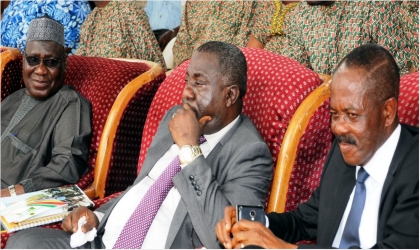
L-R: NNPC Community Relations Manager, Alhaji Alibaba Mohammed, representative of NNPC Managing Director, Mr Vitalis Ugochukwu and President, Enugu Chamber of Commerce, Industry, Mines and Agriculture, Dr Ifeanyi Okoye, during NNPC Day at the on-going 25th Enugu International Trade Fair, last Thursday.



Business
Jonathan, Diri, Others Laud Firm’s Milestone in Bayelsa …Says Project Will Drive Industrialisation, Create Jobs



-

 News3 days ago
RSG Targets Nine Million Residents in Mosquito Net Distribution Campaign
-

 Oil & Energy3 days ago
Aiyedatiwa Signs New Electricity Bill
-

 Maritime3 days ago
Marine Minister Commends President Tinubu On NPERA Bill Assent
-

 Oil & Energy3 days ago
NLNG Commissions Research And Innovation Centre In RSU
-

 News3 days ago
KenPoly Holds Eight Convocations, August 29
-

 News3 days ago
RSG Begins Another Phase of Projects Commissioning Today
-

 News3 days ago
RMAFC Completes Revenue Sharing Review, Proposes New Pay
-

 Maritime3 days ago
NAGAFF Petitions IGP Over Alleged Maritime Police Harassment