
Politics
APC’s Roadmap To A Better Nigeria

Last Thursday, the All
Progressives Congress (APC) blazed the trail by coming up with a written document that clearly lists its promises to the electorate. The party, at its inaugural national summit held at the Transcorp Hilton Hotel, Abuja, unveiled its code of ethics and agenda for the country ahead of the 2015 general elections.
A summary of the APC’s manifesto presented during the summit showed that the party places premium on job creation, fight against corruption, free and quality education, agriculture development, housing development and healthcare plan for children and adults. Other areas that were captured in the manifesto include social welfare for the less privileged, roads, power and infrastructure, better management of natural resources, security, freedom of religion and foreign affairs.
APC’s manifesto, according to the Interim National Publicity Secretary of the party, Alhaji Lai Muhammed was based on the opinion polls conducted for the party by a foreign consultant, KA Research Limited (KARL), a privately owned international research company based in Brussels, Belgium and Islanbul, Turkey.
The APC spokesperson said the public opinion polls which were conducted both in rural and urban areas, showed that unemployment remains the most challenging issue facing Nigerians with 60 per cent of respondents castigating the PDP government for unemployment. This, according to him, was closely followed by corruption recording 59 per cent of Nigerians blaming the country’s woes on weak anti-graft policy.
APC, therefore, promised to tackle unemployment head on by creating at least 20,000 jobs per state for those with minimum qualification of secondary school leaving certificate and who have technology and national training immediately on assumption of power at the centre.
The party also resolved to show zero tolerance for corruption at all levels by pursuing a legislation that will expand forfeiture and seizure of assets laws and procedures with respect to inexplicable wealthy, irrespective of whether there is a conviction or not.
APC’s blueprint is a departure from the past when political parties waited till the campaign period, more often at campaign rallies before ditching out a salad of promises to the electorate.
The Lagos State Governor, Babatunde Raji Fashola who set the ball rolling on APC’s manifesto at the summit, described the party’s roadmap as something new in Nigerian politics. He explained that the uniqueness of the event was that the party was making its intention known to the Nigerian people at a forum other than a campaign rally as had been the practice in the last 15 years.
“No party in more than 15 years has done what we will do today. Publicly, and most importantly, together as a party, we tell Nigerians what we believe in a meeting, not just in a rally, not in the middle of a political campaign”, he said.
Fashola explained that what stand APC out from other parties is that the party has got a roadmap for developing Nigeria, and code of ethics to regulate and guide the activities of its members whether in government or out of it.
The APC may have borrowed a leaf from the first and second republics when political parties were well known for their core principles and political ideologies. For instance, the Unity Party of Nigeria led by the late sage, Chief Obafemi Awolowo was well known for its five cardinal programmes including free education and free health, while the then ruling National Party of Nigeria (NPN) anchored its own programmes on affordable housing and development of agriculture, among others.
For 15 years since Nigeria returned to civilian rule, the country was bereft of political party ideologies. All the parties merely played to the gallery without clearly defined manifesto. Worse still, apart from the ruling Peoples Democratic Party (PDP) that wears a national outlook, other parties merely existed on the fringe and tended towards protecting and serving ethnic interest.
However, with the unveiling of APC’s blueprint last Thursday, the party appears to have carved a unique ideological niche for itself. The uniqueness of the APC’s roadmap lies not only in its contents but also in the procedure and methods adopted to arrive at conclusions on each of the issues affecting the lives of Nigerians. The idea of using opinion polls to gauge the feelings of Nigerians on what they consider as most needful and challenging has added a new vista to Nigerian politics.
Speaking further on the manifesto launch, Fashola said “the work we begin today is the work that will build a new Nigeria. We in the APC seek to create a new future for Nigeria; a future when there are jobs for everyone who wants to work; a future without leaders who deprive the very families they are supposed to protest; a future of peace and stability; a future when Nigeria can feed its families; a future when a Nigerian education is as good as any education in the world; a future when the high prices of food and fuel do not undermine every family’s quality of life”.
The Lagos State governor believes Nigeria’s population of over 160 million and 290 ethnic groups who speak 521 languages ought not to be a disadvantage but a source of strength which should create jobs and opportunities for all.
He berated the ruling PDP for paying lip service to anti-graft war, saying if government were committed to the anti-graft war, there would have been enough money to create jobs for the nation’s growing youth population.
“And let there be no doubt about the link between corruption and jobs. If we had a government that is serious about fighting corruption, there would be financial resources to create jobs. Instead of stopping this corruption, this government (federal government) pardons those convicted of corruption and removes those who point out corruption”, he said.
Several other speakers including leaders of the legacy parties that coalesced into APC, namely General Muhammed Buhari of the defunct Congress for Progressive Change (CPC), Asiwaju Bola Ahmed Tinubu of the Action Congress of Nigeria (ACN), Chief Ogbonaya Onu of the All Nigerian Peoples Party (ANPP), the APC’s Interim National Chairman, Chief Bisi Akande and former National Chairman of the PDP, Chief Audu Ogbeh took turns to tell the audience what led to the merger of opposition parties.
Gen Buhari said decided to come together to put an end to impurity in government and to ensure the country’s enormous resources are well managed.
In his own remarks, Tinubu who is a former government of Lagos State, said he was encouraged by the fact that everywhere he went even during the course of his exile, he could only rely on his Nigerian passport. This, according to him, made it imperative for him and likeminded progressives to build a truly national political party.
The former governor who said “the youths are the owners of APC agenda because it is their interest that the party is fighting to protect through creation of employment, sound economic development, and prudent management of resources”, gave indication of the APC’s readiness to build four refineries within four years in office to check the current overdependence on the importation of petroleum products and “to put a stop to the circle of product scarcity and subsidy scams in the country”.
Other members who spoke at the well-attended summit include former Minister of the Federal Capital Territory, Mallam Nasir El-Rufai, former Borno State Governor, Ali Mohdu Sherrif, APC State governors and the outspoken former Vice-President of the World Bank and two time minister in Nigeria, Dr (Mrs) Obiageli Ezekwesili who delivered the keynote address.
The APC’s roadmap did not only provide an avenue for the party to showcase what Nigerians should expect if it forms government in 2015, it is also an ingenious innovation that rattled the ruling PDP whose rank has depleted in the last four months due to a gale of defection from its pack to the APC.
In a quick response to APC’s blueprint, the National Publicity Secretary of the PDP, Chief Olisah Metuh last Thursday, described the roadmap as “empty and typical of all anti-democratic coalitions”, adding that it “lacks character, depth and completely addressed no issue”.
He also faulted the APC’s code of ethics, saying the PDP was the first political party to launch its code of conduct as far back as 2006 when Senator Ahmadu Ali and Ambassador Ojo Maduekwe were National Chairman and National Secretary, respectively.
Notwithstanding the PDP’s political mudslinging, the APC’s roadmap is a novel idea that could help fix all the failings of successive governments in the country. But whether or not the APC is ready to accept the challenges inherent in seeking to tackle all the myriads of ills plaguing the nation, as Dr Ezekwesili canvassed in her thought-provoking address is a question only time will tell.
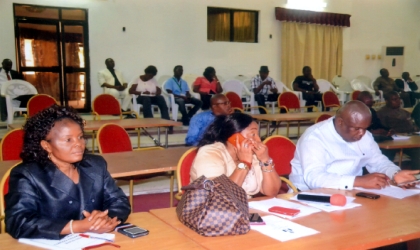
Cross section of lawmakers at sitting Government House, Port Harcourt last Thursday. Photo: Chris Monyanaga
Boye Salau



The Independent National Electoral Commission (INEC) has extended the deadline for political parties to submit the list of candidates for the 2027 governorship and state Houses of Assembly elections from Saturday, August 8, to Tuesday, August 11, 2026.
The commission announced the extension in a statement issued on Saturday and signed by the National Commissioner and Chairman of its Information and Voter Education Committee, Mohammed Haruna.
According to INEC, the decision followed appeals by political parties for additional time to complete the submission process through the dedicated online portal.
“The submission window, which according to the revised Timetable and Schedule of Activities for the General Election was originally scheduled to close on Saturday, 8th August, 2026, has been extended to Tuesday, 11th August, 2026,” the commission said.
In a a related development, INEC announced the suspension of PVC collection in Osun State ahead of the August 15 governorship election.
The commission said voters who applied for replacement of lost, damaged or defaced Permanent Voter Cards would have until midnight on Sunday, August 9, to print downloadable copies of their cards.
The electoral body explained that the deadline was necessary to enable it compile data on downloaded PVCs and produce final statistics on the total number of cards collected ahead of the election.
INEC said PVC collection in Osun commenced at the Registration Area level from July 22 to 28, 2026, but was extended to July 31 following complaints about large crowds and difficulties experienced by voters at collection centres.
The exercise subsequently moved to the local government level and ran from August 1 to 7.
The commission also disclosed that replacement downloadable PVCs had been made available to voters in Odo-Otin and Ife Central Local Government Areas following the theft of cards during attacks on the two collection centres.
It stressed that the stolen cards could not be used to vote.
INEC reassured Osun residents of its preparedness for the August 15 governorship election.
“The commission reiterates that the stolen cards cannot be used to vote.
“INEC reassures the people of Osun State of its readiness to conduct a free, fair, credible and inclusive governorship election on 15th August, 2026,” the statement said.
The commission said the deadline, initially set for Saturday, 8 August, has been extended to Tuesday, 11 August 2026, following appeals from political parties for more time.
INEC also announced that the window for voters who applied to replace lost, damaged or defaced PVCs to download their replacement cards will close at midnight on Sunday, 9 August.
The move is to enable the commission compile final PVC collection figures ahead of the 15 August Osun governorship election.
INEC said replacement downloadable PVCs have also been provided to affected voters in Odo-Otin and Ife Central Local Government Areas after hoodlums carted away cards from two collection centres, stressing that the stolen cards cannot be used to vote.
The commission reaffirmed its readiness to conduct a free, fair, credible and inclusive election in Osun State.
Gov. Kefas made the remarks over the weekend at the Federal Medical Centre (FMC), Jalingo, during the flag-off of the second phase of the Renewed Hope Medical Outreach in Taraba State, organised as part of activities marking Prof. Yilwatda’s 58th birthday.
The governor commended Prof. Yilwatda for choosing to mark his birthday by providing medical care to people in need.
“What Professor Nentawe did is a powerful demonstration of what leadership should be,” Gov. Kefas said.
He assured that his administration would continue to support initiatives that complement government efforts to improve healthcare delivery and the wellbeing of residents.
Speaking at the event, Prof. Yilwatda called on Nigerian leaders to embrace the culture of giving and use their positions to touch the lives of the less privileged.
He said his decision to celebrate his 58th birthday in Taraba State was deliberate and informed by the needs of underserved communities, particularly people who face difficulties accessing healthcare because of distance and financial constraints.
According to him, the intervention followed a needs assessment and was extended across the three senatorial districts of the state.
He said the exercise commenced on August 3 at Takum General Hospital and covered the Federal University Teaching Hospital, Wukari; First Referral Hospital, Sunkani, Ardo-Kola Local Government Area; General Hospital, Bali; General Hospital, Gembu; and FMC Jalingo.
Prof. Yilwatda said the intervention provided medical services to thousands of beneficiaries, including people who required surgical procedures.
He said sustainable national development could only be achieved when strong institutions placed Nigerians at the centre of development.
“Leadership is about service,” he said, urging political and public leaders to make giving back to society an important part of their responsibilities.
He reaffirmed his commitment to serving Nigeria and its people, saying his personal vision was to make every day of his life useful to humanity.
“Every day that I live, the vision is: let it be useful to humanity,” he said.
The Taraba State Commissioner for Health, Dr. Bordiya Buma, commended the initiative, saying it was consistent with the Renewed Hope agenda and efforts to strengthen healthcare delivery in the state.
Dr Buma said the second phase followed the successful completion of the first phase, which was conducted simultaneously in six local government areas, with two LGAs selected from each of the three senatorial districts.
According to him, more than 10,000 patients were attended to during the first phase, including people with medical and surgical conditions.
He disclosed that 327 general surgeries, 71 eye surgeries and 575 dental procedures were carried out during the exercise.
The commissioner expressed appreciation to President Bola Tinubu for the Renewed Hope Medical Outreach and thanked Prof. Yilwatda for supporting the initiative and choosing Taraba State as a beneficiary.
The Minister of Health and Social Welfare, Prof. Muhammad Ali Pate, also commended Prof. Yilwatda for choosing Taraba State to mark his 58th birthday through a medical outreach.
Prof. Pate said making healthcare the centrepiece of the birthday celebration was significant because health affects everyone.
-

 News3 days ago
RSG Targets Nine Million Residents in Mosquito Net Distribution Campaign
-

 Oil & Energy3 days ago
Aiyedatiwa Signs New Electricity Bill
-

 Oil & Energy3 days ago
NLNG Commissions Research And Innovation Centre In RSU
-

 Maritime3 days ago
Marine Minister Commends President Tinubu On NPERA Bill Assent
-

 News3 days ago
KenPoly Holds Eight Convocations, August 29
-

 News3 days ago
RSG Begins Another Phase of Projects Commissioning Today
-

 News3 days ago
RMAFC Completes Revenue Sharing Review, Proposes New Pay
-

 Maritime3 days ago
NAGAFF Petitions IGP Over Alleged Maritime Police Harassment