
Business
CBN Introduces Finger-Prints In ATM

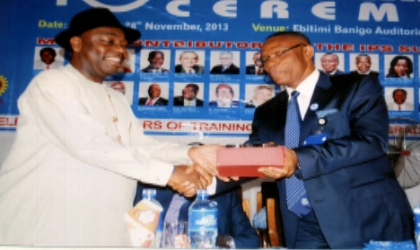
Representative of Minister of Petroleum Resources, Engr. Ernest Nwakpa (left), receiving an award from Vice Chancellor of the University of Port Harcourt, Prof. Joseph Ajienka, during an induction /anniversary ceremony organised by Institute of Petroleum Studies of the university, in Port Harcourt, recently Photo: Obinna Prince Dele
The Central Bank of Nigeria (CBN) plans to introduce ATM system that would operate with finger prints instead of card as from next year.
The Head of Information and Client Services, CBN, Port Harcourt branch, Mr. Okeke Ikechukwu Stephen disclosed this last Saturday at the Port Harcourt Bankers Committee End of year Party 2013 held in Port Harcourt.
Stephen who delivered a lecture titled “CBN’s New Initiatives”, at the event disclosed that the cashless system introduced in Rivers State had put a stop to the challenge of armed robbery attacks on banks in the state.
He urged Nigerians to embrace the cashless system and enjoy the numerous merits derivable from it.
Highlight of the lecture was the practical demonstration of the use of the Point of Sale (POS) machine.
Meanwhile, Zenith Bank was named the best bank in terms of volume of transaction, deposit and withdrawal in the Port Harcourt clearing House, Guarantee Trust Bank clinched first position in the category of banks that were most responsive to directive of CBN while First Bank came first amongst banks in terms of service to the development of Rivers State.
The Controller of CBN, Port Harcourt branch, Mr. Ken Effa expressed gratitude to those that partnered with CBN, Port Harcourt branch in discharging the core functions of the bank to Rivers people and urged them to continue in their fruitful collaboration.
He noted that the branch had remained second to Lagos in terms of impressive performance irrespective of a lot of anxieties and expectations from the sector.
Effa remarked that the quantitative easing earlier introduced by the Bank of England and Bank of Japan and most Central Banks in US and Europe in 2013 had resulted in the stability of monetary conditions and expressed hope that the stability would be sustained.
According to the CBN boss who was also the chairman of the event, the CBN had capacity through its policies to stabilise the exchange rate of Naira as it had contained inflation within the single digit.
He said as a responsive and pro-active institution, CBN had not rested as evidenced in the bank’s economic blueprint for the banking sector reform and the various policy pronouncements.
He mentioned the introduction of revised Guide To Bank Charges in April 2013, introduction of Customers forum, launching of N220 billion Micro, Small and Medium Enterprises Development fund in August, extension of the cashless policy to six states, introduction of Agent Banking Model as well as continued implementation of the 3-tiered Know-Your Customers Guildelines amongst achievements recorded by CBN within the 2013 fiscal year.
Chris Oluoh




-
Rivers1 day ago
Philanthropist Cautions Youths Against Ignoble Acts Donates Building To Musician
-
Politics1 day ago
2027: ADC Candidate Tasks INEC On Integrity, Intensifies Consultations
-

 News24 hours ago
Tinubu Appoints Enitan As New Head Of Federal Civil Service
-

 Politics1 day ago
2027: INEC To Conduct Nationwide Electoral Equipment Test Run In November
-
Sports1 day ago
NSC Celebrates Historic Beach Volleyball Olympic Qualification
-
Sports1 day ago
Arsenal Want Osimhen To Take Pay Cut
-
Sports1 day ago
Nnadozie, Osimhen Lead Highest-Rated Nigerian Players
-
Politics1 day ago
Yari Emerges DG As Tinubu Unveils 2027 Presidential Campaign Council