Environment
FG Wants EU‘s Support To Implement Climate Change Act, Environmental Policies
The Federal Government has called for European Unions‘ support to ensure effective implementation of Climate Change Act and other environmental policies to achieve a healthy environment in the country.
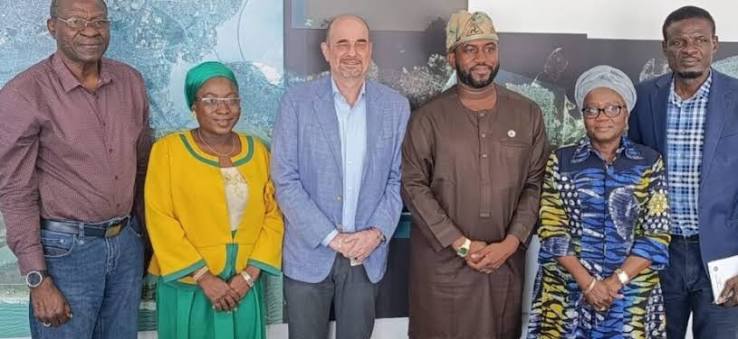
Alhaji Mohammed Abdullahi, Minister of Environment, made the call when Amb. Samuela Isopi, Head of the EU Delegation to Nigeria, paid him a courtesy visit in Abuja.
The Tide source reports that the President, Mohammadu Buhari signed the Climate Change Bill into law in November 2021.
The Act paves the way for environmental and economic accounting and a push for a net zero emission deadline plan in the country.
Abdullahi mentioned some of the environmental programmes already implemented and needed the support of the EU such as Climate Change Act, drought and desertification, energy transition planning, plastic waste management and illegal wildlife trading.
“ I am delighted to see you in this ministry because you always show this vibrancy about your job and have as well shown commitment to drive the agenda.
“The discussions we are having with the EU gives us opportunity to understand where we are taking off on the issues that concern planet which is where we are living.
“The presentations you made earlier and issues you raised which basically focused on climate change, energy transition planning and dialoguing on key programmes on the sector.
“Meanwhile, we had this legislation on climate change Act we are working towards implementation of the act.
“ We are trying to see how we can navigate around some challenges of inconsistencies in the act.
“We need the EU and other developed countries to support Nigeria as well as other African countries to address the challenges.
“So, we will need some legal cooperation from the EU, to bring expertise that will help us to implement the Act and other issues effectively,’’ he said.
Abdullahi said that Nigeria had started preparation of UN Climate Change Conference 2022 (UNFCCC COP 27), adding that the conference would be the 27th session and would take place in Sharm El-Sheikh, Egypt.
He said that Buhari made a strong commitment about meeting zero emission by 2060, adding that the ministry wanted to ensure that the effort was actualised through the EU assistance and other global intervention.
He said that the ministry, in collaboration with UN Office on Drug and Crime, had put in place National Strategy Policy to combat illegal wildlife trade and forest crimes in the country.
He added that the ministry was also working toward providing plans on how to tackle waste management, adding that various activities by people had severely raided the environment.
He said that the ministry collaborated with other relevant stakeholders, both in local and international, to ensure that environmental challenges were effectively tackled in the country.
“We are working hard to ensure that from South to North, West down to East have an environment that is friendly as well as making sure that our land will be cultivatable.
“We want to also make sure that people have access to clean water so that their livelihood will also be enhanced.
“I hope and have confidence that collaborating with the EU, we will be able to achieve our mandates effectively,’’ he said.
Earlier, Isopi said that the aim of the visit was to express the EU‘s commitment and support as well as strengthen its cooperation with Nigeria toward addressing various environmental challenges.
She said that the EU was working on important framework on political dialogue with Nigeria and the need to continue with such idea for efficient implementation of programmes and policies in the country.
“I want the cooperation to continue with the ministry of environment to enable us tackle climate change, energy transaction and other environmental issues.
“These issues are centre of our cooperation in Nigeria, whereby, we are already having a lot of dialogue with Nigeria.
“Last week, we had a first section of this sectorial dialogue and the ministry was represented, we had a good preliminary discussions on these issues and it was a progressive meeting.
“We hope that the effort will give a better result on those issues we are discussing, we really hope that we can continue the dialogue with Nigeria delegations and EU expertise.
“The dialogue will help us as we are trying to see how together we can work to support Nigeria in the implementation of those priorities.
The ambassador said that the EU had also engaged with public sectors in addressing renewable energy, adding that such involvement would help in addressing environmental issues.
She, however, assured that the EU would ensure that it provided strategy to support in combating illegal wildlife trade, forest crime and other environmental crises in the country. (NAN)

Environment
Nigeria, UAE to waive tariffs on some products
The Federal Government has signed a Comprehensive Economic Partnership Agreement (CEPA) with the United Arab Emirates (UAE) to remove tariffs on selected products.
Rep. Sam Onuigbo a member of the Governing Board of the North-East Development Commission, disclosed this in an interview with newsmen in Abuja on Tuesday.
Onuigbo said that the agreement signed in Abu Dhabi from Jan. 11 to 15, marked a major breakthrough for Nigeria-UAE economic relations.
NAN reports that Onuigbo, a member of the House of Representatives of Nigeria who represented Ikwuano/Umuahia North and South Federal Constituency, served as Chairman, Committee of Climate Change during the 8th Assembly.
“Under the CEPA signed in January 2026, UAE will eliminate tariffs on 7,315 Nigerian products. This includes immediate duty-free access for 2,805 products (38.3 per cent).
” The rest will phase out over three to five years, covering agricultural and industrial goods.
“Similarly, under the Nigeria/UAE CEPA also signed in January 2026, Nigeria has eliminated tariffs on 6,243 products imported from UAE. That agreement creates these wonderful opportunities between Nigerians and the Emirates,” he said.
Onuigbo said that the agreement was massive as it would facilitate an environment for business owners in Nigeria.
He said the pact would enable verified Nigerian business owners to establish offices in UAE, operate for up to three months and return home with expanded commercial networks.
He commended President Bola Tinubu for the agreement, saying it aimed at repositioning the country while also creating an enabling environment for employment opportunities.
He reaffirmed Nigeria’s readiness for business, noting that the country also unveiled its carbon market framework policy to attract climate-focused investments
”Nigeria is a nation of nearly 250 million people and has had, over the years, the challenge of enough energy or power to be able to attain its economic and industrialisation targets.
“And because of that, Nigeria has been engaging in different activities, for instance, the Energy Transition Plan, enactment of the Climate Change Act, and the Electricity Act which the President signed barely eight days after he assumed office in 2023.
“This shows the importance of addressing the energy gap having enough energy. Electricity is a fundamental point to developing industrially which Nigeria deems necessary,” he said.
Onuigbo lauded Nigeria’s participation at the Abu Dhabi summit saying that the summit would strengthen global economic opportunity for people.
He added that the President’s collaboration would address the challenges and devastating effects of climate change as well as boost economic growth in 2026
Environment
HYPREP Completes Phase One Mangrove Restoration In Ogoniland, Warns Against Re-Pollution
The Hydrocarbon Pollution Remediation Project, HYPREP, says it has achieved a major environmental milestone in Ogoniland with the full completion of Phase One of its mangrove restoration programme, even as it warned that renewed pollution could erase years of painstaking cleanup.
“We have completed Phase One planting and restoration at 100 per cent. We are now in the monitoring stage, with some sites already observed for up to nine months,” he said.
Beyond mangroves, Aguiyi reported significant progress in soil and groundwater remediation, describing the last quarter as one of HYPREP’s most productive periods since the Ogoni cleanup commenced.
He disclosed that shoreline cleanup has reached about 77 per cent completion, while access to safe drinking water has expanded across Ogoni communities.
“We have restored 100 per cent potable water supply to Ebubu, and reconstruction work has commenced at the Gwara Waterfall,” Aguiyi stated.
On infrastructure, he said key equipment for the long-awaited Ogoni Power Project has been procured and secured at the Wiyaakara substation, signalling movement toward energy support for the restoration effort.
Despite the progress, Aguiyi warned that re-pollution remains the single greatest threat to the success of the Ogoni cleanup.
“Our major concern is waking up one day to find areas cleaned with Ogoni people’s resources re-polluted by activities beyond our control,” he said, stressing that environmental recovery must be protected as much as it is delivered.
He attributed the sharp decline in illegal artisanal refining in Ogoniland over the past two to three years to sustained community engagement and alternative livelihood programmes, which he said have reduced economic dependence on destructive practices.
“We have not recorded incidents of artisanal refining in Ogoniland in the last two to three years, and that is the result of consistent sensitisation and viable livelihood options,” he added.
Aguiyi reaffirmed HYPREP’s willingness to collaborate with companies and partners operating in Ogoniland, noting that initiatives aligned with the project’s environmental and social objectives would be reviewed and adopted where appropriate.
He also said recommendations from recent independent and internal reports are already being implemented, underscoring HYPREP’s commitment to transparency, accountability, environmental recovery, and improved livelihoods for Ogoni communities.
Environment
Over Six Million Benue Residents Exposed To Neglected Tropical Diseases – State Government
The Commissioner for Health and Human Services, Dr. Paul Ogwuche, disclosed this during a press conference to mark the 2026 World Neglected Tropical Diseases Day, organised in collaboration with Sightsavers and themed “Unite, Act, Eliminate Neglected Tropical Diseases (NTDs).”
Represented by the Permanent Secretary of the ministry, Dr. Beatrice Tsavmbu, the commissioner announced the successful elimination of blinding trachoma in Gwer East, Gwer West and Ukum Local Government Areas, attributing the feat to years of targeted interventions, strong community participation and sustained implementation of the state’s NTDs Control and Elimination Programme.
“I am proud to announce the elimination of blinding trachoma in three of our most affected areas—Gwer East, Gwer West and Ukum. No longer will these communities face the blindness that trachoma has long inflicted,” she said.
However, Dr. Tsavmbu noted that Benue State remains highly endemic for several NTDs, with all 23 local government areas experiencing overlapping disease burdens. She listed the diseases to include onchocerciasis (river blindness), lymphatic filariasis (elephantiasis), schistosomiasis (bilharziasis), soil-transmitted helminth infections (intestinal worms), leprosy, buruli ulcer and snakebite envenoming.
“These conditions collectively put over six million people in Benue State at risk,” she stated.
She revealed that the state had treated an average of more than five million people over the past five years through preventive chemotherapy, morbidity management and disability prevention, supported by Water, Sanitation and Hygiene (WASH) initiatives and integrated vector control.
Dr. Tsavmbu also announced a major breakthrough in the fight against river blindness, noting that onchocerciasis endemicity in the state had been reclassified from ongoing transmission to suspected interruption of transmission.
On lymphatic filariasis, she disclosed that 1,064 hydrocele cases had been successfully managed through free surgeries, while 442 lymphoedema patients received free management kits to prevent disease progression. She added that 44 trachoma trichiasis cases were also treated through free surgical interventions.
According to her, Ukum, Logo and Konshisha LGAs have passed Transmission Assessment Survey 1 for lymphatic filariasis, allowing for the cessation of mass drug administration in those areas. In addition, seven other LGAs—Ado, Apa, Kwande, Obi, Ohimini, Oju and Tarka—successfully passed epidemiological monitoring surveys in 2025.
She attributed the progress recorded to strong inter-sectoral collaboration involving agencies such as the Benue Rural Water Supply and Sanitation Agency (BERWASSA), the State Universal Basic Education Board, the Ministry of Education, civil society organisations and security agencies. She also cited the inauguration of the State NTDs Advisory Committee and improvements in supply chain and logistics management systems.
In a related remark, Prof. Edward Omudu of the Department of Biological Sciences, Moses Orshio Adasu University, Makurdi, revealed that the National Universities Commission had recently approved Nigerian universities to offer degree programmes in Water, Sanitation and Health, describing the move as a critical step toward strengthening disease prevention and public health capacity in the country.
-
Politics11 hours agoPFN Rejects Call For INEC Chairman’s Removal Over Genocide Comments
-
Sports11 hours agoEnekwechi wins Orlen Cup in season opener
-
Business12 hours agoNCDMB, Jake Riley Empower 250 Youths On Vocational Skills
-
Rivers11 hours agoFasthire, PHCCIMA, CIPM Host CareerFest 2026 In PH
-
Oil & Energy13 hours agoNNPCL Unveils Gas Master Plan 2026 …….Targets 10bcf/day production
-
Oil & Energy12 hours agoElectricity Boost: Abia Launches Waste-To-Energy Project
-
Niger Delta12 hours agoStakeholders Task INC Aspirants On Dev … As ELECO Promises Transparent, Credible Polls
-
Sports11 hours agoFalconets, Senegalese Lionesses arrive Ibadan for qualifier