
City Crime
Security Challenges And Achievements In Rivers

The importance of security cannot be over-emphasised. It is the bedrock of sustainable development in every country. More so, it is the foundation on which economic growth strives as such promotes and beefs up the confidence reposed in the leaders entrusted with the governance. Although achieving absolute security is desirable, it is not probable. Society devoid of peace is bound to collapse.
Attaining high level of security comes with a lot of sacrifice and commitment from both the leaders and the led.
In Rivers State, Governor Nyesom Wike‘s administration has intensified its efforts to ensure the security of inhabitants and caused the prevalence of the much needed peace through a deliberate and concerted effort. This was done through massive support to security operatives in the state.
There is no gainsaying of the fact the state occupies a strategic position in economic and political sectors of the country; that is why all hands must be on deck to complement government’s efforts. Consequently, government’s effort to ensure a conducive environment for inhabitants of the state is underscored by both financial and logistic support given to the security agencies.
Apart from providing the aforementioned support for the security operatives, the state government has also provided for families of security operatives, who had lost their lives in active service, while enforcing and maintaining peace.
Despite all odds, security operatives in the state recorded major achievements in 2020; they carried out aggressive onslaught against criminal gangs by taking the war to their hideouts in every nook and cranny before the novel COVID-19 pandemic shut down the country.
Interestingly, the pandemic did not deter the security agencies, especially the Rivers State command of the Nigerian police, from carrying out its statutory responsibilities as they were available to enforce the state-imposed lockdown and other COVID-19 rules.
In the month of July precisely, the state government launched a joint security outfit codenamed “Operation Sting,” to address the issue of violent crimes such as: kidnapping, armed robbery, cultism and sea piracy, among others.
The state government supported the outfit through the provision of patrol vans, gunboats and sophisticated weapons. In spite of the frequent changes in the leadership of the state police command, the security outfit lived up to expectation and maintained law and order.
The incumbent Commissioner of Police, Mr Joseph Mukan, assumed office as the 40th Commissioner of Police in Rivers State on April, 2020, swung into action, and ensured that there was peace. Most importantly, CP Mukan has reduced crime to the barest minimum.
The nightmarish cultism and kidnapping have almost been consigned to the rubbish heap of history because of the onslaught against criminals spearheaded by the state police under Mukan, thereby ushering in a new lease of life for Rivers inhabitants.
Again, the ferocity of sea piracy has ebbed with the tide. Many hoodlums have abandoned the twin crime of kidnapping and cultism leaving in its wake a friendlier environment, courtesy of the commitment of the CP.
Under Mukan, the Rivers State Police Command achieved a major feat in 2020, when the notorious cultist Honest Digbara (aka Bob Risky) was killed. Digbara had killed many and committed a plethora of heinous crimes along the Ogoni axis of the state. consequently at his death, residents in the area heaved a sigh of relief.
CP Mukan is elated about the achievement so far recorded by his command.
“On assumption of duty as the 40th Commissioner of Police in April, last year, I met some challenging situations on ground. But with the benefit of hindsight, I re-strategised and repositioned my men, with a strong charge to embark on aggressive intelligence- driven policing with a view to gathering actionable information, which ultimately led to dislodgment of criminals. A case in point being the arrest of the most dreaded gang leader, Honest Digbara(Aka Bob Risky) who was declared wanted by the state government with a bounty of N30,000, 000. He was eventually arrested and the bounty redeemed,” he said.
“Not resting on the oars of that achievement, I continued with my sustained onslaught against all criminal elements in the state. To this end I can proudly tell you between April and now, I have been able to arrest and prosecute a good number of suspected kidnappers, armed robbers, rescued kidnap victims and recovered large cache of arms/ammunition, among other achievements.
As you can see, we are again in another period, characterised by upsurge in criminal activities. The command is not oblivious of the fact that, this is the period where criminals take advantage to unleash havoc on unsuspecting persons. In the view of the above, therefore, we have put in place elaborate and workable security measures that will contain the curtail these nefarious activities.”
The police deployed its personnel in to strategic locations in the state, in line with visibility policing strategy and ensured that critical government infrastructure, vulnerable and key points are given special attention, including worship and fun centres.
“Our strategy has also captured the coastal to ensure that, those travelling to riverine communities are safe. The Marine police, the mobile police and the tactical units have been put on red alert to ensure a seamless celebration, including the undercover operations,” he stated
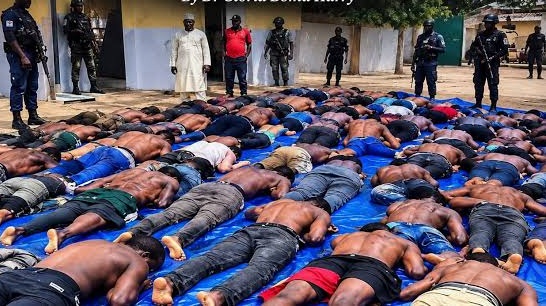
The police with other security agencies were able to curtail the excesses of members of the proscribed Indigenous People of Biafra (IPOB), who were on rampage in some parts of the state within the year under view
Caches of weapons and ammunition were rescued, while over 20 kidnapped victims were also released from their captors.
The Oyigbo, Umuebula and Afam Divisional Areas in the command, were burnt and looted and remain at a gory state till the moment.
Again, the police in its avowed affront on criminals in the state confiscated one radio transmission set belonging to Biafra Radio, large quantities of IPOB T-shirts and face caps
A calendar bearing the photograph of Nnamdi Kanu, one Television set, customised machetes, bearing members’ names
Substances used in worship of their god, ezumezu amadioha juju.
Again another cheering story of the year 2020 was the arrest of one Godspower Saturday, male, aged 23 years and David Simeon, suspected kidnappers, whose gang kidnapped a staff of Nigerian National Petroleum Corporation (NNPC), Tamuno Igbikibere-bima Esq.
Igbikiberebima Esq was kidnapped at his residence in Rumuigbo in Obio/Akpor Local Government Area of the state but was freed through the effort of the police.
The police have given assurances that they would improve on their performances in 2020 but they need to improve on their relationship with the rest of the society. Unfortunately, not many people believe on the ability of the police to guarantee unblemished law enforcement. Most people have lost confidence in the security agency.
The #ENDSARS protest in the state was another ugly situation which made the police to become the highest victims as about five personnel alongside other security men lost their lives.



Team Nigeria recorded its best-ever appearance at the Youth Olympic Games, winning three gold medals at Dakar 2026 in Senegal to surpass the country’s previous best performance at the competition since its debut.
It was a remarkable campaign defined by historic victories, record-breaking performances and the emergence of a new generation of Nigerian sporting talents, with three athletes etching their names into the country’s sporting history.
According to a press statement from the Special Assistant, SA to the Director -General of the National Sports Commission, Kola Daniel, Nigeria’s gold-medal haul came through Bright Gift, Rosemary Nwankwo and Praise Ugoh, whose outstanding performances in athletics delivered an unprecedented sprint double and a landmark victory in the women’s 400m.
Bright Gift made history by becoming the first Nigerian to win the men’s 100m title at the Youth Olympic Games, clocking an impressive 10.28 seconds to claim gold and set a new Games record.
Rosemary Nwankwo’s victory in the women’s 100m, completing Nigeria’s historic sprint double. Her 11.16-second performance made Nigeria the first country to win both the men’s and women’s 100m titles at the same edition of the Youth Olympic Games.
Praise Ugoh completed Nigeria’s golden campaign by winning the women’s 400m in a personal best of 52.76 seconds, becoming the first Nigerian to claim the event’s title at the Youth Olympic Games.
The three victories represent a new high for Nigeria at the competition, surpassing the two gold medals won at the inaugural edition in Singapore in 2010.
The National Sports Commission (NSC) has attributed the progress of Nigerian youth sports to sustained efforts in grassroots development, talent identification and the creation of competitive platforms through which young athletes can be discovered, nurtured and prepared for international competition.
The two technocrats, Mallam Shehu Dikko, and Hon. Bukola Olopade’s commitment to grassroots sports development has continued to drive initiatives aimed at building a strong pipeline of future champions.
A major component of this strategy is the Commission’s Invited Junior Athletes Initiative, alongside the National Sports Festival and the hosting of the CAA Africa U18/U20 Athletics Championships in Abeokuta. These platforms have provided opportunities for emerging talents to compete, gain exposure and progress towards representing Nigeria on the international stage.
The Director of Grassroots Sports Development at the Commission, Prince Niyi Beyeku, and other key players including Lekan Alabi epitomize the dedicated team behind implementing programmes and initiatives that strengthen talent discovery and development across the country.
The Nigeria Olympic Committee, under the leadership of its President, Engr. Habu Gumel, remained consistent in its support and leadership in coordinating Nigeria’s participation at the Games.
The Commission applauds all athletes’ coaches, technical officials, medical personnel and backroom staff whose hard work, preparation and dedication contributed to the team’s historic outing.
Beyond the medals, Nigeria’s performance in Dakar represents a significant statement about the country’s sporting future. The emergence of these young champions reinforces the importance of sustained grassroots investment and provides renewed optimism about Nigeria’s capacity to produce world-class athletes.
President Bola Tinubu on Wednesday announced the award of a ?100 million Federal Government Savings Bond to each player on Nigeria’s victorious U-17 women’s football team, the Flamingos.
The bonds attract an annual interest rate of 14 per cent. The investment by the government for the players is for five years.
President Tinubu also announced a cash gift of ?100 million for the coach and ?50 million for each member of the technical crew.
The President announced the rewards during a reception at the Presidential Villa in Abuja for the Flamingos, who reportedly won the U-17 Women’s World Cup in Morocco.
The Flamingos defeated Japan to become the first African team to win the tournament.
President Tinubu was represented at the reception by the First Lady, Senator Oluremi Tinubu.
-
News4 days ago
Parents Protest Scholarship Scheme Suspension At PAMO Varsity
-
 News4 days ago
US Hails Nigerian Military For Rescuing 125 Kidnap Victims
-
News21 hours ago
Bayelsa Boat Mishap: Tinubu Donates N250m As Death Toll Hits 29
-
News21 hours ago
Odu Pays Tribute To Late Chinwah, Describes Him As Courageous, Selfless Academic
-
Business4 days ago
Reps Raise Alarm Over N2trn Agricultural Loan Diversion
-

 Featured4 days ago
Presidents Xi, Trump, Putin Commit To Global Stability, Denuclearisation
-
Politics4 days ago
ADC Faults INEC’s Alleged Limited Capacity To Upload Election Result On IREV
-
Politics4 days ago
Tinubu Expands 2027 Campaign Tour To 19 States