
Business
Nigeria’s Border Closure: The Pains, Gains, Challenges

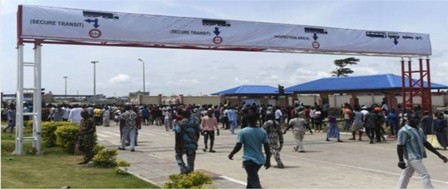
Nigeria shares international boundaries with the Republic of Benin to the west, Cameroon and Chad to the east and Niger, to the north.
Apart from these official borders, the Nigeria Immigration Service (NIS) says more than 1,400 illegal border routes exist in the country as smugglers routes, creating security challenges.
The former comptroller-general of the service, Mr David Parradang, says that although the country has only 84 approved land border control posts, there are also more than 1,400 illegal borders in the country.
But Nigerian authorities note that the porous borders have resulted in crisis in economic sector that has been affecting the development of the country.
So, in August, Nigerian authorities announced and enforced the closure of its border with the Republic of Benin.
The operation under the codename “Ex-Swift Response” was a collaborative security operation involving the Nigeria Immigration Service and Nigeria Customs Service together with Nigeria Police Force and the Armed Forces.
President Muhammadu Buhari attributes the partial closure of Nigeria’s border with Benin Republic to the massive smuggling activities, especially of rice, taking place on that corridor.
He expresses great concern over the smuggling of rice, noting that it threatens the self-sufficiency already attained due to his administration’s agricultural policies.
Similarly, the Comptroller-General of Nigeria Customs Service, retired Col. Hameed Ali, says that the closure of Nigeria’s borders was undertaken to strengthen the nation’s security and protect its economic interests.
Ali also observes that closure would stem the influx of smuggled goods, especially rice and tomatoes into the country, insisting that the closure has significantly increased revenue from import duties.
However, while the government claims to have acted in the best interests of the economy and Nigerians, some Nigerians and citizens of neighbouring countries most affected by the closure, continue to express worry about it, calling for an immediate reopening of the borders.
Some economists believe that the decision to close the nation’s land borders could be painful to the concerned neighbouring countries, considering the relationship with them.
According to them, one of the immediate gains of the closure could be a stop to the dumping of goods from European markets in Nigeria.
They are of the opinion that the action would go a long way in protecting our local manufacturers and producers.
They describe it as policy that would address and redefine relations with our neighbours in a win-win situation.
But critics insist that border closure is an economic aberration as most countries don’t usually close their borders for trade-related reasons.
According to them, the closure has the potential to disrupt the economic lifelines of many traders who depend on legitimate cross-border trade.
Irrespective of this, Emir of Kano, Sanusi Lamido Sanusi, says that the decision to close border is part of the measures to preserve foreign policy in the national interest.
“Last time, I was critical of Nigeria’s refusal to sign the African Continental Free Trade Agreement (ACFTA) and recently I have been in support of the decision to close the border.
“Nigeria is 70 per cent of the population of West Africa and if we have an industrial policy that is aimed at protecting the productive sector of Nigeria, it is a fair competition.
“We cannot allow our neighbours to open their doors to this unfair competition and through the back door undermine our industry.
“It is not about smuggling petroleum or rice; but in 2017, the Republic of Benin was the world’s second largest importer of tramadol, an opioid pain medication that is being abused, to U.S.
“So closing the borders, I hope is not a permanent solution but what I hope is that is an opportunity to sit down and agree on rules and then open up the borders.
“It is extremely important to have a Foreign Policy that is ready to take very firm decision to protect the national interest against dangerous trade activities,” Sanusi observes.
Sharing similar sentiments, Ghana’s former President, John Mahama has lauded the creation of a joint-security taskforce on the borders of Nigeria but warns that the continued delay is harming the economies of the West African region.
Mahama believes that the greatest volume of trade in West Africa takes place in the Lagos – Abidjan corridor.
“I believe that an ECOWAS meeting of the Heads of States should discuss the issues and it could lead to the resolution of the problem.
“So, closing your border is the simplest thing to do; any country can say I’m closing my border to imports from my neighbours, but it doesn’t help to build the kind of integration we are trying to build in West Africa,” he said.
He also expresses the fear that by the time the borders are re-opened, some businesses that rely on each other’s export may have collapsed.
Economists note that one of the immediate consequences of Nigeria’s action is the backlash it will have on Nigerian traders in Ghana.
They allege that more than 400 shops owned by Nigerians have been closed for flimsy excuses that were, hitherto, overlooked.
Nigeria Union in Diaspora also alleges that Nigerian traders in Accra are being harassed and victimised.
In spite of this, authorities in Nigeria, having observed the encouraging changes in the economy, recently foreclosed re-opening of the nation’s borders.
For instance, the Federal Government says 95 per cent of arms and ammunition inflow to Boko Haram insurgent group, kidnappers, killer herdsmen and bandits has gone down considerably.
Minister of Information and Culture, Lai Mohammed, says border closure against importation of foreign goods and illegal immigrants will remain, observing that 296 illegal immigrants have been arrested.
According to him, the decision to close the borders is taken to secure the country which has been confronted by numerous trans-borders economic and security challenges.
“These challenges range from banditry, kidnapping, smuggling, illegal migrants and proliferation of light weapons, among others.
“The preference for foreign goods, especially food items such as rice, has continuously impoverished our farmers and adversely affected domestic government policies supporting the agricultural sector to enhance food security.
“It is, however, disturbing that some neighbouring countries circumvent the ECOWAS protocol on transit.
“ECOWAS protocol on transit demands that when a transit container berths at a seaport, the receiving country is mandated to escort same without tampering with the seal to the border of the destination country.
“Experience has shown that our neighbours do not comply with this protocol. Rather, they break the seals of containers at their ports and trans-load goods destined for Nigeria,” he said.
The minister, who expresses satisfaction with success so far recorded by the joint task force, observed that the singular decision has reduced importation of foreign goods, increased revenue generation and enhanced security.
“On the economy, the partial closure of the borders has curbed the smuggling of foreign rice into the country, in addition to other prohibited items.
“Our series of interactions and engagements with Rice Miller Association of Nigeria since the commencement of this exercise has shown that the border closure has enhanced more production and milling of Nigerian rice.
“Patronage of local rice has increased and farmers are expanding their farms as well as engaging more hands.
“Border closure has also impacted positively on revenue generation which in turn will be used to build more infrastructures and develop critical sectors of the nation’s economy.
“The border closure has also curbed diversion of petroleum products from Nigeria to neighbouring countries,” he said.
Mohammed says further that 95 per cent of illicit drugs and weapons that are being used for acts of terrorism and kidnapping in Nigeria is through porous borders.
“Our conclusion is that the arms and ammunition these terrorists and criminal elements are using no longer gain access into the country.
“The drugs which affect the health and wellbeing of Nigerians have equally been reduced,” the minister said.
He assures the public that government, through diplomatic channels, would continue to engage the nation’s neighbours to agree to comply with the ECOWAS Protocol on Transit.
According to the minister, goods that are on the prohibition list to Nigeria, such as rice, used clothing, poultry products and vegetable oil, should not be exported to the country.
He also notes that the closure has provided a unique platform for the various participating agencies to jointly operate together, thereby strengthening inter-agency collaboration and reducing animosity.
He insists that the purpose of border closure is to promote a secure, peaceful and prosperous Nigeria.
Mohammed, therefore, calls on all Nigerians to be patriotic by patronising local rice to help the country to attain self-sufficiency in local rice production and boost the economy.
Enehikhuere writes for News Agency of Nigeria
By: Julius Enehikhuere



Business
Jonathan, Diri, Others Laud Firm’s Milestone in Bayelsa …Says Project Will Drive Industrialisation, Create Jobs



-

 News5 days ago
RSG Targets Nine Million Residents in Mosquito Net Distribution Campaign
-

 Oil & Energy4 days ago
Aiyedatiwa Signs New Electricity Bill
-

 Maritime4 days ago
Marine Minister Commends President Tinubu On NPERA Bill Assent
-

 Oil & Energy4 days ago
NLNG Commissions Research And Innovation Centre In RSU
-

 News5 days ago
KenPoly Holds Eight Convocations, August 29
-

 News5 days ago
RSG Begins Another Phase of Projects Commissioning Today
-

 News5 days ago
RMAFC Completes Revenue Sharing Review, Proposes New Pay
-

 Maritime4 days ago
NAGAFF Petitions IGP Over Alleged Maritime Police Harassment