
Business
Labour: Leadership Failure And Workers’ Future In Nigeria

The History of all hitherto
existing society is the history of class struggles, Karl Marx.
The organized Labour movement today represents the hopes of the downtroden and poor workers, caged and enslaved by fellow human beings under several guises in the class struggles of survival.
Through the organised labour movement the workers have had the opportunity to resist obnoxious working policies, overcome their enslavement as they are regarded as tools in the exploitative tendencies of the employers and owners of capital in the means of production and reproduction processes.
Also, the organised labour movement through unionisation has helped to galvanise the workers and their affiliate unions to unite and fight for better working conditions from the exploitative employers whose only primary motive is profit maximisation. But the labour movement has now been infiltrated and penetrated by various exploitative tendencies to create disunity and crisis within the once united movement.
Today,from all available indications, there is a complete failure of leadership within the organised labour movement emanating from the rescheduled election of March 12, 2015 in Abuja where officers so elected were not accepted by a faction of the congress.
The outcome of the NLC National election of 2015 factionalised the congress across two lines with two parallel executives at the state level in most States such as Rivers, Edo, Delta, Kaduna, Kano, Oyo, Kwara, among others.
Accordingly, National President of National Union of Petroleum and Natural Gas Workers (NUPENG), Comrade Igwe Achese, said that the root of the crisis within the labour movement was the refusal of the immediate past National President of NLC, Comrade Abduhaweed Omar to keep to the understanding of rotational leadership of NLC between the private and public sectors.
Achese said that there was an understanding that the NLC’s President shall rotate between the private and public sectors and upon that agreement, Comrade Adam Oshiomole from the private sector became the NLC President and consequently handed over to Comrade Abduhaweed Omar of the Nigeria Union of Teachers (NUT) from the public sector.
In keeping with the precedents within the central labour body, some labour leaders and affiliate unions have wanted the private sector unions to produce the NLC National President during the then 2015 National Delegates Election Conference in the person of Comrade Joe Ajaero, secretary general, National Union of Electricity Employees (NUEE) now NLC factional National President.
But the then outgoing NLC President Abduhaweed Omar rather preferred to handover to Comrade Wabba Ayuba of the public sector Union Medical Health Workers Union of Nigeria (MHWUN) as against the precedent in rotational leadership of NLC President.
The crisis of leadership within the NLC has polarised the labour movement into two ideological phase of centripetal and centrifugal l forces of labour struggle in Nigeria.
Thus the centre can no longer hold within the organised labour movement, even for them to speak up against the comatose nature of the economy, high rate of unemployment and ills in the country.
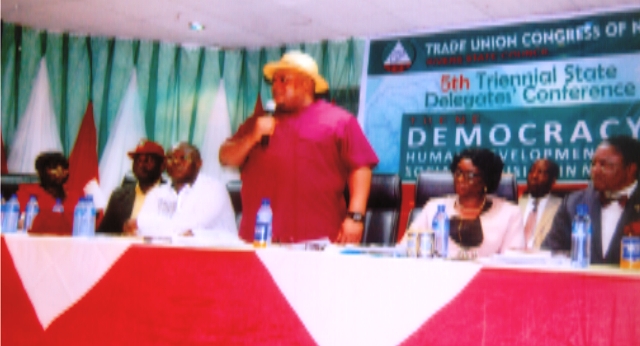
In Rivers State, NLC is factionalised between Comrade Beatrice Itubo and Addah Williams both claiming to be NLC State Chairman respectively, with the Itubo’s faction affiliating to Comrade Wabba Ayuba that is advocating N56,000 minimum wage with its labour headquarters in Abuja, while Comrade Addah Williams affiliating to Comrade Joe Ajaero’s faction advocating N90,000 minimum wage for workers with its labour headquarters in Lagos.
The workers have hoped and expected that the labour crisis could be resolved soon, but that is far from the truth as the lingering crisis persists.
As the leadership tussle rages on, the workers welfare and protection of their rights in the face of the economic reality have been relegated to the background by the factions, rather their individual aggrandisement and economic interest have overshadowed the predicaments faced by workers.
Speaking to The Tide, William said the labour crisis went beyond him and Beatrice Itubo, that the crisis was a national crisis within the labour movement in Nigeria.
The labour leadership crisis has actually eroded their sense of responsibility of rising to the challenges of tackling government to address the downward trend in economic activities and its multipliers effects on planned programmes and policies in both public and private sectors of the economy.
The labour leadership has failed to proffer any alternative platform of constructive criticism of the macro-economic policies of the government both at the State and National levels.
But the Itubo faction said she was the authentic NLC chairman even as she however called on the state government to timeously consider the payment of arrears of salaries of workers as a priority.
On the issue of the Contributory Pension Scheme, the factional NLC chairman, drew the attention of the State Government to the myriad of challenges associated with the implementation of the Contributory Pension Scheme which include non-remittance of contributions of the workers and employees into the retirement savings accounts. Others are the non-sincerity of implementation by the pension fund administrators, the faith of the worker when the amount contributed was exhausted while the worker was still alive.
Equally, Williams said the workers totally reject the monstrous, dreaded, controversial, objectionable and anti-workers policy called, Contributory Pension and rather advocated for the re-introduction of “ONE-STOP- SHOP” for pensioners abandoned by the previous administration.
They both called for the restructuring of the Primary Health Care Management Board for greater efficiency and service delivery by adhering to the provisions of the establishing law of the board which provide that the Medical and Health Worker Union in Nigeria (MHWUN) Rivers State council shall be one of the trustees of the board.
They stressed that the present composition of the board violated this provisions of the law, and they on behalf of the organised labour, demanded that the Health Care Management Board addressed poor producitivity and feeling of disenchantment.
On the issue of enhanced productivity, Itubo calls for prompt conduct and release of promotions across board, provision of imprest and over head cost to head teachers and principals of schools for effective service delivery, restoration of Christmas bonus to the workers which has not been paid for the last three years, Williams also supported the payment of Christmas bonus and called for the stoppage of over deduction with particular reference to check off dues; the need for the provision of logistics and operational vehicles to ministries, departments and agencies as well.
The re-enactment of transparent revolving housing and car loan scheme as well as renovation of sections of the state secretariat complex to ensure conducive working environment.
However, the umbrella employers body, the Nigeria employers Conbullative Association (NECA) has urged the warring factions to reconcile in the interests of the Central Labour Organisation forging a common unity on national issues.
The Director General of NECA, Olusegun Oshinowo said that the disagreement over the leadership of NLC has made negotiations of labour issues difficult for employers in the country.
Speaking to The Tide Comrade Wari Anthony called for the quick resolution of the labour crisis in the country to give focus to the labour movement and ensure that the welfare of the workers are adequately given priority attention.
He said the crisis has affected the organised labour movement in the country to the extent that the labour cannot speak with one voice on the issue of common interest of the workers.
State Chairman Nigerian Civil Service Union (NCSU) Rivers State Comrade Lilly West, said the labour was united in the State and that Comrade Beatrice Itubo remained the authentic Chairman of the NLC in the State and that she commanded the majority support of the affiliate unions in NLC.
Lilly West urged the Williams faction to work with Itubo to . ensure that workers welfare was given priority attention as workers were the live-wire of every state and nation to achieve a vibrant, strong, productive and efficient economy.
It is our contention that the organised labour and their affiliates unions must be repositioned and reinvigorated with a total commitment, dedication, zeal and vista for proper quest of the nation’s economic revival and improvement in the lives of the ordinary people and workers.
They should pre-occupy their minds with proferring drastic actions on how to fix the nation’s economy for more jobs creation, prompt salaries payment to workers rather than unnecessary leadership tussle, supremacy wrangling and brigandage that cannot move the labour movement forward to benefit the workers.
With unity within the labour movement leadership the welfare of the workers would considerably be given priority attention by government at both national and state levels in terms of prompt salaries payment as at when due, prompt release of promotion results, payment of accruing benefit arrears to the workers and improvement in their living condition.




-

 Education2 days ago
FCE Yola Graduates 3,555 Teachers , Seeks Upgrade to University
-

 Sports2 days ago
Nigerian Trio Target Titles At PFL Africa Finals
-

 Niger Delta2 days ago
Diri Restates Stance On Lagos-Calabar Coastal Highway
-

 Niger Delta2 days ago
C’River, NUJ Pay Tribute To Late Guardian Editor
-

 News2 days ago
NDLEA Recovers Tons Of Illicit Drug Consignments In Nine States
-

 Opinion2 days ago
Checking Voter Apathy In Nigeria’s Electoral Process
-

 Politics2 days ago
2027: DICKSON’S EX-ALLY VOWS TO WORK AGAINST NDC INTEREST IN BAYELSA
-

 Politics2 days ago
2027: GROUP PLEDGES 40,000 SUPPORTERS FOR COALITION CANDIDATES IN RIVERS