
Politics
2015: Political Parties And Drums Of War

Nigeria is at the thresh
old of 2015 elections with political assaults, inflammatory statements and of course violence defining events of the moment. Signals across the states of the federation indicate that there is fear in the land as drums of war rage on; an indication that the major stakeholders in the Nigeria’s election project – the political parties and their supporters have not learnt anything from past elections.
If the politicians across the board have learnt any lesson, how come that it is not manifesting in their actions during the electioneering process? Looking at the unwholesome actions of political party members and supporters, one is tempted to ask, “politicians where art thou?”
President Goodluck Ebele Jonathan and his entourage narrowly missed being mobbed in Katsina State by a large crowd chanting ‘Sai Buhari” on January 21 when the President visited the residence of the mother of late President Umaru Yar’Adua at Yar’Adua quarters. The mob reportedly threw stones at Jonathan’s convoy, but thanks to anti-riot policemen and soldiers who acted promptly to disperse the crowd. The ruling Peoples Democratic Party (PDP) pointed accusing fingers at the main opposition party, the All Progressives Congress (APC) for the assault on the President.
In Jos, some irate youths, said to be supporters of the APC, also set ablaze two buses decorated with PDP design and pictures of President Jonathan and his vice. The unfortunate incident occurred two days before the inauguration of the PDP governorship campaign in Plateau State. Before going into rampage and destruction of other vehicles in the vicinity, the youths had also touched vehicles with PDP logo.
The embarrassment suffered by President Jonathan’s re-election campaign team in Bauchi State was another act of provocation and drum of war. At the venue of the event, some people suspected to be APC supporters, threw stones and other objects at the canopy where the President and members of his campaign team were making speeches.
Although the security agents did all within their powers to prevent the hoodlums from disrupting the presidential campaign, there were reports of vandalisation of vehicles belonging to the PDP presidential campaign by the hoodlums.
If the political assaults in Katsina, Plateau and Bauchi States did not record any fatal human casualty, the story in Kano is different as one person lost his life and campaign vehicles numbering about six were burnt after a clash between supporters of the APC and their PDP counterparts.
The political tension in Rivers State and many other states is so high that many believe the polity is sitting on a keg of gunpowder ready to explode. For instance, an explosive device believed to be dynamite rocked the APC secretariat at Okrika in Okrika Local Government Area of Rivers State, prior to the governorship campaign rally in the area.
Apart from blaming PDP in the state for the explosion, Rivers Commissioner for Information and Communications, Mrs. Ibim Semenitari who also doubles as Director of Communications, Dakuku Peterside’s Greater Together Campaign Organisation said a situation in which heavily armed thugs invaded venue of the APC governorship rally in Okrika and opened fire on the workers preparing the rally venue was condemnable and a bad omen to the growth of democracy in the state nay the nation.
The political tension in Rivers State, however, took another dimension when two groups of armed youths reportedly shot at vehicles conveying supporters of the APC from Khana and Asari-Toru local government areas to the inaugural presidential campaign of APC at the Adokiye Amasiemaka stadium, Igwuruta-Eli in Ikwerre local government area of the State. According to reports, only one person died while many others sustained serious injuries.
When some members of PDP and APC clashed in Alimosho area of Lagos State, the story of the 2015 general elections that promise to be the most beleaguered since post colonial rule in 1960, was glaring even as the political parties are locked in an intractable crisis. At the Alimosho attack, no fewer than eight vehicles were destroyed, while an undisclosed number of persons feared dead and others injured.
Is it the type of democracy Nigerians cherish to have and sustain? The answer is definitely no. While the political parties, supporters beat the drums of war, they are equally busy trading blames and accusing each other over any form of political violence.
The PDP, in a statement, had accused the opposition party (APC) of instigating attacks on President Jonathan and his ruling party. But APC lashed back, claiming that the hostilities were the handwork of PDP in order to justify its ploy for the shifting of the 2015 general elections.
Memories of 2011 general elections in which hundreds of lives were killed in post-election violence, are still fresh in the minds of many Nigerians. Apart from leaving in its trail the features of misery, anguish and bitterness, the post-election riot of 2011 also left the country deeply divided along religious and ethnic lines.
Nigerians are apprehensive of an impending danger in the air. Against this background, a former head of state, Gen. Abdulsalami Abubakar (rtd) recently met with the service chiefs and the Inspector-General of Police, warning that the 2011 post-election violence should not be repeated in 2015. Abdulsalami, who spoke in his capacity as the Chairman of National Peace Committee on 2015 Elections, said there is apprehension in the land, urging Nigerians not to repeat the mistakes of the past. The committee was a fallout of the peace accord signed by party presidential candidates and their chairmen.
If the concern of the ex-Head of State is anything to go by, then “any Nigerian who loves this country must preach peace” because the wind of violence does not bring any good.
The pronouncement by the APC to form a “parallel government” should the 2015 elections be rigged amounts to heating the polity. The same is also true of the threat by a coalition of former Niger Delta militants and their followers that any attempt to unseat President Jonathan in the forthcoming election would be a direct attack on the Ijaw people and would be met with violence.
The ex-militant leaders, at the end of a crucial meeting with Bayelsa State governor, Seriake Dickson, in Yenagoa, said Jonathan’s anticipated victory in the election is non-negotiable, threatening to unleash violence and deny the rest of the country access to the oil fields in the region if Nigerians fail to re-elect the President.
The reactions of the ex-militant leaders, according to reports, followed recent attacks on President Jonathan during his campaign tour of parts of the North and other issues affecting the Ijaws.
However, elections are not war. Neither is politics a battle. Political leaders and their supporters must adhere to the code of conduct of political parties, especially in the areas of consolidating and deepening democracy, ensuring an environment conductive for successful and non-violent elections, political stability, enduring democracy and the overall wellbeing of Nigerians.
Why the threat of a parallel government or violence in the event of any shortcoming in the elections when the rule of law is there to guide every political activities and actions? As a matter of necessity, all political parties, their leaders, members and supporters should endeavour to adhere to existing laws and regulations pertaining to elections and the conduct of elections and should not do nothing whatsoever, individually or collectively to undermine, flout, disrespect or circumvent them.
Just as the political parties lack visible internal party democracy, it is not uncommon to see them engage in violent activities or resort to the use of inflammatory comments, provocative actions, or manifestations that incite violence, hatred, contempt etc. All political parties and members have crucial role in ensuring a free, fair, credible and non-violent elections. And it is not late for politicians who have fallen short in their utterances and actions to have a rethink in the interest of national peace, unity, stability, and development.
The signing of the peace pacts though commendable, the government should go a step further in bringing to justice those who incite violence before, during and after elections no matter how highly placed.
Election is not only about winning or losing contest. Importantly, it is about creating and sustaining an enduring society in which nobody should be sacrificed for others to win or lose. And elections will work only when major players like the political parties and their supporters are willing and committed, irrespective of party affiliations, to make such elections work.
Samuel Eleonu
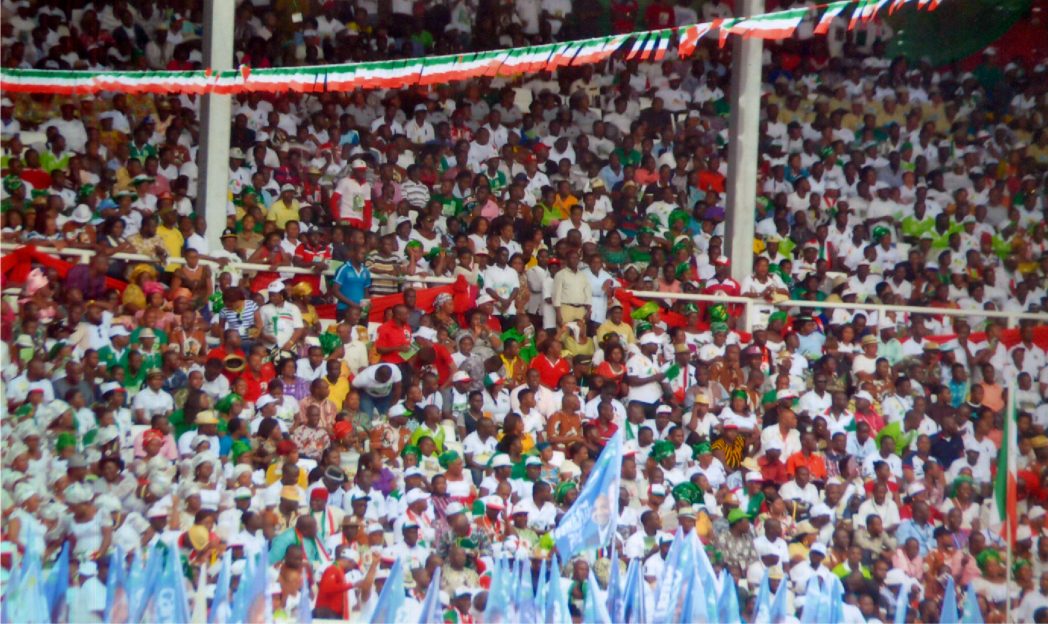
A mammoth crowd during a campaign rally in Port Harcourt, recently



The Independent National Electoral Commission (INEC) has extended the deadline for political parties to submit the list of candidates for the 2027 governorship and state Houses of Assembly elections from Saturday, August 8, to Tuesday, August 11, 2026.
The commission announced the extension in a statement issued on Saturday and signed by the National Commissioner and Chairman of its Information and Voter Education Committee, Mohammed Haruna.
According to INEC, the decision followed appeals by political parties for additional time to complete the submission process through the dedicated online portal.
“The submission window, which according to the revised Timetable and Schedule of Activities for the General Election was originally scheduled to close on Saturday, 8th August, 2026, has been extended to Tuesday, 11th August, 2026,” the commission said.
In a a related development, INEC announced the suspension of PVC collection in Osun State ahead of the August 15 governorship election.
The commission said voters who applied for replacement of lost, damaged or defaced Permanent Voter Cards would have until midnight on Sunday, August 9, to print downloadable copies of their cards.
The electoral body explained that the deadline was necessary to enable it compile data on downloaded PVCs and produce final statistics on the total number of cards collected ahead of the election.
INEC said PVC collection in Osun commenced at the Registration Area level from July 22 to 28, 2026, but was extended to July 31 following complaints about large crowds and difficulties experienced by voters at collection centres.
The exercise subsequently moved to the local government level and ran from August 1 to 7.
The commission also disclosed that replacement downloadable PVCs had been made available to voters in Odo-Otin and Ife Central Local Government Areas following the theft of cards during attacks on the two collection centres.
It stressed that the stolen cards could not be used to vote.
INEC reassured Osun residents of its preparedness for the August 15 governorship election.
“The commission reiterates that the stolen cards cannot be used to vote.
“INEC reassures the people of Osun State of its readiness to conduct a free, fair, credible and inclusive governorship election on 15th August, 2026,” the statement said.
The commission said the deadline, initially set for Saturday, 8 August, has been extended to Tuesday, 11 August 2026, following appeals from political parties for more time.
INEC also announced that the window for voters who applied to replace lost, damaged or defaced PVCs to download their replacement cards will close at midnight on Sunday, 9 August.
The move is to enable the commission compile final PVC collection figures ahead of the 15 August Osun governorship election.
INEC said replacement downloadable PVCs have also been provided to affected voters in Odo-Otin and Ife Central Local Government Areas after hoodlums carted away cards from two collection centres, stressing that the stolen cards cannot be used to vote.
The commission reaffirmed its readiness to conduct a free, fair, credible and inclusive election in Osun State.
Gov. Kefas made the remarks over the weekend at the Federal Medical Centre (FMC), Jalingo, during the flag-off of the second phase of the Renewed Hope Medical Outreach in Taraba State, organised as part of activities marking Prof. Yilwatda’s 58th birthday.
The governor commended Prof. Yilwatda for choosing to mark his birthday by providing medical care to people in need.
“What Professor Nentawe did is a powerful demonstration of what leadership should be,” Gov. Kefas said.
He assured that his administration would continue to support initiatives that complement government efforts to improve healthcare delivery and the wellbeing of residents.
Speaking at the event, Prof. Yilwatda called on Nigerian leaders to embrace the culture of giving and use their positions to touch the lives of the less privileged.
He said his decision to celebrate his 58th birthday in Taraba State was deliberate and informed by the needs of underserved communities, particularly people who face difficulties accessing healthcare because of distance and financial constraints.
According to him, the intervention followed a needs assessment and was extended across the three senatorial districts of the state.
He said the exercise commenced on August 3 at Takum General Hospital and covered the Federal University Teaching Hospital, Wukari; First Referral Hospital, Sunkani, Ardo-Kola Local Government Area; General Hospital, Bali; General Hospital, Gembu; and FMC Jalingo.
Prof. Yilwatda said the intervention provided medical services to thousands of beneficiaries, including people who required surgical procedures.
He said sustainable national development could only be achieved when strong institutions placed Nigerians at the centre of development.
“Leadership is about service,” he said, urging political and public leaders to make giving back to society an important part of their responsibilities.
He reaffirmed his commitment to serving Nigeria and its people, saying his personal vision was to make every day of his life useful to humanity.
“Every day that I live, the vision is: let it be useful to humanity,” he said.
The Taraba State Commissioner for Health, Dr. Bordiya Buma, commended the initiative, saying it was consistent with the Renewed Hope agenda and efforts to strengthen healthcare delivery in the state.
Dr Buma said the second phase followed the successful completion of the first phase, which was conducted simultaneously in six local government areas, with two LGAs selected from each of the three senatorial districts.
According to him, more than 10,000 patients were attended to during the first phase, including people with medical and surgical conditions.
He disclosed that 327 general surgeries, 71 eye surgeries and 575 dental procedures were carried out during the exercise.
The commissioner expressed appreciation to President Bola Tinubu for the Renewed Hope Medical Outreach and thanked Prof. Yilwatda for supporting the initiative and choosing Taraba State as a beneficiary.
The Minister of Health and Social Welfare, Prof. Muhammad Ali Pate, also commended Prof. Yilwatda for choosing Taraba State to mark his 58th birthday through a medical outreach.
Prof. Pate said making healthcare the centrepiece of the birthday celebration was significant because health affects everyone.
-

 News3 days ago
RSG Targets Nine Million Residents in Mosquito Net Distribution Campaign
-

 Oil & Energy3 days ago
Aiyedatiwa Signs New Electricity Bill
-

 Maritime3 days ago
Marine Minister Commends President Tinubu On NPERA Bill Assent
-

 Oil & Energy3 days ago
NLNG Commissions Research And Innovation Centre In RSU
-

 News3 days ago
KenPoly Holds Eight Convocations, August 29
-

 News3 days ago
RSG Begins Another Phase of Projects Commissioning Today
-

 News3 days ago
RMAFC Completes Revenue Sharing Review, Proposes New Pay
-

 Maritime3 days ago
NAGAFF Petitions IGP Over Alleged Maritime Police Harassment