Connect with us

Maritime

FOU Zone Customs Impounds N1.01bn Worth Goods

Published

on

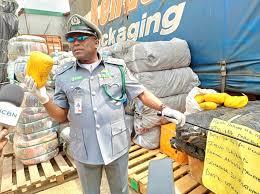
The Federal Operations Unit Zone ‘C’ Owerri of the Nigeria Customs Service (NCS) has said it made seizures of illicit goods worth N1.010billion and generated a revenue of N13.45million from Demand Notices.
According to the command’s Public Relations Officer, R. Nche, who disclosed this in a press statement made available to The Tide in Lagos, the new Controller of the unit, Comptroller Bashir Abdullahi Balogun, disclosed this information during his first press briefing at the unit’s headquarters in Owerri, which took place onThursday.
Frowning at the activities of smugglers, the Controller of the unit stated the damages of smuggling, describing it as “economic sabotagex.
He said, “bringing in prohibited goods into the country would hurt the nation’s local industries and affect the well-being of individuals”.
The seized goods include 725 bales of second-hand used clothing; 2,762 rolls of satin fabric of 60 yards; 2,589 used tyres; 233 sacks of 2kg foreign rice; 181 rolls of wall covering; 102 bottles of 75cl diesel; 80 Jerry cans of 25 litre of PMS (Calabar); 78 Jerry cans of 25 litres crude oil; 32 new tyres; 25 bales of cannabis sativa; and 24 bottles of 150cl of diesel.
Others  are 14 bags of 50kg foreign rice; three cacharte red wine; one sack of used shoes; one scannia container body truck Reg No: T 281 A2LA; one Mercedes Truck with Reg No: NKE 323 XE; two Mack Trucks with Reg Nos: XB654-BNY 2001 and APP 808 XA; two X 40 FT empty container; and five PCanadian loud.
Comptroller Bishir stated that no matter the intentions of smugglers and their patronisers, the unit will not relent in carrying out its statutory functions, which are backed up with intelligence-driven strategies by the Comptroller General of Nigeria Customs Service, Bashir Adewale Adeniyi.
The Controller of the unit, while commending officers/men of the unit during the briefing, anchored his successes on focus, diligence, professionalism and the decision to contribute his quota to the national economy, by blocking all revenue leakages, enforcement of trade facilitation and taking charge of the nation’s entry points which is of uttermost importance to the unit.
The seized cannabis sativa was handed over to the National Drug Law Enforcement Agency (NDLEA).

“These timely successes and achievements are a result of the purposeful leadership of the Comptroller General of Customs, high level of professionalism, commitment, and teamwork.

“The unit is also determined to sanitize the zone of any form of un-customs activities and facilitate legitimate trade.

“NCS is committed to the consolidation of successes achieved, collaborative engagement with critical stakeholders, and innovative ideas in its dealings to ensure efficiency and effectiveness in customs operations”, he said.

The Controller commended the media for their continuous support and for spreading the gospel. He called on them not to relent, urging them to continue with the advocacy and campaign against illicit trade within and across the nation’s borders.

“Nigerians should support the service with the necessary information and intelligence that will assist in effectively discharging our statutory functions to protect lives and the nation’s economy to better the lives of Nigerians at large”, the CAC stated.

Continue Reading

Maritime

NSC Decries Police Interferences With Cargoes At Seaports

Published

on

The Nigerian Shippers’ Council (NSC) has decried interferences with cargoes by police at the seaports.
NCS said such action has disrupted cargo dwell time, increased demurrage and storage charges payable by consignees.
Executive Secretary, NSC, Dr Pius Akutah, made this known at a one-day training programme for officers of the Maritime Police and other security stakeholders, in Lagos.
The training with the the theme: “Facilitating Port Efficiency: The Strategic Role of the Police,” was organised by the NSC in collaboration with the Maritime Police Command of the Nigeria Police Force.
Represented by the Director, Regulatory Services Department, NSC, Mrs Margaret Ogbonnah, Akutah said that police interference with cargoes had also led to increase in the cost of doing business in Nigerian ports.
He noted that several reports brought to the attention of the NSC by stakeholders pointed to incessant interference in the cargo clearance processes, placement of detention orders on duly cleared cargoes, thereby barring its exit from the port terminals.
Akutah said that port operators, especially personnel of shipping line agencies and terminals, also complained of intimidation by the police officers, who, in turn, claim that they are acting on intelligence reports.
The Secretary explained that the council had on several occasions carried out investigations on the matter to ascertain the veracity or otherwise of the claims.
He said that intimidation of ports operators had in most cases been confirmed, adding that these practices were carried out by various police formations without the knowledge of the Assistant Inspector General of Police (AIG).
“This development, therefore, led to robust engagement by the council with the Inspector General of Police (IGP) to put a stop to these practices and to ensure adherence to process in matters of container detention and other port related issues.
“As a result, the Assistant Inspector General AIG, Maritime Police Command notified key stakeholders vide a letter dated Dec. 11, 2018 about its decision to collectively streamline the plethora of letters being issued by various un-authorised persons on behalf of the Police.
“The IGP also directed all key stakeholders to disregard any correspondence without the signature of the AIG or officers nominated by him.
“Together, we have achieved quite a lot, although we cannot rest on the past achievements because some of these infractions still occur either deliberately or due to ignorance on the part of the officers involved.
” Our main focus has to be firmly on attaining international best practices”.
“In essence the meeting between the NSC and the Inspector General of Police; the issue of capacity building for officers of the maritime police was discussed in order to enlighten and educate them on the nitty-gritty of port operations and the role of the police,” Akutah said.
Also Speaking, Assistant Inspector General of Police, Chinedu Oko, represented by the Assistant Commissioner of Police Administration, Ports Authority Police (Western) Command, Olufikayo Fawole, explained that the Maritime Police, was a specialised arm of the Nigeria Police Force.
Fawole said that the maritime police played a critical role in securing maritime assets, mitigating threats, combating cargo-related crimes, preventing pilferage and vandalism, and ensuring the smooth flow of legitimate trade.
“Our mandate is not just to enforce the law but also to protect the economic lifeblood of our nation.
“Nigeria’s competitiveness in the global maritime economy is influenced greatly by the level of safety, predictability, and confidence that stakeholders experience at our ports.
“This is why continuous training is essential. The operational landscape is evolving, new technologies, changing criminal patterns, multimodal logistics, and international compliance requirements all demand that our officers become smarter, more proactive, better informed, and better equipped.
“Through this programme, participants will gain valuable insights into modern port operations, cargo handling procedures, supply-chain vulnerabilities, and best practices for promoting trade facilitation while maintaining robust security,.
The AIG pledged the police’ continuous commitment in ensuring secure port system, adding that the force would contribute more to national prosperity, economic stability, and Nigeria’s overall competitiveness in global trade.
Continue Reading

Maritime

NIMASA :FG Appoints Iyelolu As Registrar Of Ships

Published

on

The Minister of Marine and Blue Economy, Chief Adegboyega Oyetola, has approved the appointment of Barrister Adenike Adeyele Iyelolu as the Registrar of Ships
 for the Federal Republic of Nigeria.
Her appointment, which is for a four-year tenure, follows the recommendation of the Director General of the Nigerian Maritime Administration and Safety Agency (NIMASA), Dr. Dayo Mobereola.
In line with the NIMASA Act 2007, the Registrar of Ships will report directly to the Director General for the effective administration of the Nigerian Ship Registry.
The Act provides that “the Registrar of Ships shall, with the approval of the Minister, be appointed by the Director General from among the staff of the Agency.”
According to a press statement issued by the Head of Public Relations, NIMASA, Edward Osagie, the new Registrar who is currently a Deputy Director in the employ of NIMASA is an accomplished legal and maritime governance professional with over twenty-five (25) years of post-call experience spanning maritime and legal practice, arbitration, procurement, contract administration, corporate governance, and institutional leadership amongst others.
Barr. Iyelolu’s appointment comes following the retirement of the former Registrar of Ships, Barr. Tajudeen Giwa, after years of commendable service.
Continue Reading

Maritime

Cargo Tracking System’ II Save Nigeria N900bn In Revenue Leakages ……SEREC

Published

on

The Sea Empowerment and Research Centre (SEREC) says implementing the International Cargo Tracking Note (ICTN) will save Nigeria an estimated N900 billion annually in revenue leakages.
Head of Research at the Centre, Dr Eugene Nweke, stated this in a document on its policy commentary on
the Urgent Imperative of Implementing the ICTN in Nigeria, and made available to newsmen.
Nweke said that the system, when implemented, could cut cargo clearance time by 25 to 35 per cent and curb trade malpractices by 40 per cent within 18 months, boosting Nigeria’s competitiveness and credibility in the regional maritime economy.
The Director described ICTN as a trade facilitation system aimed at improving transparency, security and efficiency in Nigeria’s ports.
According to him, it enables pre-arrival processing of cargo data for faster clearance, reduces demurrage and documentation time, curbs illicit trade, closes revenue leakages and enhances Nigeria’s competitiveness in global maritime trade.
He disclosed that the Nigerian Shippers’ Council (NSC), under the supervision of the Federal Ministry of Marine and Blue Economy, is the lead agency implementing the ICTN.
“The NSC would do it in collaboration with the Nigeria Customs Service (NCS), the Nigerian Ports Authority (NPA) and the Nigerian Maritime Administration and Safety Agency (NIMASA)”
He expressed concern that in spite of the Federal Executive Council approval of the implementation of the ICTN in 2023, it was yet to be implemented.
“Without this pre-verification system, Nigeria’s trade regulators would continue to operate in a reactive intelligence model, allowing room for cargo concealment, under-declaration and falsified manifests.
“Experts estimated that the delay in implementation could lead to an estimated annual loss from non standardised cargo declarations and transshipment concealment between N800 billion and N1.2 trillion.
“Ghana, Senegal, Ivory Coast, and Angola recorded an 18 to 22 per cent rise in customs revenue and a 30 per cent drop in port clearance delays within two years of adopting ICTN.
“The countries also saw a 40 per cent fall in false declarations during the same period.
“The delayed implementation could also affect the smooth implementation of the National Single Window (NSW) projected for the first quarter of 2026 and the modernisation drive of the Nigerian Customs Service,” he explained.
Nweke added that with customs modernisation advancing rapidly and the NSC approaching rollout, Nigeria must not operationalise these systems without ICTN integration or risk reinforcing data fragmentation.
“Government must recognise ICTN not as a competing system, but as a strategic enabler of all other reforms.
“The ICTN should serve as the data feeder layer into the National Single Window, Customs modernisation and port efficiency frameworks,“ he stated.
The Director also noted that although various digital modernisation efforts were underway in the maritime sector, the ICTN remained the key missing link needed to fully integrate trade intelligence across the system.
He emphasised that the continued delay in ICTN deployment poses critical national risks, including revenue leakage, national security exposure, reputational deficit and a fragmented digital ecosystem.
“The absence of verifiable pre-shipment data weakens Nigeria’s ability to detect high-risk or illicit consignments (arms, drugs, waste cargo, etc.) before arrival.
“Nigeria remains among the few major trading nations in West and Central Africa without an operational electronic cargo note system, affecting investor confidence in its maritime sector.
“It has also impacted the country’s compliance ratings under the World Customs Organisation (WCO) SAFE Framework of Standards and the International Maritime Organisation (IMO) International Ship and Port Facility Security (ISPS) guidelines”, Nweke said.
By: Chinedu Wosu
Continue Reading

Trending