
Featured
Tinubu Promises To Reconstruct Eleme Axis Of East-West Road …Thanks Rivers For Support To FG

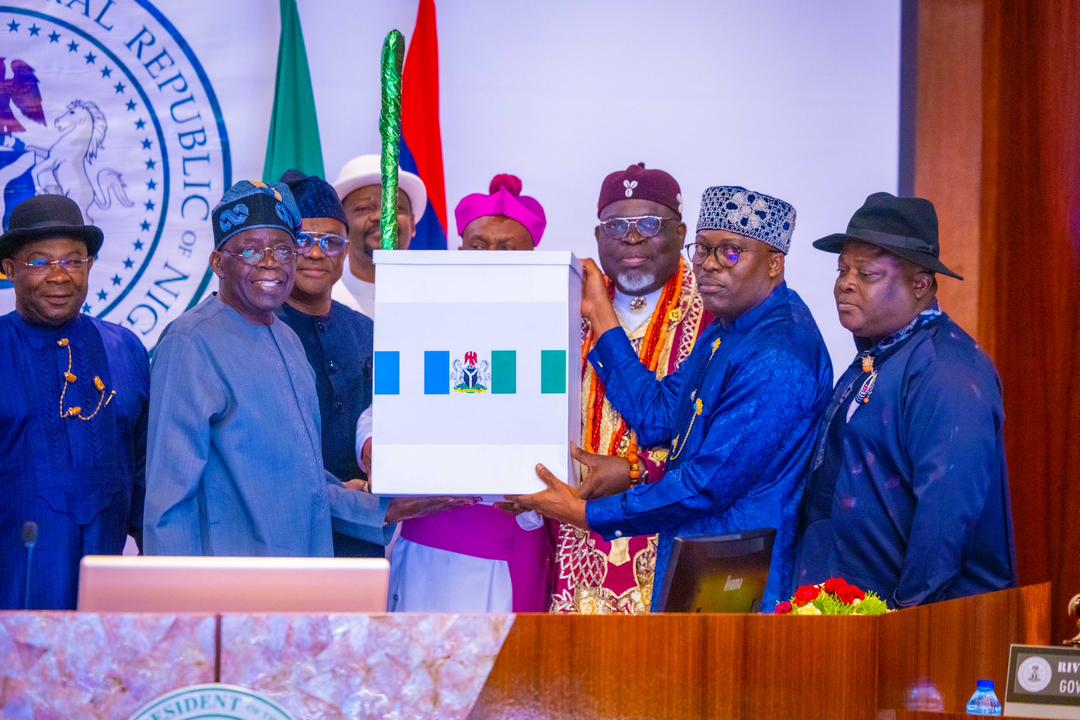
Blessed with enormous human capacity and natural resource wealth, President Bola Tinubu yesterday in Abuja, said that neither Rivers State nor Nigeria has any business being associated with poverty, insecurity or under-development, assuring that under his leadership, the narrative will be permanently and positively changed.
Welcoming a high-powered 62-man delegation, comprising leaders from both the governing All Progressives Congress (APC) and the opposition Peoples Democratic Party (PDP), to the State House, the President said the Honourable Minister of the Federal Capital Territory, Nyesom Wike, has left big shoes to fill for the new Rivers State Governor, Siminalayi Fubara, and that as one of his most trusted allies, Rivers State will always have direct access to him in their joint march toward sustainable development.
“We are not meant to be in a position to be poor. We will turn the tide! Somewhere, somehow in this storm, there’s a quiet and peaceful place for us. We will locate it!
”We are not lazy people. We are richly endowed. We just need to be our brother’s keeper, and good neighbours to one another. I am not a President that will give excuses. I will work hard for our nation with purpose, determination and dedication to create wealth for all Nigerians. We have no reason to be poor! We will not look back, we will run aggressively forward.
“Today, we may be swimming against the tide. But the waves will soon propel us forward from behind. We will achieve the goals and dreams of our forefathers. I am inspired by the nation of people I now lead,” the President thundered.
President Tinubu noted that concerning infrastructure development in Rivers State, he had heard the cries of prominent Rivers sons, with particular reference to the Eleme Junction-Onne axis of the East-West Road, linking the Port Harcourt Refinery. On this, the President said the FCT Minister, Nyesom Wike, is a strong adviser, and would follow up on the issue for prompt action.
“The Honourable Minister, Wike, is not just the Minister of FCT, he is also my adviser and an admirer of mine. He has hit the ground running and he should be encouraged by the State,” the President affirmed.
Advising the younger generation to be more patient with the processes of government, the President said, “I am the Captain and Chief Salesman of the country. We have to reverse the trend and achieve possibilities within a short period of time. Our people have high expectations for us. I pledge to work hard, and I pray to God to put me on the right path, not to disappoint Nigerians,” the President concluded.
In his remarks, the Rivers State Governor, Siminalayi Fubara, told the President that the delegation, which included leaders of political parties, and past and present members of the State and National Assemblies across parties, was on a solidarity and thank you visit.
“The people of Rivers State voted for you in the last general elections based on their belief in fairness, equity and justice. This is the first time that Rivers State is truly feeling the impact of the federal government since the inception of democracy in 1999,” he said.
The Governor noted that the delegation greatly appreciated the President for appointing capable sons and daughters of the state into highly strategic positions within his administration.
The Governor particularly thanked the President for the appointments of the Honourable Minister of the Federal Capital Territory, Barr. Nyesom Wike; Special Adviser to the President on Media and Publicity & Official Spokesperson of the President, Chief Ajuri Ngelale, as well as other sons and daughters of Rivers State into the Boards and Management of the Niger Delta Development Commission (NDDC) and other institutions.
The Governor applauded the President for attracting a $14 billion dollars investment approval for projects nationwide during the G-20 Summit, including the expansion of Indorama Petrochemicals in Eleme, Rivers State, adding that the State had just allocated 209 hectares of land in support of the new investment.




Featured
JUNE 12: Democracy Remains Nigeria’s Strongest Path To Unity, Progress, Says Fubara ….Extols Abiola, Wife


Governor of Rivers State, Sir Siminalayi Fubara, has reaffirmed that democracy remains the most effective system of government for Nigeria, given the country’s rich diversity of ethnic, religious, and cultural identities.
In a goodwill message to Nigerians on the occasion of the 2026 Democracy Day celebration, Governor Fubara said June 12 represents far more than a historic date; as it embodies the enduring struggle, sacrifice, and collective aspiration of Nigerians for freedom, justice, and representative governance.
The Governor extended warm felicitations to Nigerians at home and in the Diaspora, paying tribute to the heroes and heroines of the democratic struggle, particularly Chief MKO Abiola, his wife, Kudirat Abiola, and countless others whose courage and sacrifices helped secure the democratic freedoms Nigerians enjoy today.
According to him, “June 12 is a reminder of the price paid for the democracy we enjoy today. The sacrifices made by Chief MKO Abiola, Kudirat Abiola, and many other patriots who laid the foundation for the democratic journey we continue to enjoy today. Their commitment to the principle that power must ultimately reside with the people remains a source of inspiration for every generation of Nigerians.”
Governor Fubara noted that thirty-three years after the historic June 12, 1993 election, Nigeria’s democratic experiment has continued to evolve despite challenges and setbacks.
“Our democratic journey has not been without difficulties, but the resilience of our institutions and the determination of our people have kept the nation moving forward. The ability to express differing opinions, engage in constructive debate, and peacefully choose leaders through the ballot remains one of the greatest achievements of our nation,” he said.
Governor Fubara stressed that democracy provides the best framework for managing Nigeria’s diversity and transforming it into a source of national strength.
“Nigeria’s diversity should never be seen as a weakness. Properly harnessed, it is our greatest asset. Democracy offers us the opportunity to build consensus, promote inclusion, strengthen national unity, and create the conditions for sustainable development and shared prosperity,” he said.
Governor Fubara commended President Bola Ahmed Tinubu, for his commitment to the Renewed Hope Agenda and ongoing efforts aimed at economic revitalization, strengthening security, and deepening democratic institutions across the country.
He reiterated the readiness of Rivers State to continue partnering with the Federal Government in advancing policies and programmes that improve the lives of citizens through infrastructure development, job creation, enhanced security, quality education, healthcare delivery, and good governance.
The Governor further called on Nigerians, regardless of political affiliation, ethnic background, or religious belief, to use the occasion of Democracy Day to renew their commitment to the Nigerian project and the ideals that underpin democratic governance.
“Democracy must not be viewed merely as a periodic electoral exercise. It must be reflected in our daily commitment to accountability, transparency, tolerance, justice, respect for the rule of law, and responsible leadership. As citizens and leaders, we all share a collective responsibility to strengthen our democracy and build a nation that future generations will be proud to inherit,” he said.
Governor Fubara expressed optimism about Nigeria’s future, urging citizens to remain united, hopeful, and committed to the values of peace, dialogue, and national development.
“Together, we can build a stronger, more inclusive, and more prosperous Nigeria where every citizen has the opportunity to thrive and contribute meaningfully to national progress,” he said.

Governor of Rivers State, Sir Siminalayi Fubara, has reaffirmed the unwavering commitment of his administration to peace, unity, security, and inclusive development as Rivers State marked its 59th anniversary, last Wednesday.
In a goodwill message issued on Wednesday to commemorate the anniversary, Governor Fubara stated that despite the challenges faced over the years, the people of Rivers State have continued to demonstrate resilience, strength, and an enduring spirit of unity that has sustained the state since its creation.
The Governor noted that the strong bond of brotherhood among the various ethnic nationalities of the state, including the Ijaw, Ikwerre, Ogoni, Etche, Ekpeye, Andoni, Kalabari, and others, remains one of Rivers State’s greatest strengths and a critical foundation for peace, stability, and progress.
He further observed that Rivers State has remained a major driver of Nigeria’s economy for decades, not only because of its abundant oil and gas resources, but also because of the exceptional contributions of its people across diverse sectors including academia, jurisprudence, business, entertainment, public service, and sports.
Governor Fubara assured the people that his administration will continue to prioritize policies and programmes that promote peace, protect lives and property, and expand development across all parts of the state. He emphasized that governance must be people centered and impactful, with equal attention given to every Local Government Area of the state.
The Governor also paid tribute to the elders and founding leaders of the state for preserving the spirit of unity and coexistence over the years, while urging the youths to remain hopeful, responsible, and actively committed to building a greater Rivers State through innovation, hard work, and patriotism.
He equally acknowledged the invaluable role of women in strengthening families, communities, and society, describing them as indispensable partners in the continued growth and stability of the state.
Governor Fubara called on all Rivers people to use the occasion of the anniversary as a moment of reflection and renewed commitment to peaceful coexistence, mutual respect, dialogue, and collective progress, stressing that the unity and future of Rivers State must always rise above personal interests and political differences.
Rivers State was created on May 27, 1967, by General Yakubu Gowon.
