
Editorial
Hurray, Nigeria Is 62!

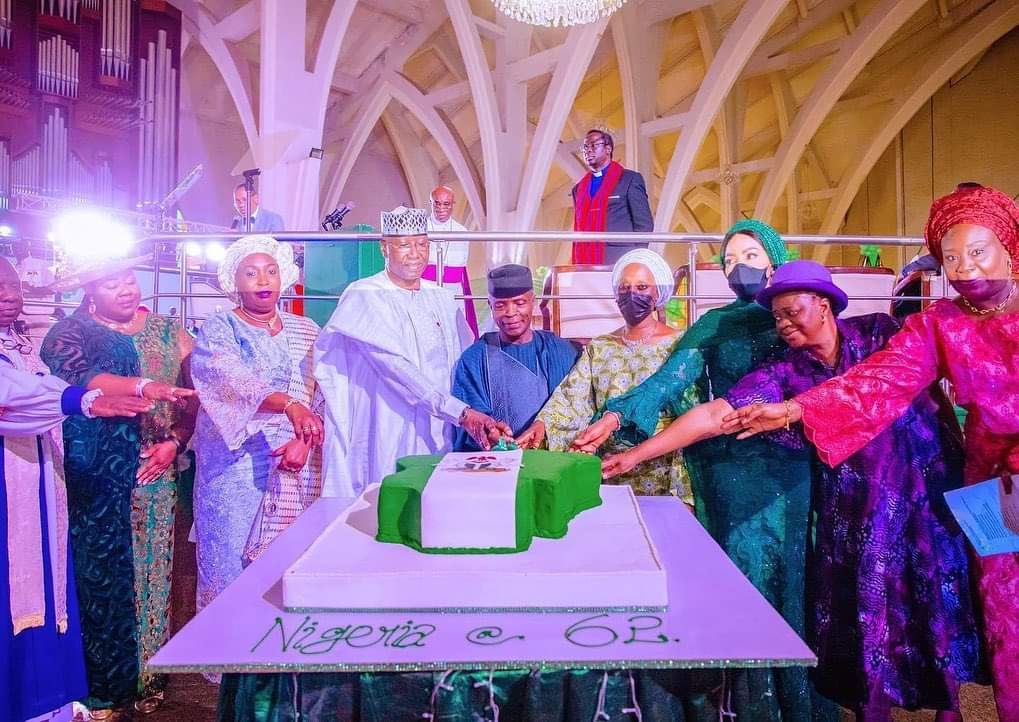
Instead of grappling with the elevating issues of development, the country’s over 200 million population and more than 250 ethnic nationalities are smouldering with dissatisfaction about the present, and anxious about a precarious future. Now, the grand promise and hope of “unity in diversity” lie in bloody ruins, and separatist agitations have again taken a centre stage in national politics. If the years of military dictatorship are seen as “years eaten by locusts,” then the inhumane descent of Nigeria today can be said to be “more years eaten by the locusts.”
Every sector of our national life has been affected, from governance to the economy, security and national cohesion. Setbacks and deficits in each area of development define the country. Traumatised, abused and oppressed, young people have lost hope in the country. Just like in 1966, Nigeria is once again on the fast track to the point of no return. All Nigerians should be well-meaning enough to embark on conscientious sober reflection on the state of the nation.
Successive leaders have abandoned our founding fathers’ dream of Nigeria and replaced it with a motive for self-aggrandizement. The country is torn apart, the people are poor, life and property are insecure, and life is worthless. Now and then, we witness Nigerians loathe their country and spit out the worst abuse on their homeland. While the wealthy have acquired foreign citizenship for themselves and their families, others are working frantically to do so or emigrate from Nigeria.
This is Nigeria for the next generation of leaders: a disillusioned, morally weak, socially divided, religiously lost and economically stupefied country. This is not the way of a truly independent nation. To chart a path to progress, however, Nigeria needs people with big dreams, especially those who do not want to do things the usual way. To justify any independence claim, Nigerians must first determine the basis for their assertion to independence.
Nigeria’s problems are foundational. What we have is a corporate catastrophe. The country is a complicated, intricate, and flummoxing organism where wrongs rule and doing right is impossible. Do the different people who make up the nation see themselves as Nigerians in the first place? Or do they profess allegiance to their clan or tribe as their most basic identity? Nigerians require a sense of national pride and ethos that draws on all the values, spirits, and cultures of different peoples.
To this end, the political class and ruling elite must not place one part of the country above other parts or treat other parts as second-class citizens. Leadership is not racial domination or selfish power imbalances; rather, it is a tendency to truly carry out a mission for the common good. President Muhammadu Buhari should accept that under his leadership, Nigeria has witnessed its worst reversal ever. Leaders and followers must do their best to ensure that they aspire to a new and better Nigeria.
As she commemorates the 62nd anniversary of independence, Nigeria’s top priority should be leadership in Africa and the black world. The country is naturally given this leadership role, and she has indeed played a convincing role in her past activities on the African continent and abroad. Leaders should look to the exemplary and inspiring role this country can play 50 years from now. However, this will only happen if Nigeria shakes off the incompetence, and greed ingrained in its leadership.
What is there to celebrate is the tenacity of Nigerians in their decision to have their country despite a repeated siege by various outlaws. These Nigerians include farmers and locals trapped in terrorist and bandit enclaves, schoolchildren being hunted back and forth, disillusioned women and children in IDP camps, soldiers in trenches and police officers who sacrifice their lives, and lonely Nigerians who every day hope in God that this too will pass. It is these Nigerians who hold this country together and deserve the greatest courtesy.
Economically, Nigeria has fallen behind its peers. Diversification gave way to a single product model. Agriculture was once the backbone of the country and its defunct regions, contributing more than 60 per cent of Gross Domestic Product (GDP) in 1960. Today, it is a paltry 22.13 per cent of nominal GDP by June 2021. The Central Bank of Nigeria says oil and gas contributed less than 1.0 per cent of GDP and 6.65 per cent of export earnings in 1961, but contributed 47.72 per cent of GDP and 98.72 per cent of export earnings in 2000.
Despite successive governments’ efforts to industrialise the country and achieve sustainable economic growth, stakeholders in the real sector believe that the economy is gradually declining. Industrialisation, seen as the only means to achieve economic growth and development, remains unfulfilled 62 years after the founding of the nation. The scarcity of industry, stunted growth in manufacturing, rising unemployment, and lack of food and investment, among others, remain a great challenge.
Infrastructure has failed to pace with the tremendous population growth assessed at 45.14 million by the United States Census Bureau in 1960, to the estimated 211 million in 2021. Roads, airports, ports, and power are inadequate, requiring $3 trillion to fix, says the African Development Bank. In human development, failure is writ large. Whereas the poverty level was 15 per cent at independence, it averaged 27.2 per cent from 1980 to 2010 and reached 69 per cent by 2011.
Nigerians must vote wisely in the next year’s general elections by choosing a good leader. They have to be astute in their voting and avoid elevating needless issues. Nigerians should never again elect nepotistic, tribalistic and religious fundamentalists into governance. We need to salvage and retrieve our country from imminent collapse and looming disaster. The election next year is yet another opportunity to vote candidates that can transform the country and eliminate the pains the citizens are currently going through.
The duty to save our nation is a moral responsibility. A great nation is built based on the character of its people. If Nigeria has to be great, everyone has to take responsibility; everyone has to commit to doing what is fitting. This is a fundamental moral obligation to the state. That is what true independence means.



Nigeria stands at a critical juncture as the world marked World Press Freedom Day (WPFD) on May 3. This annual observance is a reminder that a free press is central to democratic life, good governance, and public accountability. For Nigeria, it is also a moment for sober reflection on how far the country has come and how far it still has to go in safeguarding the independence of its media.
World Press Freedom Day exists to highlight the fundamental importance of freedom of expression and to honour journalists who risk their lives in pursuit of truth. It underscores the idea that without a free press, societies cannot function transparently, nor can citizens make informed decisions. In countries like Nigeria, where democracy continues to evolve, the observance carries particular urgency.
This year’s theme, “Shaping a Future at Peace: Promoting Press Freedom for Human Rights, Development and Security”, places journalism at the heart of global stability. It emphasises that a peaceful society cannot be built on silence, fear, or manipulated information. Rather, it depends on the free flow of accurate, timely, and independent reporting.
At its core, the theme highlights the role of journalism in fostering accountability, dialogue, and trust. These are not abstract ideals. In Nigeria, where public confidence in institutions is often fragile, the media remains one of the few platforms through which citizens can question authority and demand transparency. When press freedom declines, so too does public trust.
Journalism serves as a foundation for peace, security, and economic recovery. Countries with robust media systems tend to attract greater investment, maintain stronger institutions, and resolve conflicts more effectively. Nigeria’s economic challenges, ranging from inflation to unemployment, require open scrutiny and informed debate, both of which depend on a free press.
However, the issue of information integrity has become increasingly complex in the digital age. Artificial Intelligence (AI) and online platforms have amplified the spread of misinformation and disinformation. In Nigeria, where internet penetration has grown rapidly, false narratives can travel faster than verified facts. This makes the role of credible journalism more vital than ever.
The challenge is not only technological but also ethical. AI-driven manipulation of information threatens to distort public discourse, influence elections, and deepen social divisions. In such an environment, professional journalism must act as a stabilising force, ensuring that truth prevails over sensationalism and propaganda.
Equally troubling is the safety of journalists. Across Nigeria, reporters face growing levels of online harassment, judicial intimidation, and physical threats. Self-censorship is becoming more common, as media practitioners weigh the risks of reporting sensitive issues. This trend undermines the very essence of journalism.
A particularly alarming incident involved a serving minister in the present administration, who openly threatened to shoot a journalist during a televised exchange. Such conduct, broadcast to the public, sends a dangerous signal that hostility towards the press is acceptable. It erodes the norms of democratic engagement and places journalists in harm’s way.
This year’s theme aligns closely with the United Nations Sustainable Development Goal (SDG)16, which promotes peace, justice, and strong institutions. Freedom of expression is a cornerstone of this goal. Without it, institutions weaken, corruption thrives, and justice becomes elusive. Nigeria’s commitment to SDG 16 must therefore include genuine protection for the media.
Historically, the Nigerian press has been a formidable force. From resisting colonial rule to challenging military dictatorships, our journalists have played a central role in shaping the nation’s political landscape. Today, however, that legacy appears to be under strain, as the media operates under what can best be described as a veneer of freedom.
Beneath this facade lies a troubling reality. Journalists are routinely harassed, detained, and prosecuted for performing their constitutional duties. Reports from media watchdogs indicate that dozens of Nigerian journalists face legal threats or arrest each year, often for exposing corruption or criticising those in power.
The Cybercrimes (Prohibition, Prevention, etc.) Act of 2015 has become a focal point of concern. Originally intended to combat cyber threats, it has increasingly been used to silence dissent. Sections 24 and 27(1)(b), in particular, have been invoked to target journalists, bloggers, and social commentators.
Although amendments introduced in February 2024 were meant to safeguard journalists, concerns persist. The law continues to be wielded in ways that stifle investigative reporting and restrict freedom of expression. Legal reforms must go beyond cosmetic changes to address the root causes of misuse.
To safeguard the future of journalism in Nigeria, decisive action is required. The Cybercrimes Act must be revisited to ensure it cannot be weaponised against the press. Law enforcement agencies must operate free from political influence, upholding the rule of law and protecting journalists’ rights. Civil society and international partners must also strengthen independent media through funding, training, and platforms for wider reach.
In this rapidly evolving world shaped by artificial intelligence and digital innovation, Nigeria faces a clear choice. It can either allow press freedom to erode under pressure, or it can champion a truly independent media landscape. The path it chooses will determine not only the future of journalism, but also the strength of its democracy and the peace it seeks to build.

-

 Featured5 days ago
WASSCE: RSG Distributes Science Materials To Secondary Schools
-
News5 days ago
Xenophobic Attacks: Nigerian Lives More Important Than Foreign Investment – Oshiomhole
-
Rivers5 days ago
MBA Forex Trial Adjourn To June 3, Amid Bereavement … As Court Declines Cost Application
-
News5 days ago
ActionAid Demands Probe Of Govs Using Public Funds For Campaign
-
Politics5 days ago
2027: Bayelsa Senator Gets Critical Endorsement For Second Term
-

 Politics5 days ago
INEC Sets Rivers South-East Senatorial By-Election For June 20
-

 Sports5 days ago
LGA Boss Pledges To Reintroduce School Sports
-
Sports5 days ago
Football Pundit Lauds Chelle’s Effort In Monitoring Nigeria League Players