
Editorial
ASUU: Time To Call Off Strike

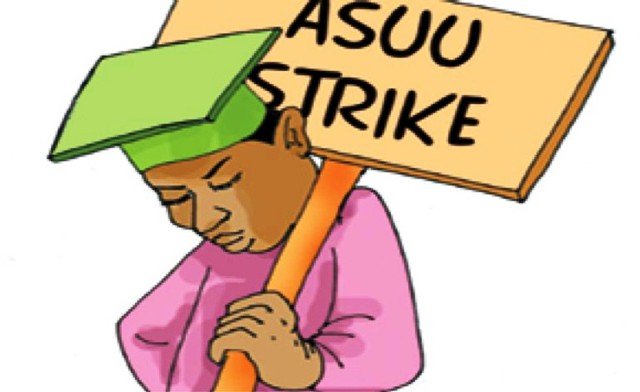
Six months into the strike by university lecturers in Nigeria, there is little hope in sight that academic work will resume as the Federal Government and the Academic Staff Union of Universities (ASUU) pipe discordant tunes. The President, Muhammadu Buhari, and his ministers should prepare and do whatever is reasonably possible to have the universities reopen without further delay.
That the strike went on for so long, resulting in the depletion of a semester or even an entire school year, flaunts the pretension of Buhari’s regime towards education. This is grievous to students, their parents, and guardians and indeed the entire nation. In this modern age, it is an untenable situation for a government to permit its universities to remain padlocked, virtually paralysing academic activities for a drawn-out time.
The ongoing ASUU strike originates largely from the failure of successive governments to respect agreements. Going forward, the government must stay true to its pacts with the ASUU and other unions. Government is a long continuum, and pacts signed by previous administrations are binding on their successors; at best they can only be renegotiated. Ultimately, it is the responsibility of the federal and state governments to terminate the present stalemate.
ASUU embarked on strike on 14 February this year, demanding, among other things, the deployment of the University Transparency and Accountability Solution (UTAS) to replace the Integrated Payroll and Personnel Information System (IPPIS) and the implementation of the 2009 renegotiated agreement which incorporates its members’ conditions of service. The failure to reach concurrence with the government has led the union to extend the strike severally.
Cumulatively, the public university system has lost about 1,400 days, or approximately three years and eight months to strikes since 1999. This is roughly equivalent to the four-year duration of most undergraduate programmes. These have retrogressed students at public universities while their peers at private higher institutions completed their courses in record time.
We observe that the never-ending crisis in the higher education sector, leading to the yearly ASUU strike, portends greater social danger to the country. A “two-tier system” appears to be emerging in the sector. The public university system, which was once a melting pot for children from all walks of life, is gradually becoming the status of an institution for the poor, while the children of the rich now enjoy a better no-strike education system at private universities. The consequences are better imagined than experienced.
While the strike may be justified and merits the approval of all, especially devotees of education, ASUU leadership seems to be dissipating the initial goodwill it relished from Nigerians. It is well known that the union and the Federal Government have since resolved their differences on most of the issues driving the strike. However, the union’s insistence on the payment of its members for the period they have downed tools has again stalled their resumption. Buhari rebuffed the condition, claiming that it violated the Trade Disputes Act.
The Minister of Education, Adamu Adamu, while briefing journalists, said that “all disputes between the government and ASUU have been resolved, except for the demand for payment of members’ wages during the strike, which Buhari categorically rejected.” The government is right on this point. Section 43 of the Trade Disputes Act specifically insists that striking workers are not entitled to remuneration while they are not working.
ASUU President Emmanuel Osodeke’s response to the Federal Government’s “no work, no pay” stance has been rather grumpy. “He is joking,” Osodeke said. “If they don’t pay, we are not going to teach those students; we are not going to make up that time. We are going to start a new session. We are not going to have an exam; we are going to start a new session entirely”. This fit of temper is not congenial for the hapless students who have supported the strike against their interests.
The “no work, no pay” law is universal. While strikes are a legitimate and legally protected tool for protesting against employers’ discreditable practices and negotiating better conditions of service, employers are not obligated to recompense workers for periods in which they cease to provide service following a strike. The striking lecturers must comprehend this, particularly considering that most of the children of the government officials they are fighting are not enrolled in any public university.
Globally, when unions go on strike, they do so without the expectation that they will be salaried for the work they withhold. Recognising that they may not be paid during the strike, they have contingency plans for this, usually in the form of paying members from union dues or other sources during the strike. To demand to be indemnified while on industrial action amounts to wimpiness and reprehensible cruelty.
Given the country’s bankrupt governance, any union could handily adduce a plethora of reasons for a strike in Nigeria. Nonetheless, ASUU should alternate tactics and be more responsible. Closing universities because of the feckless actions of an insensitive government will only discomfit innocent students and their parents. As scholars, they should explore more efficacious and ingenious ways of protesting to take the edge off the anguish of the suffering students.
Although the striking university teachers may be on a pursuit to reclaim the Nigerian university system from consummate rot, it is now stepping outside the bounds of ratiocination and exactitude by insisting that it must always be remunerated for the period it is on hold out. In doing so, it is affirming to be above the law. Hence, continuing the industrial action is no longer tenable as ASUU has nothing left to fight for. We hope the lecturers discern this truth and prevail on themselves to end the strike forthwith.



Nigeria stands at a critical juncture as the world marked World Press Freedom Day (WPFD) on May 3. This annual observance is a reminder that a free press is central to democratic life, good governance, and public accountability. For Nigeria, it is also a moment for sober reflection on how far the country has come and how far it still has to go in safeguarding the independence of its media.
World Press Freedom Day exists to highlight the fundamental importance of freedom of expression and to honour journalists who risk their lives in pursuit of truth. It underscores the idea that without a free press, societies cannot function transparently, nor can citizens make informed decisions. In countries like Nigeria, where democracy continues to evolve, the observance carries particular urgency.
This year’s theme, “Shaping a Future at Peace: Promoting Press Freedom for Human Rights, Development and Security”, places journalism at the heart of global stability. It emphasises that a peaceful society cannot be built on silence, fear, or manipulated information. Rather, it depends on the free flow of accurate, timely, and independent reporting.
At its core, the theme highlights the role of journalism in fostering accountability, dialogue, and trust. These are not abstract ideals. In Nigeria, where public confidence in institutions is often fragile, the media remains one of the few platforms through which citizens can question authority and demand transparency. When press freedom declines, so too does public trust.
Journalism serves as a foundation for peace, security, and economic recovery. Countries with robust media systems tend to attract greater investment, maintain stronger institutions, and resolve conflicts more effectively. Nigeria’s economic challenges, ranging from inflation to unemployment, require open scrutiny and informed debate, both of which depend on a free press.
However, the issue of information integrity has become increasingly complex in the digital age. Artificial Intelligence (AI) and online platforms have amplified the spread of misinformation and disinformation. In Nigeria, where internet penetration has grown rapidly, false narratives can travel faster than verified facts. This makes the role of credible journalism more vital than ever.
The challenge is not only technological but also ethical. AI-driven manipulation of information threatens to distort public discourse, influence elections, and deepen social divisions. In such an environment, professional journalism must act as a stabilising force, ensuring that truth prevails over sensationalism and propaganda.
Equally troubling is the safety of journalists. Across Nigeria, reporters face growing levels of online harassment, judicial intimidation, and physical threats. Self-censorship is becoming more common, as media practitioners weigh the risks of reporting sensitive issues. This trend undermines the very essence of journalism.
A particularly alarming incident involved a serving minister in the present administration, who openly threatened to shoot a journalist during a televised exchange. Such conduct, broadcast to the public, sends a dangerous signal that hostility towards the press is acceptable. It erodes the norms of democratic engagement and places journalists in harm’s way.
This year’s theme aligns closely with the United Nations Sustainable Development Goal (SDG)16, which promotes peace, justice, and strong institutions. Freedom of expression is a cornerstone of this goal. Without it, institutions weaken, corruption thrives, and justice becomes elusive. Nigeria’s commitment to SDG 16 must therefore include genuine protection for the media.
Historically, the Nigerian press has been a formidable force. From resisting colonial rule to challenging military dictatorships, our journalists have played a central role in shaping the nation’s political landscape. Today, however, that legacy appears to be under strain, as the media operates under what can best be described as a veneer of freedom.
Beneath this facade lies a troubling reality. Journalists are routinely harassed, detained, and prosecuted for performing their constitutional duties. Reports from media watchdogs indicate that dozens of Nigerian journalists face legal threats or arrest each year, often for exposing corruption or criticising those in power.
The Cybercrimes (Prohibition, Prevention, etc.) Act of 2015 has become a focal point of concern. Originally intended to combat cyber threats, it has increasingly been used to silence dissent. Sections 24 and 27(1)(b), in particular, have been invoked to target journalists, bloggers, and social commentators.
Although amendments introduced in February 2024 were meant to safeguard journalists, concerns persist. The law continues to be wielded in ways that stifle investigative reporting and restrict freedom of expression. Legal reforms must go beyond cosmetic changes to address the root causes of misuse.
To safeguard the future of journalism in Nigeria, decisive action is required. The Cybercrimes Act must be revisited to ensure it cannot be weaponised against the press. Law enforcement agencies must operate free from political influence, upholding the rule of law and protecting journalists’ rights. Civil society and international partners must also strengthen independent media through funding, training, and platforms for wider reach.
In this rapidly evolving world shaped by artificial intelligence and digital innovation, Nigeria faces a clear choice. It can either allow press freedom to erode under pressure, or it can champion a truly independent media landscape. The path it chooses will determine not only the future of journalism, but also the strength of its democracy and the peace it seeks to build.

-

 Featured3 days ago
WASSCE: RSG Distributes Science Materials To Secondary Schools
-
News4 days ago
Xenophobic Attacks: Nigerian Lives More Important Than Foreign Investment – Oshiomhole
-
Rivers4 days ago
MBA Forex Trial Adjourn To June 3, Amid Bereavement … As Court Declines Cost Application
-
News4 days ago
ActionAid Demands Probe Of Govs Using Public Funds For Campaign
-
Aviation4 days ago
Passengers Stranded As Delta Airline From Atlanta Route Back Eight Hours After
-
Business4 days ago
Customs Impound N2.35bn Cocaine, 15 Trailers of Rice
-
Politics4 days ago
2027: Bayelsa Senator Gets Critical Endorsement For Second Term
-

 Politics4 days ago
INEC Sets Rivers South-East Senatorial By-Election For June 20