
Niger Delta
Gov Unveils Administration Of Criminal Justice Monitoring C’ttee

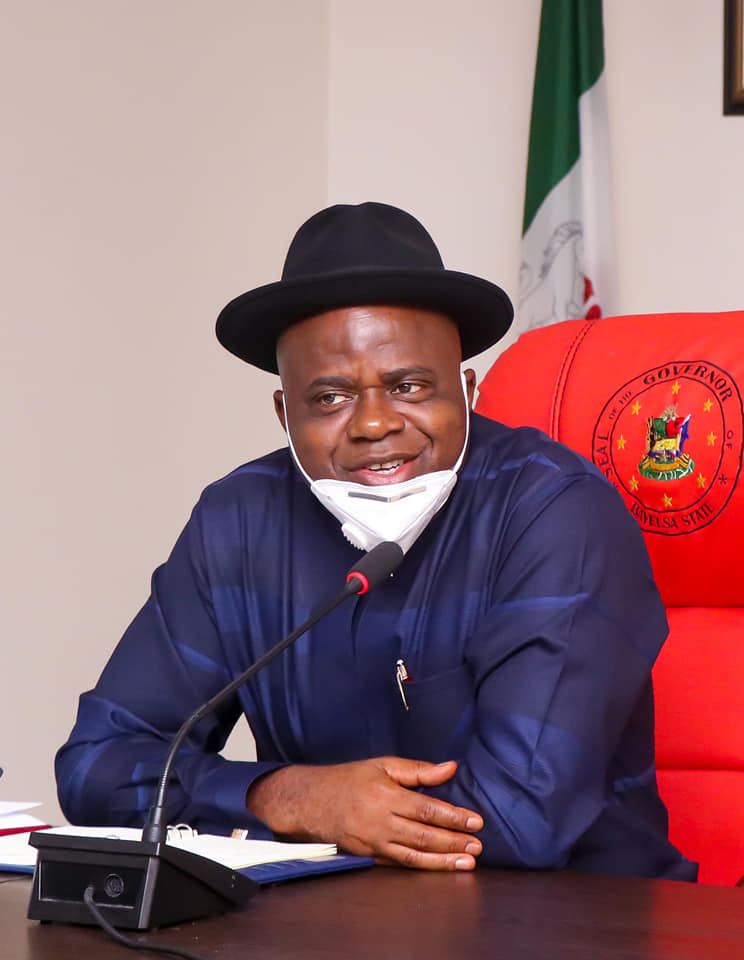
Bayelsa State Governor, Senator Douye Diri, yesterday inaugurated the state’s Committee on Administration of Criminal Justice Monitoring at the State Judiciary Multi-Door Court Complex, in Yenagoa.
Speaking at the ceremony, Governor Diri tasked all critical stakeholders in the chain of the criminal justice system to play their statutory roles to ensure the speedy dispensation of justice in the state.
The Governor, who was represented at the event by his Deputy, Senator Lawrence Ewhrudjakpo, emphasised that there was a compelling and urgent need to do what he called ‘critical self-examination’ to get it right with the administration of the criminal justice system.
According to the Bayelsa Chief Executive, equity holds the key to a peaceful and virtually crime-free society, where no one is denied their rightful benefits and entitlements as law-abiding citizens.
He said the lack of equity in the Nigerian society had over the years provided the breeding ground for the emergence of criminals and criminality in every part of the country.
“Let us talk more about equity because I believe most of the crimes being committed in our society is as a result of lack of equity. A man who is into oil bunkering feels that his country is producing the crude oil from his backyard and he is not getting a fair reward from it.
“And so, he feels that the only way for him to get the national cake is to go for illegal refining. We arrest and criminalize them. But the question is, if there is equity, will still go and break the pipelines?
“I’m not trying to be a lawyer or solicitor on their behalf. But I also think there is the need for equity. More often than not what we have done in our society is to put justice first instead of equity.
‘Equity is the bedrock of every system. Justice is a remedy for injury. But when we talk about equity, it means you are giving to me what what is rightly due me”, he said.
He noted that the country had not fully attained its goals in the dispensation of justice because the justice system had been compromised, adding that the Police, the Correctional centres and the Judiciary should effectively play their constitutional roles to achieve seamless delivery of justice.
The Governor, who made a case for mobile courts in the rural areas to handle criminal cases, suggested that magistrates should make unscheduled visits to police stations in the various local government areas to examine files of detainees, some of whom are being illegally detained.
In her remarks, the Chief Judge of Bayelsa State, Justice Kate Abiri, explained that the need for the implementation of the Administration of Criminal Justice Law justified the inauguration of the committee in the state.
Justice Kate Abiri assured that the state’s judiciary as critical institution in the administration of criminal justice sector would continue to play its role to complement the work of the State Implementation Committee.
She noted that when the Committee was operational, it would speed up criminal trials in the courts by cutting out most of the delays currently being experienced.
The Chairman of tbe Bayelsa State Administration of Criminal Justice Interim Monitoring Committee is the Chief Judge, Honourable Justice Kate Abiri, while Senior Magistrate Mariam Pere and Mr. Charlie Ebinyon are to serve as Secretary and Assistant Secretary respectively.
While the Attorney-General and Commissioner for Justice, Mr Biriyai Dambo (SAN), the state Commissioner of Police, CP Ben Okolo and the state Comptroller of the Nigerian Correctional Services, Mr. Seth Edoughotu are members.
Other members include the Chairman Nigerian Bar Association (NBA) Yenagoa Branch, Mr. Ukunbiriowei. Saiyou; the State Coordinator of the Legal Aid Council, Mr. Eddy Inemo Yabo; representative of civil society, Mr. Jim Dorgu and the state Coordinator of the National Human Rights Commission, Mr Eugene Baidom.
By: Ariwera Ibibo-Howells, Yenagoa




History was made on Wednesday 17th June, 2026 when the Okey Onuchuku Institute of Peace and Conflict Studies building was handed over to Ignatius Ajuru University of Education (IAUE).
Speaking during the hand over ceremony, which attracted an array of personalities from various works of life, the 13th Pro-Chancellor and Governing Council Chairman of IAUE, Chief Chinyere Igwe, commended the Vice Chancellor of IAUE, Professor Okechuku Onuchuku, for giving back to the University with the institute’s building project.
While affirming that Government cannot do it all, he encouraged individuals, corporate organizations, institutional partners to ensure the growth of University education in Nigeria.
He praised Tertiary Education Trust Fund (TETFUND) for sustaining University Education in Nigeria, and called for good initiatives and support “that will not only benefit the University, but put IAUE on the map of academic excellence in Nigeria and beyond.”
Earlier, the Vice Chancellor, Professor Onuchuku, expressed gratitude to his wife, Mrs. Chika Onuchuku, and family for all the support given for the vision achieved.

He also thanked his close associates, political friends, well-wishers, and others who donated generously towards the building project.
“The growth of Universities all over the world”, Professor Onuchuku said, “comes from personal efforts of individuals, alumni associations and others.”
He noted that donations as being witnessed is the best way to go and called on all to invest in the Nigerian education system and immortalize their names with worthwhile donations and contributions..
The Okey Onuchuku Institute of Peace and Conflict Studies building, he further stated, “is donated as a Professorial Chair with the Dean of Postgraduate School, Professor Chibuzor Chile Nwobueze, also a Professor of Peace Studies, as the occupant of the Professorial Chair.
Giving his address, the Director, Okey Onuchuku Institute of Peace and Conflict Studies, Professor Kingdom Elendu Ohia Nwaenyi, lauded Professor Okechuku Onuchuku for sacrificing his hard earned salaries, allowances and funds raised from two volumes of textbooks in his honour and titled “Perspectives on Nigeria’s Development”, launched on his 60th birthday.
He noted that the project is the first legacy to be accomplished by any serving Vice Chancellor in the institution.
Professor Nwaenyi stated that the Institute mounted five programmes: Peace and Conflict Studies; Peace Building and Development; Peace Building and Security Studies; Peace Building and Conflict Management; and Peace Education.
The institute, he explained, has birthed over fifty students running programmes in Postgraduate Diploma, M.A, M.Sc, M. Phil, and PhD.
Thirty students are in the PhD programme, fifteen are admitted into the Masters and M.Phil, and eight in Postgraduate Diploma Programme.
He expressed hoped that the Institute would check litigation and provide alternative dispute resolution.
In a vote of thanks, the Chairman, Okey Onuchuku Peace and Conflict Studies and Dean of Postgraduate School, Professor Chibuzor Chile Nwobueze, thanked God for His grace and enablement.
He prayed for the donor and Vice Chancellor of IAUE, Professor Okechuku Onuchuku, and further expressed his gratitude to Professor Isaac Olawale Albert, the third most cited Peace Scholar in the world, for his collaboration in developing a world class curriculum.
While thanking all who supported and celebrated with the University in this regard, Professor Nwobueze assured the public that the Okey Onuchuku institute of Peace and Conflict Studies will emerge as a centre of excellence, contributing meaningfully to scholarship, policy formulation, community engagement and the promotion of peaceful coexistence within Nigeria, Africa and the global Community.
The Institute, he stated, is willing to partner with the Society for Peace Studies and Practice (SPSP) in line with its mandate to promote peace studies, Peace building, Conflict Management and sustainable development.
The institute has over four lecture halls with sixty to one hundred and twenty capacity, a befitting conference hall, offices for staff and a library.
A donation of one million naira was made during the event for the best two graduating students of the institute by Barrister Nyema Wagbara, the Leader of Dynamic Development Club of Port Harcourt based in Rumuolumeni.
Each of the two best graduating students will get the sum of five hundred thousand naira.
The event featured goodwill messages from Professor Isaac Albert, Professor Alwell Nteegah, the Chairman of Society for Peace Studies and Practice, Rivers State Chapter, Dr. Benjamin Ibietonye.
Dr. Emem Nyewene presented the goodwill message of the Society for Peace Studies and Practice National.
Others who gave goodwill messages are Ambassador Green Isaac, the Country Director, Relief International Africa, and Comrade Levi Zachariah George, Chairman Postgraduate Students Association.
The event also featured rendition for Professor Okechuku Onuchuku by Dr Maria Abidiak.
-
Rivers17 hours ago
Rivers Police Uncovers Firearm Concealed In Loaf Of Bread
-

 Niger Delta13 hours ago
Pro-Chancellor Hands Over Okey Onuchuku Peace, Conflict Institute Building
-

 News14 hours ago
Fubara Reaffirms Commitment To Blue Economy, Private Sector Growth …Calls For Protection Of Marine Resources
-
Sports17 hours ago
Six Nigerians To Play For NBA Teams
-
Business17 hours ago
Gas Economy: Decade of Gas, Pi-CNG/ EV Deepen Media Engagement
-

 Business14 hours ago
IPMAN Raises Concern Over Delay In Chinese Refinery Deal …Predicts Lower Fuel Prices Through Competition
-
Business18 hours ago
Navy Nabs 13 Black Sand Miners In Bayelsa –Impound Two Boats
-
Business17 hours ago
Accountable Leadership, Urgent Reforms Will Stimulate Economic Growth — Osi