
Politics
How Buhari’s Indecision Caused Confusion In APC

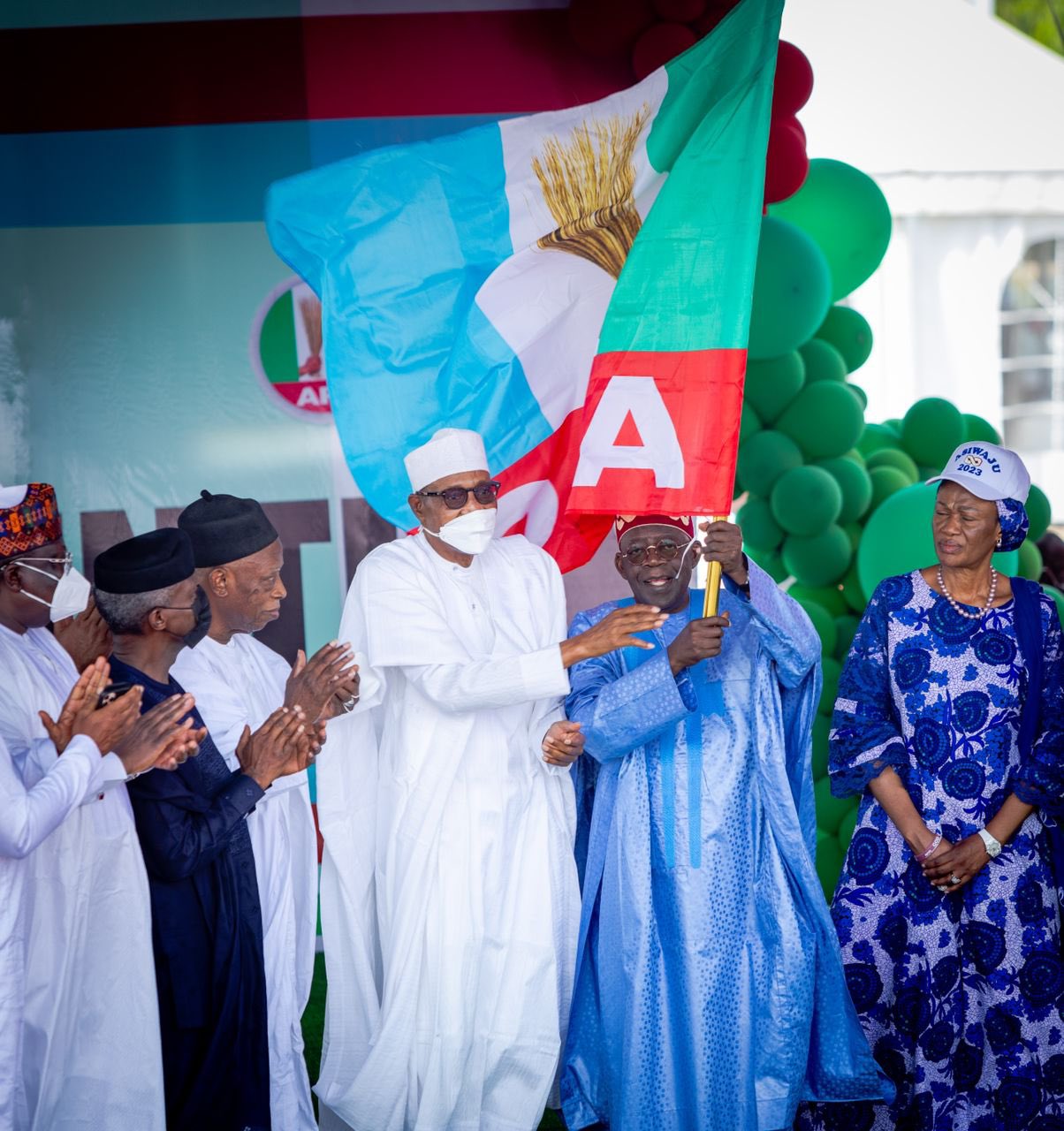
The road to the special convention of the All Progressives Congress (APC) to elect its presidential candidate was tinged with hazy permutations, melodrama and political machinations.
Pundits and party chieftains pointed to one direction for the heightened drama: President Muhammadu Buhari.
The development aggravated the tension ahead of the convention as various interest groups used the president’s silence to intensify horse-trading and peddle the name of the president to sell the candidature of their preferred aspirants.
The Tide source reports that the battle to succeed President Buhari had been fierce and tension-soaked in the ruling party. From the 23 aspirants who were screened by the John Oyegun-led screening committee, the electioneering had been breath-taking as members of the party studied the body language of Buhari who once said he had a preferred successor but failed to name him.
Up to the last minute of the electioneering, the President kept members of the party guessing on his preferred successor, with different contradictory statements, saying at one time that he had a preferred candidate and at another recanting the claim on his successor.
So many chieftains of the party were apprehensive over the president’s indecision amidst speculations that he might want to have his way.
He did that during the race for the chairmanship of the party. He settled for Senator Abdullahi Adamu at the eleventh hour amidst grumbling from party stakeholders, including the Governors of the party. But he had his way. Adamu emerged as the consensus candidate and was eventually affirmed at the convention held on March 26.
But while many aspirants were banking on the president’s endorsement to win, pundits said that pasture was a miscalculation as the President was not known to put a spirited fight for anyone.
As far back as January this year, Buhari granted an interview to Channels Television where he hinted that he had a favourite to succeed him but he would not reveal the name.
He said he was “open to the emergence of anyone,” but later, when pressed, added that he had one person in mind but he would not name him so that he would not be eliminated.
Pressed on whether he had any favourite in the APC, he added: “No. I wouldn’t because the person could be eliminated if I mention it. I better keep it secret.”
Earlier in the interview, Buhari said: “I am not interested in who becomes the presidential candidate of the ruling All Progressives Congress (APC) as I am open to the emergence of anyone.
“No. Let him come, whoever it is. The only important thing (is) I made sure that on record, nobody should ask me to come and give any evidence in any court.
“Otherwise, whoever it is, he will be in trouble. Because all the important things are on record. I made sure about that. Important issues are all on record.”
Days after the conduct of party primaries for other elective positions in 2023, the President met the party’s Governors under the aegis of the Progressive Governors’ Forum (PGF), urging them to allow him to pick his successor.
Buhari at the meeting on Tuesday May 31, stated that state Governors were given the opportunity to pick their successor, so they should also allow him to do the same at the federal level.
Buhari said, “In keeping with the established internal policies of the party and as we approach the convention in a few days, therefore, I wish to solicit the reciprocity and support of the governors and other stakeholders in picking my successor, who would fly the flag of our party for election into the office of the President of the Federal Republic of Nigeria in 2023.
“We gave governors re-election tickets or opportunity to pick their successors; allow me pick my successor.”
The APC national chairman on Monday flew a kite when he announced Senate President Lawan as the consensus candidate endorsed by President Buhari. The announcement was greeted with a flurry of angry reactions, especially from the camp of 13 other aspirants in the race.
His announcement came after Governors of the party from the North backed power shift to the South.
However, the kite failed to fly anywhere as the President, through a statement from Presidential spokesman Garba Shehu countered the national chairman, saying Buhari had not anointed anyone as his preferred candidate.
Shehu expressed the president’s determination to ensure that “there shall be no imposition of any candidate on the party.”
He quoted Buhari as speaking during a meeting with the Governors at the State House, Abuja, saying the party is important and its members must be respected and made to feel they are important.
The President said he had a clear mind about what he was doing and asked the APC governors to feel the same. “You were elected as I was. Have a clear mind as I have. God gave us the chance; we have no reason to complain. We must be ready to take pain as we take the joy. Allow the delegates to decide. The party must participate, nobody will appoint anybody,” he said.
A public affairs analyst and political scientist, Gbade Ojo said, “All eyes being on Mr President is making him a dictator. In a democracy, Mr President doesn’t have to dictate who should be his successor.”
According to him, if the president’s favourite is not the preference of majority of the party’s members, the person might suffer legitimacy crisis.
Eze writes for Daily Trust.



The Rivers contest is expected to draw heightened attention in the oil-rich state, as political actors position for influence in a district long regarded as strategic to the balance of power in Rivers State.
INEC disclosed that the by-elections will hold concurrently with the Ekiti State governorship election, underscoring what promises to be a politically charged day across several parts of the country.
Beyond Rivers, the electoral body listed other affected constituencies to include Nasarawa North Senatorial District, Dawakin Kudu/Warawa Federal Constituency in Kano State, Ondo South Senatorial District, and Enugu North Senatorial District.
The vacancies, according to INEC, arose from a combination of deaths, resignation, and other constitutional developments. In Nasarawa, the demise of Senator Godiya Akwashika has left a gap in a district considered a stronghold of the All Progressives Congress (APC). In Enugu, the passing of Senator Okey Ezea has set the stage for a competitive race in the South-East.
Similarly, the Ondo South seat became vacant following the resignation of Senator Jimoh Ibrahim, who now serves as Nigeria’s Permanent Representative to the United Nations, while the Dawakin Kudu/Warawa seat in Kano opened up after the death of Hon. Muhammad Danjuma Hassan.
Analysts say the Rivers South-East by-election, in particular, could reshape political alignments in the state, as parties jostle to fill the void left by Sen. Mpigi and consolidate their foothold ahead of future electoral contests.
Stakeholder from Bayelsa East Senatorial District, on Monday, endorsed the incumbent Senator representing them to run for a second term.
Leading the stakeholders, the former Commissioner for Culture and Tourism and Special Adviser to Governor Douye Diri on Political Affairs (iii), Dr Iti Orugbani, said the reason for the endorsement was based on the federal lawmaker’s trajectory of good deeds and massive execution of projects across communities of the Senatorial district.
Dr Orugbani highlighted some of the projects to include landing jetties, telecommunication masts and town halls amongst others, noting that Sen. Agadaga’s performance has exceeded those of others who hitherto represented the oil rich area.
Bayelsa East Senatorial District comprises Ogbia, Brass and Nembe Local Government Areas of the State.
The Governor’s aide who called on the State’s Eastern political enclave to respect the 2022 new zoning agreement, which guaranteed second term for Senators from the District, stressed the need for political tolerance and peace in the forthcoming 2027 polls.
“In 2022 the leaders and stakeholders across party lines from Bayelsa East held a meeting and altered the old single term for Senators from the district’s agreement and signed that begining from 2023 any Senator emerging from the district must serve for a minimum of two terms.
“In 2023, Senator Biobarakuma Degi-Eremienyo, then an incumbent Senator representing the Senatorial district under the platform of the All Progressives Congress (APC) was given a second term ticket by the party. Though he lost to the PDP.
“Now that the entire state is now APC and the District has an APC Senator in the person of Benson Agadaga from Ogbia LGA, why not also give him a second tenure?
“The stakeholders in 2022 changed the old political agreement because they saw that it wasn’t beneficial to the district any longer. And so, because it was Ogbia Local Government Area that started the old zoning arrangement by producing the first Senator in 1999, I want to plead that let Ogbia also begin the new two terms zoning agreement”, he said.
Also speaking, the duo of woman leader of a support group, ‘Agadema Women’, Mrs. Owadaba Jokori and the Information Officer of the Ijaw Youths Council (IYC), Central Zone, Comrade Ikio, stated that the incumbent Senator has done well for the district in the past three years that he has been in office.
They lauded the federal lawmaker for his infrastructure projects, especially the construction of landing jetties in select communities of the three local government areas of the district, commending stakeholders for supporting the lawmaker in his second term bid.
In his remarks, Senator Agadaga thanked the stakeholders for the confidence reposed in him and the endorsements he has received lately from constituents and admirers across political parties.
The lawmaker noted that within the past three years that he has been Senator, he has delivered dividends of democracy to his constituents across the Senatorial District, emphasizing that the call for him to be senator from the Brass Senatorial District came to him as a surprise, noting that he accepted the clarion call when the clamour became so loud.
“I was Chief of Staff to the State Governor, Senator Douye Diri, when various groups from the zone came calling on me to contest the 2023 Senatorial polls.
“Ever since winning the elections as a senator, I’ve continued to deliver on my mandate in both representation, lawmaking, oversight, project execution and support for constituents when called upon. And I shall continue to do more if elected for a second term”, the Senator said.
By Ariwera Ibibo-Howells, Yenagoa
Justice Peter Lifu of the Federal High Court in Abuja has set May 15 as deadline for definite hearing in a suit filed by a lawyer, Johnmary Jideobi, seeking to stop former President Goodluck Jonathan from contesting the 2027 presidential election.
The judge on Monday shifted the hearing date following the absence of the plaintiff, Mr Jideobi, and his lawyer in court without any information.
Apart from the absence of the plaintiff, who is a legal practitioner, the Independent National Electoral Commission (INEC) and the Attorney General of the Federation (AGF) and Minister of Justice, who are 2nd and 3rd defendants in the matter, were also not in court.
Following the absence of the plaintiff and the two defendants, Chris Uche, SAN, representing Dr Jonathan, applied to the court to strike out the suit for lack of diligent prosecution.
Having joined issues with each other, Mr Uche said, the suit is liable for dismissal with a N5 million cost to be awarded against the plaintiff and payable to Dr Jonathan.
He argued that from all indications, the plaintiff has abandoned the suit and ran away upon sighting the preliminary objections raised against the suit, adding that the court is a busy place and not for unserious matters.
Justice Lifu, however, noted that there was no evidence of service of hearing notice on INEC and AGF to appear in court for the suit, adding that lack of service of hearing notice is fundamental.
The judge said rather than striking out the suit, he prefers to bend backward to accommodate the plaintiff and the two defendants for the last time.
While adjourning the matter to May 15, Justice Lifu ordered that hearing notice be served on the plaintiff and the 2nd and 3rd defendants who were not in court on Monday.
The plaintiff, Mr Jideobi, had filed the case seeking an order to restrain Dr Jonathan from presenting himself to any political party as an aspirant for the 2027 election.
He is also asking the court to stop INEC from accepting, processing or publishing Dr Jonathan’s name as a presidential candidate.
-

 Featured3 days ago
WASSCE: RSG Distributes Science Materials To Secondary Schools
-
News3 days ago
Xenophobic Attacks: Nigerian Lives More Important Than Foreign Investment – Oshiomhole
-
Rivers3 days ago
MBA Forex Trial Adjourn To June 3, Amid Bereavement … As Court Declines Cost Application
-
News3 days ago
ActionAid Demands Probe Of Govs Using Public Funds For Campaign
-
Aviation3 days ago
Passengers Stranded As Delta Airline From Atlanta Route Back Eight Hours After
-
Business3 days ago
Customs Impound N2.35bn Cocaine, 15 Trailers of Rice
-
Politics3 days ago
2027: Bayelsa Senator Gets Critical Endorsement For Second Term
-
 Politics3 days ago
INEC Sets Rivers South-East Senatorial By-Election For June 20