
Featured
My Presidency’ll Address Leadership Deficit -Wike …Vows To Tackle Insecurity, Ailing Economy, If Elected

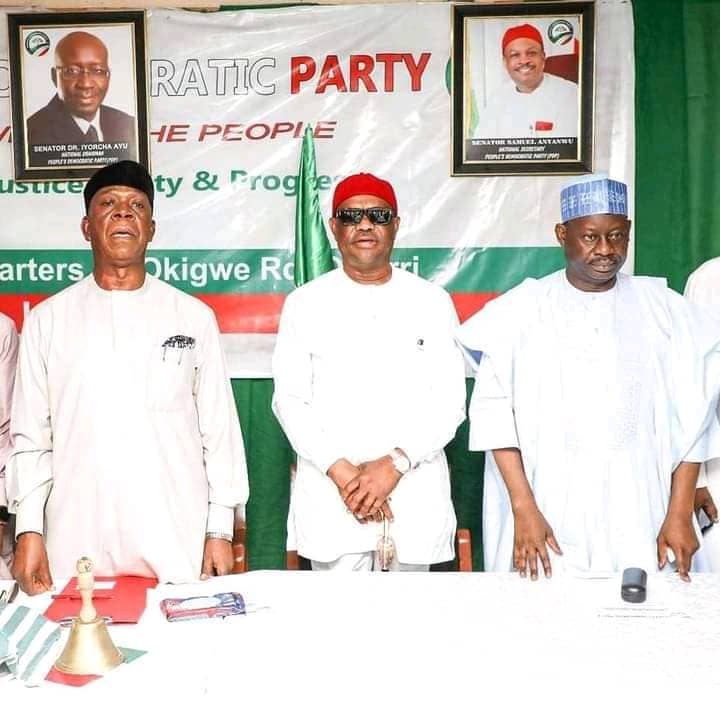
Rivers State Governor, Chief Nyesom Wike has told Nigerians that his presidency would solve the leadership problem that has stunted economic growth in the country.
Wike gave the assurance when he met with the Peoples Democratic Party (PDP) delegates at the party’s secretariat in Owerri, yesterday, as part of his ongoing consultation ahead of the party’s presidential primary next month.
This is as the Rivers State governor has vowed to expeditiously tackle the festering security and economic challenges facing Nigeria, if elected president.
The governor said he has clarity of purpose and the capacity to galvanise, coordinate the abundant human talents, expertise and resources in steering the county to greatness.
“Each time, our party people will say but for Wike, the party would have died. Now, the same person has come out.
“That Wike who has stood for this party, that Wike who has made this party not to die, that Wike who has made this party to be alive has come out to say I want to now lead this party.
“Nigeria is full of talents. Nigeria is full of people who are intelligent. What is the problem of this country today is leadership.
“You require somebody who can galvanise, coordinate those resources and it takes leadership. If you give me the mandate of the party, I know I will win the election in 2023.”
Wike stated that it was hard to believe that President Muhammadu Buhari was truly in charge of affairs of the country, given the intractable insecurity situation in parts of the country and poor performance of the economy.
He pointed to issues of insincerity in the fight against corruption because persons with such charges on them are either made chairman of the APC or shielded from the course of justice.
Wike assured that his presidency would be in charge of the armed forces, provide them with requisite support, strengthen their capacity to gather intelligence and demand results from them.
This is because, he said, any government that cannot protect life and property of citizens has failed.
Wike pointed out that it is such failure that he was desirous to reverse with the PDP ticket.
“If you cannot protect and property, governance is zero. This is because without life what are roads for? Without life, what are schools for and without life what are hospitals for? People must be alive to go to schools.
“You need a firm, courageous and fearless person. You can’t go to this election without you leading. You can’t be at the back. What I’m fully prepared for is this particular seat, to be the President of Nigeria.”
The governor asserted that without security, the economy cannot thrive and he is courageous to tackle the menace across the country.
He also stated that economists and experts shall be engaged as part of his presidency and be allowed to fashion out modalities and strategies that are required to set the road map in growing the nation’s economy.
Wike said he is passionate about the development of his people and loves the provision of infrastructure as seen in Rivers State.
He assured of replicating the success record secured in Rivers State, when elected president of Nigeria.
Wike told the delegates that his winning chances would have been secured if they give him the party’s ticket because he was the only person who can take the power from APC for PDP on behalf PDP for Nigerians.
Former Gombe State Governor, Dr Ibrahim Hassan Dankwambo, urged Imo State PDP leaders and delegates to support Wike’s presidential aspiration because he was competent, fearless and above all, kind hearted.
Dankwambo described Wike as a tested and detribalised Nigerian, who believes in development, having unrelentingly delivered dividends of democracy in Rivers state in the past seven years.
Earlier, Imo State PDP Chairman, Chief Charles Ugwuh, said Nigeria was in search of a great leader like Wike at this critical juncture.
“The governor is a unique personage, very courageous, strong willed, clear headed and focused man: A man who is able to state his belief and conviction without equivocation. He represents a great resource for Nigeria and PDP.”
Ugwuh commended Wike for offering himself to rescue and rebuild Nigeria.
According to him, “Imo State loves you because you’re very direct, you’re very outspoken, and you’re not shy to define what you believe.”
Similarly, Rivers State Governor, Chief Nyesom Wike has vowed to expeditiously tackle the festering security and economic challenges facing Nigeria, if elected president.
Wike maintained that at this critical juncture, the country desperately requires a leader with political will and courage to decisively end the scourge of insecurity and revive the ailing economy.
The Rivers State governor made the pledge while addressing Peoples Democratic Party (PDP), delegations from Borno and Yobe states in Maiduguri, the Borno State capital, last Monday.
He observed that in the past seven years, the security and economic situation in the country had deteriorated due to the incompetence of the current All Progressives Congress (APC)-led Federal Government.
“I came here today because there is a problem, and that problem is that Nigeria is dying, and we must not allow Nigeria to die. We must rescue this country. So, I came as a Nigerian, a member of the Peoples Democratic Party, a party I have never left since 1998 till now. A party I have worked for, and will continue to work for. A party I believe with it, Nigeria has hope.
“And so, I want to run for the presidency of this country under the platform of the Peoples Democratic Party. I came because I feel concerned. I came because I have no other country to run to, and therefore, I have come to offer myself to solve most of the problems that this APC administration could not solve.”
He further said: “Before, people used to talk about insecurity in Borno State.Today, insecurity is all over Nigeria. Hunger does not know Muslim; hunger does not know Christian. Insecurity does not know Muslim; insecurity does not know Christian. Insecurity does not know North; insecurity does not know South. You need somebody who will have the courage to fight insecurity in this country, and I want to tell you that I have that courage.”
He advised the delegates not to be deceived by those who may want to use geopolitical and religious sentiments to influence how they would vote during the PDP convention.
According to him, the socio-economic and security challenges bedevilling the country does not exclusively affect Muslims or Christians alone.
“Nigerians are aware that everybody is suffering. Nigerians are aware that people are dying. Muslims are dying, Christians are dying. Northerners are dying, southerners are dying. We need somebody that can stop all these, and that person is me.”
Wike accused APC leadership of covertly scheming against his emergence as the flag-bearer of the PDP.
According to him, APC leaders are afraid that if Wike clinches the PDP presidential ticket, that would mark the end of their grip on power.
The governor commended the leader of PDP in Borno State, Mohammed Imam for being a steadfast and dependable political ally.
The Rivers State governor also commended his Borno counterpart, Prof Babagana Zulum, for the hospitality and warm reception accorded him and his entourage.
“Let me on behalf of our team, express appreciation and thanks to my brother, the governor of Borno State. Let me sincerely thank you for displaying maturity and this is what we lack in this country. You have shown maturity, irrespective of the party you belong to.”
In his remark, Borno State Governor, Prof Babagana Zulum said the unity of the nation, deepening internal democracy, promoting peace, social cohesion, and stability in Nigeria, cannot be overemphasised.
“The nexus between peace and development need not be overemphasised. We shouldn’t allow ourselves to be divided along political lines to the detriment of the vision of developing one strong Nigeria.”
Zulum thanked Wike for coming, and wished him well while in his state.
He disclosed that he and Wike were close, and revealed that during the stormy days of Boko Haram, Wike was among few Nigerians who called him on phone to show concern.
In his welcome address, the Borno State PDP Leader, Hon. Mohammad Imam explained that he was one of the friends who purchased the expression of intent and nomination forms for Wike, because they were convinced of his capacity to lead Nigeria out of its current socio-economic predicaments.
Imam, who spoke on behalf of PDP delegates in Borno and Yobe states, decried the nonchalance shown by the All Progressives Congress (APC)-led Federal Government to issues of security that has crumbled business in the two states.
“We in Borno and Yobe are business people. We are bordered with three countries: Niger, Cameroon and Chad. Our people are businessmen.
“On a daily basis, lots of people here can attest to that, over 2,000 truck-loads of goods come out from Maiduguri market, cutting (taken)across these three Trans Sahara regions that I’ve mentioned: Maiduguri, Banki-Bama to Cameroon, Lake Chad, Niger, up to Central Africa and Libya.”
Imam also expressed grief over the level of devastation that their communities have suffered within the period because of the unrestrained marauding Boko Haram killers.
According to him, despite their cries, there has not been meaningful response from the Federal Government.
He said they were now looking up to Wike who was a man of vision and courage to rescue Nigeria, guarantee safety to Nigerians and improve the economy.
“We are peasant farmers; we don’t go to farm now. Our people cannot access their farms. In the Lake Chad, we are fishermen. 40percent of the fish consumed in Nigeria and other Sub-Africa states come from Lake Chad Basin.
“Why we want you to be the President and Commander-in-Chief of this country is because we have hope in you as a person because we know your capacity.
“We know your capability. We know your vision for this country. We have no other hope here in Borno, particularly in the North-East, without you at the helm of affairs at the Aso Villa come 2023.”
Speaking further, Imam said the people in Borno and Yobe states would support a man who would restore peace in the area.
“We don’t see any reason why we will have a president that sits down in the Villa while Boko Haram is killing our people in Sambisa Forest here”.
Earlier, Rivers State Governor, and presidential aspirant on the platform of the PDP, Chief Nyesom Wike had paid a courtesy call on the Governor of Borno State, Prof. Babagana Zulum at the Government House, Maiduguri.
Wike, who was accompanied by former Governor Ibrahim Dankwambo of Gombe and former Attorney General and Minister of Justice,Barrister Michael Aondoakaa, later addressed delegates from Borno and Yobe states before departing Maiduguri.

Featured
JUNE 12: Democracy Remains Nigeria’s Strongest Path To Unity, Progress, Says Fubara ….Extols Abiola, Wife


Governor of Rivers State, Sir Siminalayi Fubara, has reaffirmed that democracy remains the most effective system of government for Nigeria, given the country’s rich diversity of ethnic, religious, and cultural identities.
In a goodwill message to Nigerians on the occasion of the 2026 Democracy Day celebration, Governor Fubara said June 12 represents far more than a historic date; as it embodies the enduring struggle, sacrifice, and collective aspiration of Nigerians for freedom, justice, and representative governance.
The Governor extended warm felicitations to Nigerians at home and in the Diaspora, paying tribute to the heroes and heroines of the democratic struggle, particularly Chief MKO Abiola, his wife, Kudirat Abiola, and countless others whose courage and sacrifices helped secure the democratic freedoms Nigerians enjoy today.
According to him, “June 12 is a reminder of the price paid for the democracy we enjoy today. The sacrifices made by Chief MKO Abiola, Kudirat Abiola, and many other patriots who laid the foundation for the democratic journey we continue to enjoy today. Their commitment to the principle that power must ultimately reside with the people remains a source of inspiration for every generation of Nigerians.”
Governor Fubara noted that thirty-three years after the historic June 12, 1993 election, Nigeria’s democratic experiment has continued to evolve despite challenges and setbacks.
“Our democratic journey has not been without difficulties, but the resilience of our institutions and the determination of our people have kept the nation moving forward. The ability to express differing opinions, engage in constructive debate, and peacefully choose leaders through the ballot remains one of the greatest achievements of our nation,” he said.
Governor Fubara stressed that democracy provides the best framework for managing Nigeria’s diversity and transforming it into a source of national strength.
“Nigeria’s diversity should never be seen as a weakness. Properly harnessed, it is our greatest asset. Democracy offers us the opportunity to build consensus, promote inclusion, strengthen national unity, and create the conditions for sustainable development and shared prosperity,” he said.
Governor Fubara commended President Bola Ahmed Tinubu, for his commitment to the Renewed Hope Agenda and ongoing efforts aimed at economic revitalization, strengthening security, and deepening democratic institutions across the country.
He reiterated the readiness of Rivers State to continue partnering with the Federal Government in advancing policies and programmes that improve the lives of citizens through infrastructure development, job creation, enhanced security, quality education, healthcare delivery, and good governance.
The Governor further called on Nigerians, regardless of political affiliation, ethnic background, or religious belief, to use the occasion of Democracy Day to renew their commitment to the Nigerian project and the ideals that underpin democratic governance.
“Democracy must not be viewed merely as a periodic electoral exercise. It must be reflected in our daily commitment to accountability, transparency, tolerance, justice, respect for the rule of law, and responsible leadership. As citizens and leaders, we all share a collective responsibility to strengthen our democracy and build a nation that future generations will be proud to inherit,” he said.
Governor Fubara expressed optimism about Nigeria’s future, urging citizens to remain united, hopeful, and committed to the values of peace, dialogue, and national development.
“Together, we can build a stronger, more inclusive, and more prosperous Nigeria where every citizen has the opportunity to thrive and contribute meaningfully to national progress,” he said.

Governor of Rivers State, Sir Siminalayi Fubara, has reaffirmed the unwavering commitment of his administration to peace, unity, security, and inclusive development as Rivers State marked its 59th anniversary, last Wednesday.
In a goodwill message issued on Wednesday to commemorate the anniversary, Governor Fubara stated that despite the challenges faced over the years, the people of Rivers State have continued to demonstrate resilience, strength, and an enduring spirit of unity that has sustained the state since its creation.
The Governor noted that the strong bond of brotherhood among the various ethnic nationalities of the state, including the Ijaw, Ikwerre, Ogoni, Etche, Ekpeye, Andoni, Kalabari, and others, remains one of Rivers State’s greatest strengths and a critical foundation for peace, stability, and progress.
He further observed that Rivers State has remained a major driver of Nigeria’s economy for decades, not only because of its abundant oil and gas resources, but also because of the exceptional contributions of its people across diverse sectors including academia, jurisprudence, business, entertainment, public service, and sports.
Governor Fubara assured the people that his administration will continue to prioritize policies and programmes that promote peace, protect lives and property, and expand development across all parts of the state. He emphasized that governance must be people centered and impactful, with equal attention given to every Local Government Area of the state.
The Governor also paid tribute to the elders and founding leaders of the state for preserving the spirit of unity and coexistence over the years, while urging the youths to remain hopeful, responsible, and actively committed to building a greater Rivers State through innovation, hard work, and patriotism.
He equally acknowledged the invaluable role of women in strengthening families, communities, and society, describing them as indispensable partners in the continued growth and stability of the state.
Governor Fubara called on all Rivers people to use the occasion of the anniversary as a moment of reflection and renewed commitment to peaceful coexistence, mutual respect, dialogue, and collective progress, stressing that the unity and future of Rivers State must always rise above personal interests and political differences.
Rivers State was created on May 27, 1967, by General Yakubu Gowon.

-

 Niger Delta1 day ago
Warri Airport Manager Disputes Air Peace Bird Strike Claim
-

 News2 days ago
Nigeria Won’t Surrender Any Territory To Criminals -Tinubu
-

 News2 days ago
FG Begins Trial Of Over 600 Terrorism Suspects
-

 Rivers1 day ago
79th IAUE Inaugural Lecture: Prof Anero Advoctes Tuition-Free Education For Children
-

 Politics1 day ago
Parties’ Deregistration: How Justice Lifu Overruled Appeal Court Justices
-

 Politics1 day ago
ADC: Okonkwo Rejects Amaechi As Presidential Running Mate, Withdraws Support
-

 Politics1 day ago
2027: Tinubu’s Projects Give APC Edge In South East – Yilwatda
-
Politics1 day ago
2027: Rivers PFN To Mobilise 600,000 Votes