
Editorial
Task Before Eguavoen, Amuneke

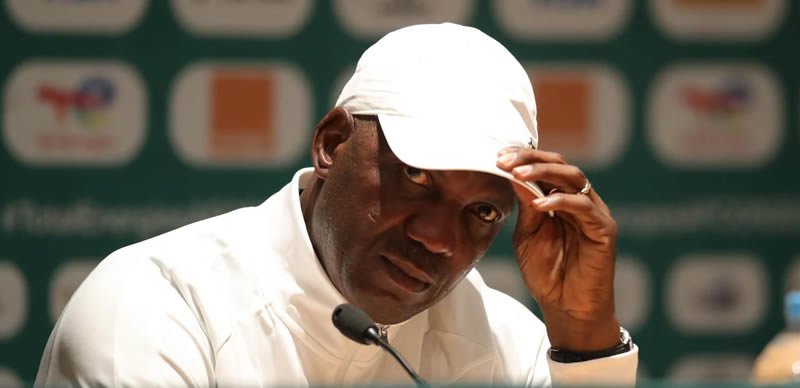
Few days ago, the football ruling body in Nigeria, Nigeria Football Federation (NFF) confirmed the duo of ex-
internationals, Austin Eguavoen and Emmanuel Amuneke as substantive technical heads of the national team, Super Eagles. This followed the not-so- successful outing of the national team under the tutelage of Eguavoen in interim capacity at the recently concluded 33rd edition of the African Cup of Nations ( AFCON) tagged Cameroon 2021, and the failed attempt to engage Portuguese tactician, Jose Peseiro. While Eguavoen remains the Technical Adviser and Head of the coaching crew, Amuneke was drafted as the coach.
At the Cameroon 2021 Championship, Eguavoen and the Super Eagles, after flying off the blocks in impressive fashion ended up flattering to deceive. They won all their group matches to raise the expectations of not only Nigerians but their fans across the globe. But the Eagles came unstuck in the very first knock out stage and game against their counterparts from Tunisia.
That is why, we think that the combination of Eguavoen and Amuneke could not have come at a better time, especially as the final qualifying matches for Qatar 2022 World Cup looms by the corner. Indeed, the Super Eagles team, as presently constituted, boasts of young and enterprising talents that have the potential to become world beaters, if only technically and tactically sound minds could work to weave their talents into a consistent formidable unit in the field of play.
We are glad that the new gaffers played the game to the highest level and have proved themselves as technical managers with relative successes. Both played professional club football with reputable sides in Europe, played for the national team and won the Nations Cup in 1994, with Amuneke also winning the Olympic football gold medal in 1996.
As coaches, both have some cognate experience to fall back on. While Eguavoen has been in the saddle of the Super Eagles before now and has the record as the only coach to have seen the team eke out perfect record in group matches as the AFCON in more than one edition, the recent disappointment of Cameroon 2021 should be handy. Amuneke, on his part, has brought world youth football glory to the country as an assistant and substantive coach of the Golden Eaglets in 2013 and 2015. He also broke new grounds, leading the Taifa Stars of Tanzania to their second African Cup of Nations outing in 2019, 39 years after their debut outing in 1980.
Now, therefore, we think is the time for both coaches to bring their experiences to bear on the national team and steer it to greater height and glory, beginning with the momentous two-legged encounters with neighbours and archrivals, Ghana, next month. The Black Stars of Ghana are the last hurdle between Nigeria and an appearance at the next mundial and qualifying for the biggest football rendezvous in the world is non-negotiable. It is indeed an acid test for the Eagles’ handlers and inkling into what their tenure holds for the national team and Nigeria.
We expect Eguavoen and Amuneke to close ranks and work with mutual respect and unity of purpose to ensure that their names are not only written in gold but serve as positive milestones for indigenous coaches in their quest for opportunities in the continent and beyond. These we believe are achievable with clearly stated goals, programmes and methods, which should have long, medium and short term strategies.
Over the years, it is on record that the NFF tended to treat indigenous coaches with less respect than their expatriate counterparts. While we are not encouraging confrontational attitude or insubordination, we expect that, as professionals, the coaches have a clear contract with stipulated rule of engagement in place in order to avoid the cataclysmic developments that have inundated past arrangements.
Being ex-players, Eguavoen and Amuneke must be ready to enforce discipline in the Super Eagles without being unduly high handed in order to have and maintain a peaceful dressing room. In fact, the onus lies on the coaches to provide leadership and act as role models for the players, without hesitating to whip into line any one that steps out of order, no matter his status in the team.
Hassan Shehata, who won multiple Nations Cup title for Egypt, Djamel Belmadi of Algeria, who led Algeria to the title at the penultimate AFCON, our own late Stephen Keshi, who won with the Super Eagles in 2013 and Aliou Cisse, coach of current AFCON Champions, Teranga Lions of Senegal are some examples of indigenous coaches to have led their countries to glory. Taking some leaves off their books, especially, Cisse, who stuck to his beliefs and methods to finally achieve with Senegal, would not be a bad idea. The duo should strive to be shining examples of ideal local coaches with capacity.
Apart from a healthy working relationship between both men on and off the field, we demand fair and firm disposition from them in scouting, selecting and fielding players for the national team. The practice of favouritism or double standard should not find room in the choice of personnel to prosecute one match or another. Also, some Nigerian coaches have in the recent past run foul of FIFA rules and stand against corruption, match-fixing and other forms of bribery, Eguavoen and Amuneke must at all times maintain high moral grounds against any matter that may blemish their integrity.
The two coaches will, at the end of the day be judged by how far they would have taken the national team to the next level and their ability to identify, wean and integrate new players to the Super Eagles. We, therefore, think that while going for the best legs to represent the country in the national teams, products of the domestic league must not be forgotten players from the Nigerian Professional Football League, (NPFL) should not be outrightly dismissed as second class players but ought to be given ample opportunities to prove themselves among the litany of usually favoured foreign- based counterparts.
For sure, Nigerians are looking up to the coaches to bring positive vibes, especially better technical depth, good spirits and undivided commitment to the team. The Super Eagles are being expected to re-enact their exhilarating performances of the past and hopefully hit the form that saw them captivate the world at Tunisia ’94 AFCON and the FIFA World Cup of 1994 in the United States of America.
As the country looks to be part of the party come Qatar 2022 World Cup, Eguavoen and Amuneke must make a loud and clear statement of intent with the upcoming final qualifiers against the Black Stars of Ghana in March.



Nigeria stands at a critical juncture as the world marked World Press Freedom Day (WPFD) on May 3. This annual observance is a reminder that a free press is central to democratic life, good governance, and public accountability. For Nigeria, it is also a moment for sober reflection on how far the country has come and how far it still has to go in safeguarding the independence of its media.
World Press Freedom Day exists to highlight the fundamental importance of freedom of expression and to honour journalists who risk their lives in pursuit of truth. It underscores the idea that without a free press, societies cannot function transparently, nor can citizens make informed decisions. In countries like Nigeria, where democracy continues to evolve, the observance carries particular urgency.
This year’s theme, “Shaping a Future at Peace: Promoting Press Freedom for Human Rights, Development and Security”, places journalism at the heart of global stability. It emphasises that a peaceful society cannot be built on silence, fear, or manipulated information. Rather, it depends on the free flow of accurate, timely, and independent reporting.
At its core, the theme highlights the role of journalism in fostering accountability, dialogue, and trust. These are not abstract ideals. In Nigeria, where public confidence in institutions is often fragile, the media remains one of the few platforms through which citizens can question authority and demand transparency. When press freedom declines, so too does public trust.
Journalism serves as a foundation for peace, security, and economic recovery. Countries with robust media systems tend to attract greater investment, maintain stronger institutions, and resolve conflicts more effectively. Nigeria’s economic challenges, ranging from inflation to unemployment, require open scrutiny and informed debate, both of which depend on a free press.
However, the issue of information integrity has become increasingly complex in the digital age. Artificial Intelligence (AI) and online platforms have amplified the spread of misinformation and disinformation. In Nigeria, where internet penetration has grown rapidly, false narratives can travel faster than verified facts. This makes the role of credible journalism more vital than ever.
The challenge is not only technological but also ethical. AI-driven manipulation of information threatens to distort public discourse, influence elections, and deepen social divisions. In such an environment, professional journalism must act as a stabilising force, ensuring that truth prevails over sensationalism and propaganda.
Equally troubling is the safety of journalists. Across Nigeria, reporters face growing levels of online harassment, judicial intimidation, and physical threats. Self-censorship is becoming more common, as media practitioners weigh the risks of reporting sensitive issues. This trend undermines the very essence of journalism.
A particularly alarming incident involved a serving minister in the present administration, who openly threatened to shoot a journalist during a televised exchange. Such conduct, broadcast to the public, sends a dangerous signal that hostility towards the press is acceptable. It erodes the norms of democratic engagement and places journalists in harm’s way.
This year’s theme aligns closely with the United Nations Sustainable Development Goal (SDG)16, which promotes peace, justice, and strong institutions. Freedom of expression is a cornerstone of this goal. Without it, institutions weaken, corruption thrives, and justice becomes elusive. Nigeria’s commitment to SDG 16 must therefore include genuine protection for the media.
Historically, the Nigerian press has been a formidable force. From resisting colonial rule to challenging military dictatorships, our journalists have played a central role in shaping the nation’s political landscape. Today, however, that legacy appears to be under strain, as the media operates under what can best be described as a veneer of freedom.
Beneath this facade lies a troubling reality. Journalists are routinely harassed, detained, and prosecuted for performing their constitutional duties. Reports from media watchdogs indicate that dozens of Nigerian journalists face legal threats or arrest each year, often for exposing corruption or criticising those in power.
The Cybercrimes (Prohibition, Prevention, etc.) Act of 2015 has become a focal point of concern. Originally intended to combat cyber threats, it has increasingly been used to silence dissent. Sections 24 and 27(1)(b), in particular, have been invoked to target journalists, bloggers, and social commentators.
Although amendments introduced in February 2024 were meant to safeguard journalists, concerns persist. The law continues to be wielded in ways that stifle investigative reporting and restrict freedom of expression. Legal reforms must go beyond cosmetic changes to address the root causes of misuse.
To safeguard the future of journalism in Nigeria, decisive action is required. The Cybercrimes Act must be revisited to ensure it cannot be weaponised against the press. Law enforcement agencies must operate free from political influence, upholding the rule of law and protecting journalists’ rights. Civil society and international partners must also strengthen independent media through funding, training, and platforms for wider reach.
In this rapidly evolving world shaped by artificial intelligence and digital innovation, Nigeria faces a clear choice. It can either allow press freedom to erode under pressure, or it can champion a truly independent media landscape. The path it chooses will determine not only the future of journalism, but also the strength of its democracy and the peace it seeks to build.

-

 Featured3 days ago
WASSCE: RSG Distributes Science Materials To Secondary Schools
-
News3 days ago
Xenophobic Attacks: Nigerian Lives More Important Than Foreign Investment – Oshiomhole
-
Rivers3 days ago
MBA Forex Trial Adjourn To June 3, Amid Bereavement … As Court Declines Cost Application
-
News3 days ago
ActionAid Demands Probe Of Govs Using Public Funds For Campaign
-
Aviation3 days ago
Passengers Stranded As Delta Airline From Atlanta Route Back Eight Hours After
-
Business3 days ago
Customs Impound N2.35bn Cocaine, 15 Trailers of Rice
-
Politics3 days ago
2027: Bayelsa Senator Gets Critical Endorsement For Second Term
-

 Politics3 days ago
INEC Sets Rivers South-East Senatorial By-Election For June 20