
News
After 10 Years, Buhari Unveils NDDC Housing Facility For SPU …As Wike Restates Commitment To Partner Police In Keeping Rivers Safer

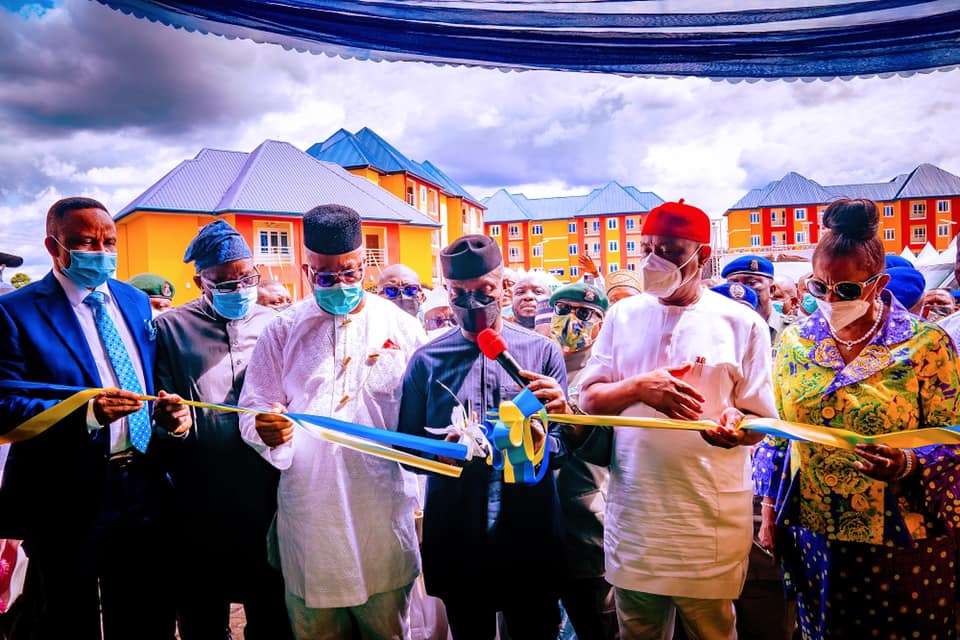
The Niger Delta Development Commission (NDDC)-built office and residential complex for the Base 6 of the Special Protection Unit (SPU) of the Nigeria Police Force, in Omagwa, Ikwerre Local Government, has been commissioned by President Muhammadu Buhari.
The intervention infrastructure consists of an administrative block, armoury, gate house, underground cell, and 66 units of accommodation made up of the commander’s residence, second-in-command’s residence, and 64 one-bedroom flats.
Buhari, represented by the Vice President, Prof. Yemi Osibanjo, yesterday, noted, “Today’s event meets two objectives. First, it is an important part of our government’s commitment to improve lives and livelihoods of police officers and men. It is also another milestone in my administration’s pursuit of the peace, prosperity and development of the Niger Delta.
“Establishing adequate security is integral to this objective, which is why we have committed significant resources to projects such as we are about to commission.
“This project is a means by which we can alleviate the accommodation challenges for senior security personnel posted to Rivers State, and ultimately enhance the security footprint in the region.
“The cumulative impact of this and similar projects would be the improvement of security in the state, and consolidation of the economic and social life of the people of this area.”
Buhari stated that the reform of the police force also included yearly recruitment target that have been set to increase the number of police personnel. He said, already, the process is on to equip the personnel with personal gears and hardwares.
“It is my understanding that the contract for this building was originally awarded in 2012 but was stalled by a series of delays. I am gratified that it has finally been delivered.
“This project is important because it is a means by which we can alleviate the accommodation challenges of senior security personnel posted to Rivers State and ultimately enhance the security footprint in the region. The cumulative impact of this and other similar projects will be the improvement of security in the state and the consolidation of the economic and social life of the people of the area.”
In his remarks, Rivers State Governor, Chief Nyesom Wike, berated the NDDC for taking about eleven years to complete the SPU Base 6 housing projects.
According to Wike, it is, however, not surprising because NDDC projects, often, are abandoned due to poor conceptualisation, political in nature and without commensurate provision of fund.
“Mr. Vice President, this is my first time of attending what NDDC is doing. In fact, I don’t know who gave out the information. About seven months ago, I had decided to take over this property for security reasons. I’m sure somebody must had told the interim head, that look, better go and complete the project, as the governor is about taking them over.
“You see, this is the problem with Nigeria. Look at a project like this that was awarded in 2011/2012. Ten years after is when we are commissioning it. This project shouldn’t have lasted this long. The minister has told us here that over 13,777 projects of NDDC were abandoned. Why will they not be abandoned when they’re projects without conceptualisation, projects being done politically, projects with no funding.”
Wike said the problem of non-performance of NDDC should not be blamed on the commission alone, but also on Abuja portfolio contractors and other political interests who are seeking compensation from those they have assisted to positions within NDDC.
According to Wike, these people have all ensured that the commission remained as a cash cow to serve as avenue to siphon money for their election purposes.
“Let nobody say that the problem of NDDC is only of the Niger Delta, no. The problem of NDDC is from the entire Nigeria. You have the Abuja problem, and you have the Niger Delta problem here.”
Speaking further, Wike urged the leadership of NDDC to fulfil its promise to pay N2.5billion, as counterpart funding, for the reconstruction and expansion of the Eastern Bye-Pass Road that leads to their corporate headquarters office in Port Harcourt.
The governor also told NDDC to adopt the culture of synergising with governors of states in Niger Delta to understand their needs in order to achieve a uniform and purposeful development.
While commending the current interim committee for their dogged determination to right the wrongs of the past and completing projects it inherited, Wike also lauded the Inspector General of Police for removing politics from the posting of police commissioners to the state.
“This is the only IG, I have seen, since 2015, I have had over 15 commissioners of police. They change them by the minute and that had affected the security architecture. Look at the peace we are having in Rivers State, today, it’s because the security agencies in this state are now apolitical.”
Wike also used the occasion to reaffirm that he was not leaving the Peoples’ Democratic Party, which he described as the hope of Nigeria.
“I thought we came fully to commission this project. I didn’t know that former Governor Akpabio will turn it to a political rally. But, let the records be straight. I prefer to stay where there is malaria, than to go to where there is cancer. Former Governor (Akpabio), malaria is treatable. With cancer at 4th stage you’re likely to die. I don’t want to die now. I’m very comfortable to remain where Nigerians have hope.”
Also speaking, the Inspector General of Police, Alkali Baba Usman, said, “The SPU building is a legacy project, first as the first major purpose-built facility for the SPU since its establishment in 2009. It demonstrates NDDC’s commitment to supporting President Buhari and the police in the task of internal security.
“It will enhance the operational efficiency of the police in Rivers State, especially in the host environment, and also help government in addressing housing deficiency in the country.”
In his address, the Sole Administrator, NDDC, Effiong Akwa, said that, “the Project was abandoned for 10 years as all six contractors were owed for various milestones completed.”
He said the commission under his headship, with push from the president, has been able to complete it against all odds, particularly with paucity of funds, aggravated by reluctance of oil firms to remit funding to the commission in defiance of the NDDC Act.
Akwa said, “Oil companies are reluctant to remit funds against the provisions of the act establishing NDDC. When you confront them, they give all sorts of excuses, creating funding challenges for the commission.”
By: Lilian Peters



The Chief of Army Staff (COAS), Lt.-Gen. Waidi Shaibu, has tasked troops of Operation SAVANNAH SHIELD to dominate the battlespace and intensify offensive operations against kidnappers, bandits and other criminal elements in the North Central region.
Shaibu gave the directive yesterday during his maiden operational visit to the Headquarters, Joint Task Force North Central (JTF-NC), at Sobi Barracks, Ilorin.
This is contained in a statement by the Acting Director, Army Public Relations, Col. Appolonia Anele, in Abuja, yesterday.
Shaibu said the Nigerian Army would remain resolute in its constitutional responsibility of safeguarding lives and property, stressing that troops must sustain pressure to decisively deny criminal elements freedom of action.
He assured personnel of continued deployment of combat enablers and operational resources to enhance clearance operations and dismantle criminal hideouts across Kwara and Niger states.
The COAS reaffirmed his commitment to troop welfare, noting that improved welfare remained critical to sustaining morale, operational effectiveness and combat readiness.
He urged the troops to remain disciplined, professional and loyal to the Constitution and the democratically elected government.
Earlier, the Theatre Commander, JTF-NC Operation SAVANNAH SHIELD, Maj.-Gen. Yakubu Yahaya, commended the COAS for his strategic leadership and support.
Yahaya assured that troops would remain committed and steadfast in restoring peace and stability in the region.

The Nigerian Navy says it is expanding training and infrastructure to address emerging security threats and strengthen operational efficiency across formations and units nationwide.
The Chief of Naval Staff, Vice Adm. Idi Abbas, spoke during the inauguration of projects at the Nigerian Navy Basic Training School (NNBTS) in Onne, Rivers as part of activities marking the Nigerian Navy’s 70th anniversary.
Abbas, represented by the Flag Officer Commanding, Naval Training Command (NAVTRAC), Rear Adm. Ebiobowei Zipele, said the projects reflected significant progress made by the navy since its establishment in 1956 from the British Royal Navy.
“Training and infrastructure have improved significantly to meet contemporary security challenges and fulfil the navy’s constitutional responsibilities.”
According to him, the anniversary provides the navy an opportunity to reflect on its achievements and contributions over the past seven decades.
Projects inaugurated included a remodelled female trainees’ hostel accommodating more than 500 occupants and an expanded golf course upgraded from one to nine holes.
Others were the NNBTS fuel dump, Chief Boatswain’s Mate House, renovated pharmacy department and a new theatre block at the Naval Medical Centre, Onne.
Abbas described the new theatre as a major milestone for the navy’s medical services.
“Previously, injured personnel requiring surgeries were referred outside the facility.
“With this theatre, surgeries can now be conducted within the base.’’
He added that a 30KVA inverter had also been installed to guarantee uninterrupted electricity supply at the training school.
The naval chief assured officers, ratings and trainees that the navy leadership remained committed to their welfare and wellbeing.
“These infrastructure upgrades show the commitment of the Chief of Naval Staff to addressing operational and welfare challenges promptly,” he said.
In addition, NAVTRAC distributed educational materials to pupils of Community Primary Schools One and Two, Ogale, in Ebubu-Eleme area of Rivers.
Items distributed included exercise books, school bags and other writing materials as part of the navy’s civil-military engagement initiative.
Zipele said the outreach was designed to strengthen relations between the navy and host communities while supporting children’s education.
“Education remains critical to national growth and youth empowerment. Some of these pupils may eventually serve in the Nigerian Navy,” he said.
He noted that the initiative demonstrated the navy’s commitment to educational development, peace, security and sustainable community relations.
Zipele urged the pupils to remain disciplined, focused and committed to their studies while embracing patriotism, integrity and hard work.
He thanked the Ebubu community for its continued support for the naval training command headquarters and the navy.
-
News18 hours ago
Obuah’s Victory Excites Former Lawmaker as APC Primaries Conclude in Rivers West
-

 Politics3 days ago
APC PRIMARIES: FUBARA’S WITHDRAWAL, HISTORIC SACRIFICE FOR NATIONAL STABILITY ……. GROUP
-

 News3 days ago
Court Sentences Seven To Death Over Murder Of Cleric In Rivers
-
News20 hours ago
105 Nigerians Killed In S/Africa In Seven Years
-

 Sports3 days ago
PH Arsenal Community Set For Streets Procession, Saturday
-

 Politics3 days ago
IPAC Flays INEC Over Election Guidelines Judgement
-

 Politics3 days ago
NDC To Adopt Electronic Voting For Future Primaries
-

 Politics3 days ago
Otu Vows To Recall Indolent, Arrogant Cross River Legislators