
Politics
Soludo Picks APGA Guber Ticket In Anambra

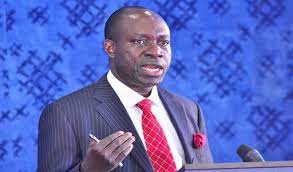
Former Governor of Cetral Bank of Nigeria (CBN), Prof. Chukwuma Soludo has won all the 21 local government areas of Anambra State in the governorship primary election held in Awka on Wednesday by the All Progressives Grand Alliance, APGA, for the November 6 election.
The election was held by the Chief Victor Oye faction of the party, which also has the support of the only governor of the party, Chief Willie Obiano of Anambra State.
Soludo in the primary election which he contested with four other aspirants, Hon ThankGod Ibe, Hon Okwudili Ezenwankwo and Barr Damian Okolo, scored 740 votes out of the total 792 votes cast in the election.
Soludo’s challengers, Okwudili Ezenwankwo got 41 votes,
ThankGod Ibe 10 votes and Okolo Damian seven votes.
Announcing the result at the Prof Dora Akunyili Women’s Development Centre, the Chief Returning Officer of the party, Mr Olalere, who is the Vice Chairman Southwest of the party said: “By the power conferred on me as the Chief returning officer of the election, I hereby declare Prof Chukwuma Soludo the duly elected candidate of APGA for the November 6 governorship election.”
Speaking immediately after the declaration, the Governor of Anambra State, Chief Willie Obiano assured the candidate and members of the party that the party would again win the governorship election in November overwhelmingly as it did in 2017.
“I want to commend the National Working Committee, the state working committee for the peaceful conduct. It is exceptional. Just know that the job has just started and we are going to win over 21 local government areas again as we did in 2017,” he said.
In his acceptance speech, Prof Soludo thanked the members of the party for choosing him as their flagbearer and promised to unveil his manifesto for the election in August.
The Tide source reports that five aspirants of the party, Akachukwu Nwankpo, Nonso Okafor, Carter Dike, Chuma Umeoji and Ifeanyi Ozoka, who were disqualified weeks back, boycotted the exercise, giving indication that they may participate in the Jude Okeke faction of the party primary election.



Alhaji Abubakar, who is also the 2027 presidential candidate of the African Democratic Congress (ADC), stressed that Chief Obasanjo’s latest public outburst against him is yet another failed attempt to rewrite history.
Alhaji Abubakar specifically said that if the true history of Chief Obasanjo’s political journey is ever written—free from selective recollection and personal bitterness, he (Atiku) would feature prominently as one of those whom God used to change the course of his (Obasanjo) life and political career.
These were contained in a statement the Senior Special Assistant on Public Communication to the former Vice President, Mr Phrank Shaibu, released in which Atiku said he watched the former President’s interview with profound sadness, but not anger, because it reflected the disposition of a man who has allowed personal resentment to cloud historical truth.
Alhaji Abubakar said the genesis of Chief Obasanjo’s hostility towards him is well known to Nigerians, stressing that he is proud that he stood against the third-term agenda and stood by the constitution of the Federal Republic of Nigeria.
In the words of Alhaji Abubakar: “I have no apology whatsoever for frustrating every attempt to subvert our democracy for personal ambition. If Chief Obasanjo’s bitterness stems from my refusal to support an unconstitutional third term, then I wear that resentment as a badge of honour.
“No individual, regardless of his status or accomplishments, is bigger than the Federal Republic of Nigeria. The Constitution is supreme, and I chose Nigeria over personal loyalty”.
Alhaji Abubakar noted that the struggle against the third-term agenda was never about two individuals, but about preserving Nigeria’s constitutional democracy for future generations.
He said: “The Nigerian people won that battle. Democracy won that battle. History has already delivered its verdict. It Is therefore unfortunate that the same man whose unconstitutional ambition was resisted now seeks to sit in judgment over those who defended the Constitution”.
The ADC Presidential candidate said it was particularly instructive that barely twenty-four hours before Chief Obasanjo’s latest outburst, the Director-General of the World Trade Organization (WTO), Dr. Ngozi Okonjo-Iweala, publicly paid glowing tribute to the economic management team he led, describing it as “the best Nigeria has ever had”.
“Whether or not the timing is merely coincidental is for Nigerians to judge. What is beyond dispute, however, is that while distinguished Nigerians who served at the highest levels continue to acknowledge my contributions to one of Nigeria’s most successful periods of economic management, Chief Obasanjo appears determined to diminish them.
“Chief Obasanjo may choose not to appreciate my role in building one of Nigeria’s most prosperous economic eras, but history has been far kinder. The record speaks for itself, and so do the testimonies of those who worked closely with that administration,” he said.
Alhaji Abubakar further stated that Nigerians also deserve to remember the other side of history which Chief Obasanjo conveniently omits, saying: “History records that while Chief Obasanjo was in prison, I stood firmly by him. I supported his family, worked tirelessly with other patriots for his release and never wavered in my belief that he deserved his freedom”.
He further said: “When he eventually regained his freedom, he had little to his name. I received him, clothed him, ensured he was properly cared for and extended every support necessary to help him regain his footing.
“Beyond that, I mobilised political structures, built alliances and made enormous personal and political sacrifices that culminated in his emergence as President of the Federal Republic of Nigeria”.
Alhaji Abubakar, however, said he harbours no regrets over any of those acts.
According to him: “Do I regret helping Chief Obasanjo? Absolutely not. When God gives you the opportunity to lift another human being, you do so without expecting repayment. Acts of kindness are matters of conscience, not commercial transactions”.
He added, however, that gratitude should never be replaced with revisionism.
Alhaji Abubakar particularly expressed disappointment that, at a time when Nigeria is battling economic hardship, mass unemployment, insecurity and widespread despair, a former President would devote so much energy to recycling old grudges instead of contributing solutions to the country’s challenges.
In the words of Atiku: “The 2027 election should be about rebuilding Nigeria, restoring security, reviving the economy and giving hope to the next generation—not reopening old political wounds”.
The former Vice President said he had deliberately maintained restraint over the years out of respect for the office Chief Obasanjo once occupied and in deference to the relationship they once shared.
He said: “That restraint should never be mistaken for weakness or docility. There comes a point when silence in the face of repeated distortions of history ceases to be a virtue. While I have no desire to engage in a public quarrel with a man I once stood beside in his most difficult moments, neither will I permit falsehoods, half-truths and calculated attempts to rewrite history to go unanswered.
“Chief Obasanjo is entitled to his opinions. He is entitled to his personal grievances. What he is not entitled to, are his own facts,” Alhaji Abubakar insisted.
The ADC presidential candidate reaffirmed that his attention remains firmly fixed on Nigeria’s future.
According to him; “I have chosen the path of service over resentment, vision over vendetta and national renewal over personal recrimination. Those who mistake my civility for capitulation, or my restraint for weakness, make a grave mistake.
“History is stubborn. It cannot be rewritten by bitterness, nor erased by repeated falsehoods. In the end, history will render its verdict—and so will the Nigerian people,” he stated.
According to the electoral umpire, campaigns for the presidential and National Assembly elections will commence on August 19, 2026, and end on January 15, 2027, exactly 24 hours before the elections scheduled for January 16, 2027.
INEC also announced that campaigns for governorship and State Houses of Assembly elections will begin on September 9, 2026, and conclude on February 5, 2027, ahead of the polls slated for February 6, 2027.
The commission explained that the campaign schedule complies with the Electoral Act 2026, which stipulates that electioneering activities must not begin earlier than 150 days before an election and must end at least 24 hours before voting.
INEC urged political parties, candidates and other stakeholders to strictly adhere to the approved timetable and conduct their campaigns in accordance with the law, while encouraging the public to obtain electoral information only from its official communication channels to avoid misinformation.
-

 News5 hours ago
Soldier, Police Officer Killed As Army Rescues Nine Abductees In Zamfara
-
 News5 hours ago
PH NBA Election: Committee Uncovers Over 500 Padded Names On Voters’ Register
-
 News5 hours ago
Fubara Reaffirms Commitment To Creating Conducive Environment For Business Growth …Commissions Paint Manufacturing Plant
-
 Rivers5 hours ago
Women Renew Call For Unity, Back Fubara’s Political Direction
-

 Oil & Energy4 hours ago
NEDC Plans N100b Power Grid For 102 Council Areas
-
 Business4 hours ago
Asaba Private Jet Incident Was A Security Violation—Keyamo
-
 Oil & Energy4 hours ago
NGLPP: FG Targets 5m Households By 2030
-
Sports5 hours ago
INEC Seeks Media Partnership, Declares Readiness For Osun Guber Poll