
Politics
PDP Decampees, Mere Political Neophytes -Wike

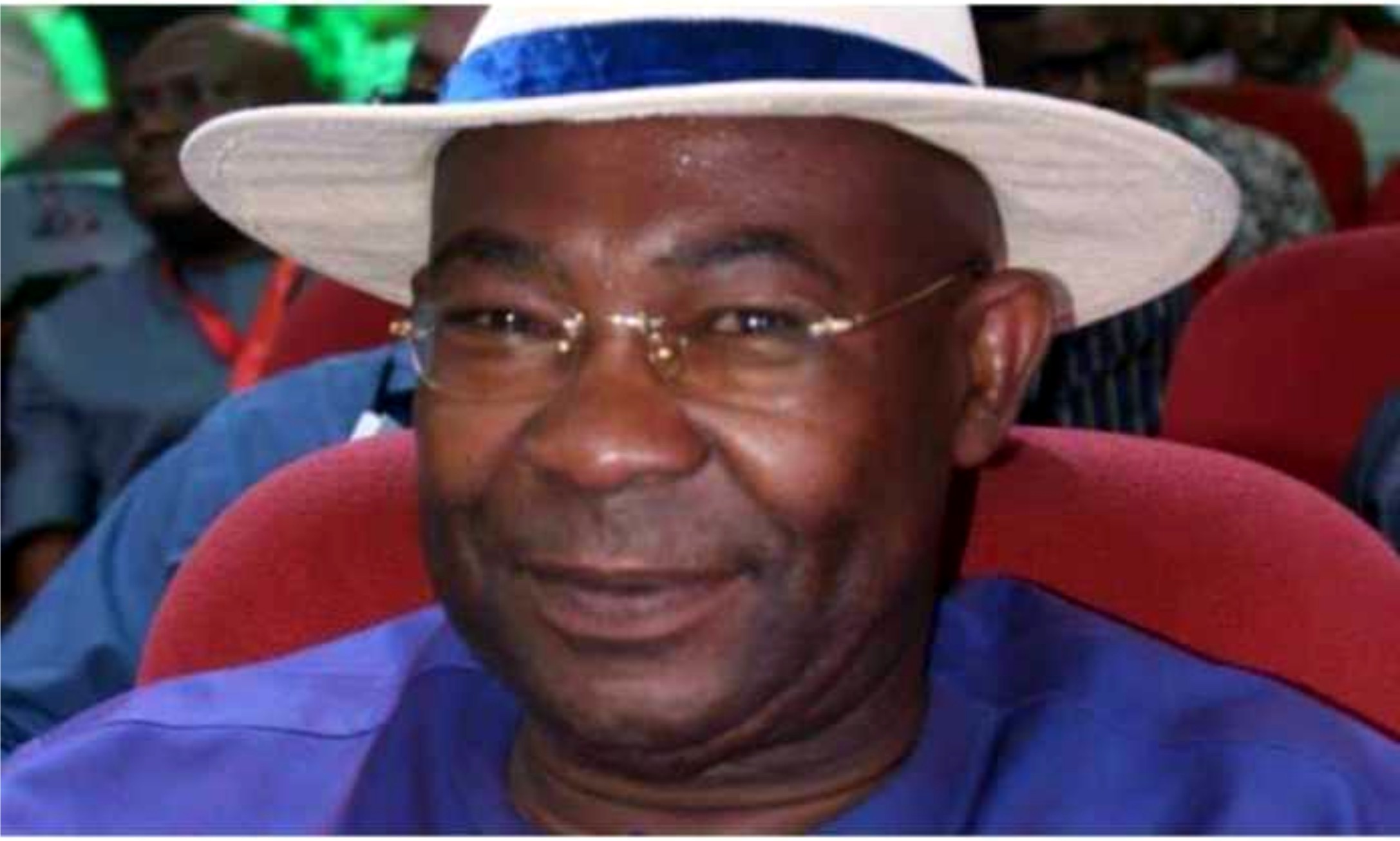
The Rivers State Governor, Chief Nyesom Wike, has described two former Peoples Democratic Party (PDP) members, Dr John Bazia and Michael West, who recently decamped to the All Progressives Congress (APC) in the state, as political neophytes, with slippery characters.
He said the two men, who served as commissioners in his cabinet during his first tenure, became disgruntled because he did not retain them.
The governor while speaking on a live television programme in Port Harcourt, last Friday, said the decision of Bazia and West to decamp to the APC was of no political consequence because they were politically irrelevant.
“What are the qualities of the people that defected? The two people: Michael West and John Bazia, who knew them in my cabinet? Have you ever heard them speak on behalf of PDP before? Have you ever heard them speak on behalf of our administration?”
He further said, “You knew the position of Dr Chidi Llyod when he was in APC. Ask the former Commissioner for Transport (Michael West), he contested PDP primaries with me, and got only three votes, but because of politics of carrying everybody along and the money he spent, I decided to accommodate him. He was commissioner for transport, ask him his contribution to the administration.”
The governor explained that during his first tenure, he almost sacked West as a commissioner for taking 13 luxurious buses belonging to the state government to Calabar for a spiritual programme, and also diverting funds generated by the task force on transport into his personal accounts.
“I called the commissioner for transport, and asked him of his whereabouts. He told me he was in Calabar to see his father, the Olumba Olumba. I was amazed, and said: you took our 13 buses to Calabar without permission? I would have sacked him that day. People prevailed on me to manage him till after the election.
“Task force personnel were collecting money and paying into the commissioner for transport’s private accounts. I called him in the State Executive Council meeting, and ask: how would you pay state money into your private account? I managed him till the end of my first tenure. You expect me to bring this kind of person to my cabinet again?
The governor said the reason given by West for his resignation from the PDP was that they didn’t allow him to head his ward executive committee of the party.
“So, how can we give somebody we know will be leaving the party EXCO position? So, that when he is defecting, he will say he has defected with the entire EXCO? He thinks he is smarter than anybody? These are neophytes in politics. We all kept our eyes on them.”
Speaking on former Commissioner for Chieftaincy and Community Affairs, Dr John Bazia, the governor revealed that while serving in the State Executive Council, Bazia caused him so much embarrassment.
“During the 2015 presidential campaign, the President brought Kola to the Traditional Rulers. You can’t believe what happened: the chairman of Rivers State Traditional Rulers Council called me that the chiefs are waiting for their Kola. I was amazed and asked, which Kola? You have not received it? They said no. The then commissioner for information, who was the chairman of the sub-committee of our campaign, said they gave the Kola to John Bazia. Do you know what Bazia did? He took 80 per cent and brought 20 per cent of the Kola to the traditional rulers!
“The then commissioner for information got angry and slapped him, and called him ‘armed robber’. Everybody was angry, and compelled him to bring the Kola. What an embarrassment!”
Wike also narrated how he had to personally intervene and pay off €40,000 debt Bazia was owing.
He explained that his administration has done several projects in both Tai and Asari-Toru LGAs where the two decampees hail from.
The governor described as laughable the allegation that he was constructing seven flyover bridges in Port Harcourt and Obio/Akpor LGAs, and declared that he would be constructing additional three flyover bridges in Port Harcourt to ease traffic congestion.



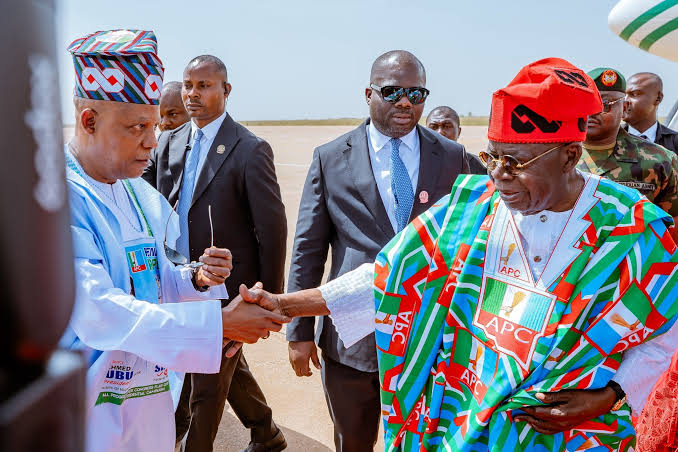
The campaign rally, held at the Kaduna Township Stadium, attracted Vice-President Kashim Shettima, APC governors, party leaders, federal and state lawmakers, political stakeholders and supporters from across the country.
The flag-off marks the beginning of the APC’s drive to secure a second presidential term for President Tinubu, with the party expected to promote its achievements, defend its economic reforms and outline its policy priorities under the proposed Renewed Hope 2.0 agenda.
Kaduna’s selection for the campaign launch underscores the strategic importance of the North-West, a region with a substantial voting population and considerable influence on presidential election outcomes.
The APC faces a significant challenge in Kaduna, where the Peoples Democratic Party’s presidential candidate, Alhaji Atiku Abubakar, defeated President Tinubu in the 2023 election. The rally therefore provides the ruling party an opportunity to strengthen its grassroots structures and regain electoral support in the state.
Addressing supporters, Vice-President Shettima appealed to Northern voters, highlighting President Tinubu’s political relationships with prominent Northern leaders, including Alhaji Abubakar, Mallam Nuhu Ribadu and the late President Muhammadu Buhari.
The Vice-President’s appeal reflects the APC’s determination to consolidate its support in the North as the party intensifies preparations for the presidential contest.
The Renewed Hope 2.0 agenda is expected to feature prominently in the campaign, providing a platform for President Tinubu to explain his administration’s economic policies and outline plans for another term.
However, the President’s record on economic reforms, rising living costs, petrol prices, employment, infrastructure and insecurity is expected to attract considerable scrutiny during the electioneering period.
-
 Education2 days ago
FCE Yola Graduates 3,555 Teachers , Seeks Upgrade to University
-

 Sports2 days ago
Nigerian Trio Target Titles At PFL Africa Finals
-
 Niger Delta2 days ago
Diri Restates Stance On Lagos-Calabar Coastal Highway
-
 Niger Delta2 days ago
C’River, NUJ Pay Tribute To Late Guardian Editor
-

 News2 days ago
NDLEA Recovers Tons Of Illicit Drug Consignments In Nine States
-
 Opinion2 days ago
Checking Voter Apathy In Nigeria’s Electoral Process
-
 Politics2 days ago
2027: DICKSON’S EX-ALLY VOWS TO WORK AGAINST NDC INTEREST IN BAYELSA
-
 Politics2 days ago
2027: GROUP PLEDGES 40,000 SUPPORTERS FOR COALITION CANDIDATES IN RIVERS