
News
Buhari Presents 2020 Budget To NASS, Tuesday

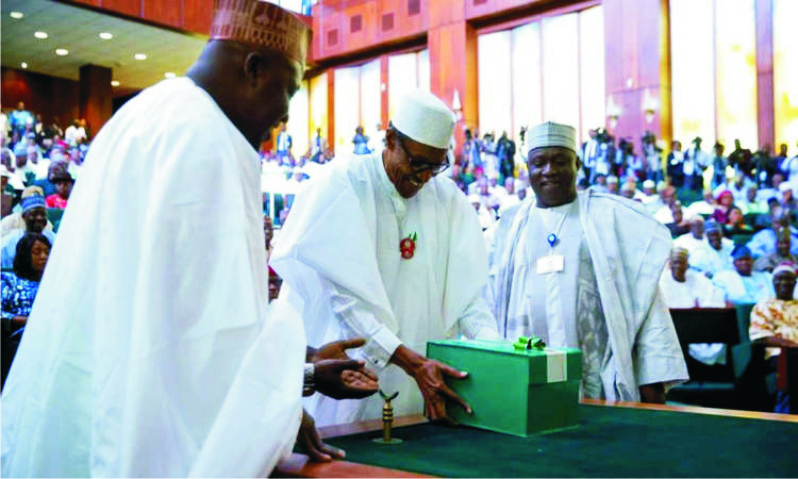
President Muhammadu Buhari will next Tuesday present the 2020 budget to the joint session of the National Assembly.
This was disclosed by the Senate President, Dr. Ahmad Lawan, yesterday.
Lawan made the disclosure in a letter from Buhari, which he read to the lawmakers on the presentation of the 2020 Appropriation Bill on Tuesday, 8th October, 2019 to the Joint Session of the National Assembly.
The reading of the letter comes after the Senate, yesterday, passed the 2020-2022 Medium Term Expenditure Framework and Fiscal Strategy Paper (MTEF/FSP) submitted to it by President Muhammadu Buhari, last week.
This followed the presentation and consideration of the report of the Senator Solomon Adeola-led Senate Committee on Finance by the Red Chamber in Abuja.
The upper chamber in the approved MTEF/FSP for 2020-2022 increased the Federal Government’s proposed expenditure for 2020 from N10.002trillion to N10,729.4trillion.
The Senate also increased the oil benchmark from $55 per barrel to $57 per barrel, representing a $2 increase.
The Senate also increased the 2020 revenue target by the Nigeria Customs Service (NCS) by N557.4billion, that is, from N942.6billion to N1.5trillion.
It, however, retained the exchange rate at N305 per dollar and oil production benchmark at 2.18mbpd as proposed in the MTEF/FSP by the executive.
The committee also recommended the adoption of N1.5trillion as the amount for new borrowing by the Federal Government in 2020, as a result of reduction of N200billion which was sourced from the increase of revenue target of the Nigeria Customs Service.
The committee further called for an urgent review and amendment to the Fiscal Responsibility Act (FRA Act) and the various laws of the revenue generating agencies to align with current realities.
This information form part of the recommendations of the National Assembly Joint Committee on Finance report on 2020-2022 MTEF/FSP which was considered by the Senate in Abuja, yesterday.
The committee’s recommendations which were approved by the Senate are as follows: “Following intensive engagement with NNPC and relevant information obtained during the session, the committee recommends the adoption of 2.18mbpd as daily production output in 2020. In view of concerted effort by NNPC and security agencies the menaces of oil theft and vandalization, the 2.18mbpd would be realizable.
“The committee recommends the adoption of $57/barrel as crude oil benchmark price for the fiscal year 2020.
“The revenue target of Nigeria Customs Service (NCS) of N942.6billion for 2020 should be increased to N1.5trillion, as a result of the performance of NSC in last nine months with three months still outstanding.
“The NCS revenue as at September stood at N1trillion against the budget figure of N969.8billion for the year 2019. The Joint Committee commends the NCS for exceeding the targeted revenue despite the global economic challenges and closure of the Nigerian borders.
“The sum of N557.4billion from the revenue increment of NCS be used to reduce borrowing by N200billion and increase capital expenditure thereby decreasing the size of the budget deficit from N1.7trillion to N1.5trillion and also increase the total capital available to MDA by N357billion, from N1.01trillion to N1.367trillion.
“The exchange rate of N305/$ should be maintained for economic stability. While more work should be done by the Honourable Minister of Finance and all economic advisers and her team on improving the economic growth by increasing the GDP and reducing the inflation rate to single digit.
“The saving on income accruing from the increase of the benchmark amounting to N172billion which represent the Federal Government portion of the $2 added to the benchmark be used to pay salaries and emolument of the proposed 30,000 new employees.
“Proper investigation be carried out on the e-collection stamp duties domicile with Central Bank of Nigeria (CBN) for the past years so as to show probity and accountability and of course increase the revenue base of the country.
“Immediate amendment of the National Assembly Act on Production sharing Contracts (PSC) with lOCs. Proper investigation be carried out on NNPC so as to ascertain the actual cost associated with the Joint Venture agreements.
“More government-owned enterprises budget be added to the nation’s budget to ensure proper checks and balances among all Federal Government agencies.
“Debt Management Office (DMO) should put more efforts and strategies in managing foreign and local debts.
“Total estimated expenditure of the Federal Government should be increased from N10.002trillion to N10.729.4trillion.
“National Assembly should expedite action on the passage of the finance bill which will be brought along with the National Budget into Law for easy implementation of the 2020 budget, most especially in the area of VAT.
“The committee calls for an urgent review/amendment to the FRA Act and the various laws of the revenue-generating agencies to align with current realities.
“The committee recommends earmarking 1 per cent of the Consolidated Revenue Fund to finance the Basic Healthcare Provision Fund to be classified as Statutory Transfer.
“The committee recommends the adoption of N1.5trillion as the amount for new borrowing as a result of reduction of N200billion which was sourced from the increase of revenue target of the Nigeria Customs Service.
“However, borrowing must be project-tied. ln borrowing, government must remain focused and ensure that it used the money to fund critical projects that will increase productivity and contribute to finance financing such debt.”
The committee in its findings observed that crude oil receipt accounted for over 50 per cent of Federal Government revenue and about 90 per cent of Nigeria’s foreign exchange earnings.
“Therefore, crude oil production and export will continue to have important implication on federal fiscal operation.
“Over the last three years crude production average 1.92mbpd, however, following consultations with stakeholders, crude oil production is estimated at 2.18mbpd, 2.2mbpd and 2.3mbpd in 2020, 2021 and 2022,” the committee said.
The committee also noted that oil prices had generally been rising since April, 2016 as Bonny Light crude oil price rose from an average of $43 per barrel in 2016 to $56.2 in 2017 and $72.1 in 2018 partly due to geopolitical tensions.
It said that 2019, Bonny Light crude oil price increased steadily from January average of $60/barrel (to) a six-year high well above $70/barrel between April and May, 2019.
“It is noteworthy, that volatility of crude all markets and fluctuating price requires constant review and forecast.
“The non-oil revenue for 2020, 2021 and 2022 is budgeted to be as follows: N1,836,693,720.000; N2,205,807,930,754 and N2,337,091,481,680, respectively,” the committee said.
The committee further said it observed during the public hearing on the 2020-2022 MTEF & FSP, that the salaries and remunerations for the proposed recruitment of 30,000 personnel in Police, Army, Immigration and civil defence was not captured.
It also said that the total VAT proposed in the 2020-2022 MTEF/FSP amounting to N23trillion can be realized only after the amendment of the finance bill is passed into law by the National Assembly.
The committee, however, frowned at the attitude of Central Bank of Nigeria (CBN) for the under disclosure of the e-collection of stamp duties.
The committee further observed that the activities of NNPC as it relates to cost of production is shrouded in secrecy, “the direct deduction of cost from revenue without recourse to relevant agencies of government is unacceptable.”
It also noted that 10 government-owned enterprises (GOEs) budget would be presented along with the 2020 National Budget
“These GOEs include FAAN, NCAA, NlMASA, NPA, NAMA, Shippers Council, NDIC, NCC e.t.c.,” the committee said.
The findings read in part: “The committee observed that the exchange rate of N305/$ is maintained over the past three years. Also noted that the GDP growth rate is currently standing at 2.93 per cent and an inflation rate at 10.81 per cent.
“That most of the revenue-generating agencies have failed to comply with relevant extant law of the Fiscal Responsibility Act which stipulates payment of 80 per cent of operational surpluses to the Consolidated Revenue Fund.
“The committee observed that the Federal Government is stepping up investment in health and education to fill the skills gap in the economy, and meet the international target set under the UN’s Sustainable Development Goals (SDGs).
“The Federal Government is earmarking 1 per cent of the Consolidated Revenue Funds to finance the Basic Healthcare Provision Fund to be classified as Statutory Transfer. Federal Government believes that investing in people is a core objective of ERGP.
“Government is taking steps to enhance human capital development particularly in health, education and social intervention programs in other to reduce poverty.
“Based on the joint IMF-World bank debt sustainability framework which has a Debt/GDP threshold of 56 per cent for countries in Nigeria’s Peer Group, Nigeria’s debt is expected to remain sustainable within the MTEF period.
“This implies that Nigeria Debt/GDP ratio of 19.39 per cent can afford it to expand its borrowing limits. As at 31st December, 2018, Nigeria public debt stock is valued at N24.387trillion ($79.436billion), rising at an average of 12.24 per cent per annum.
“With regard to 2020 fiscal year, the estimated budget deficit is N1.70trillion and it will largely be financed through borrowing as it has been the tradition while also additional financing of N252.08billion will be derived from privatization proceeds and N328.13billion from loans secured for specific developmental projects.
“The committee further observed that Nigeria’s current debt profile is not alarming as expressed in some but within the threshold of 3 per cent as contained in the Fiscal Responsibility Act.”
Each of the recommendations was unanimously adopted by the Senate when they were put to voice vote by the President of the Senate, Dr Ahmad Lawan.
Similarly, the House of Representatives has approved the 2020 to 2022 Medium Term Expenditure Framework (MTEF) submitted to it by President Muhammadu Buhari.
In the approval, the House jerked up the 2020 budget size from N10.002trillion contained in the MTEF to N10.729trillion.
It also adopted $57 as a benchmark as the price for a barrel of oil in the international market, placing N305 per dollar as official exchange rate while adopting production of 2.18 million barrels of crude per day.
The House gave the approval at the Committee of Supply when it considered the MTEF, yesterday.
Part of the resolutions read thus: “That the total expenditure of the Federal Government should be an increase from N10.002trillion to N10.729.4trillion.
“That the exchange of N305/$ should be maintained for economic stability while more work should be done by the minister of finance and her team and all economic advisers on improving economic growth by increasing the GDP and reducing the inflation rate to a single digit.”



The Chief of Army Staff (COAS), Lt.-Gen. Waidi Shaibu, has tasked troops of Operation SAVANNAH SHIELD to dominate the battlespace and intensify offensive operations against kidnappers, bandits and other criminal elements in the North Central region.
Shaibu gave the directive yesterday during his maiden operational visit to the Headquarters, Joint Task Force North Central (JTF-NC), at Sobi Barracks, Ilorin.
This is contained in a statement by the Acting Director, Army Public Relations, Col. Appolonia Anele, in Abuja, yesterday.
Shaibu said the Nigerian Army would remain resolute in its constitutional responsibility of safeguarding lives and property, stressing that troops must sustain pressure to decisively deny criminal elements freedom of action.
He assured personnel of continued deployment of combat enablers and operational resources to enhance clearance operations and dismantle criminal hideouts across Kwara and Niger states.
The COAS reaffirmed his commitment to troop welfare, noting that improved welfare remained critical to sustaining morale, operational effectiveness and combat readiness.
He urged the troops to remain disciplined, professional and loyal to the Constitution and the democratically elected government.
Earlier, the Theatre Commander, JTF-NC Operation SAVANNAH SHIELD, Maj.-Gen. Yakubu Yahaya, commended the COAS for his strategic leadership and support.
Yahaya assured that troops would remain committed and steadfast in restoring peace and stability in the region.

The Nigerian Navy says it is expanding training and infrastructure to address emerging security threats and strengthen operational efficiency across formations and units nationwide.
The Chief of Naval Staff, Vice Adm. Idi Abbas, spoke during the inauguration of projects at the Nigerian Navy Basic Training School (NNBTS) in Onne, Rivers as part of activities marking the Nigerian Navy’s 70th anniversary.
Abbas, represented by the Flag Officer Commanding, Naval Training Command (NAVTRAC), Rear Adm. Ebiobowei Zipele, said the projects reflected significant progress made by the navy since its establishment in 1956 from the British Royal Navy.
“Training and infrastructure have improved significantly to meet contemporary security challenges and fulfil the navy’s constitutional responsibilities.”
According to him, the anniversary provides the navy an opportunity to reflect on its achievements and contributions over the past seven decades.
Projects inaugurated included a remodelled female trainees’ hostel accommodating more than 500 occupants and an expanded golf course upgraded from one to nine holes.
Others were the NNBTS fuel dump, Chief Boatswain’s Mate House, renovated pharmacy department and a new theatre block at the Naval Medical Centre, Onne.
Abbas described the new theatre as a major milestone for the navy’s medical services.
“Previously, injured personnel requiring surgeries were referred outside the facility.
“With this theatre, surgeries can now be conducted within the base.’’
He added that a 30KVA inverter had also been installed to guarantee uninterrupted electricity supply at the training school.
The naval chief assured officers, ratings and trainees that the navy leadership remained committed to their welfare and wellbeing.
“These infrastructure upgrades show the commitment of the Chief of Naval Staff to addressing operational and welfare challenges promptly,” he said.
In addition, NAVTRAC distributed educational materials to pupils of Community Primary Schools One and Two, Ogale, in Ebubu-Eleme area of Rivers.
Items distributed included exercise books, school bags and other writing materials as part of the navy’s civil-military engagement initiative.
Zipele said the outreach was designed to strengthen relations between the navy and host communities while supporting children’s education.
“Education remains critical to national growth and youth empowerment. Some of these pupils may eventually serve in the Nigerian Navy,” he said.
He noted that the initiative demonstrated the navy’s commitment to educational development, peace, security and sustainable community relations.
Zipele urged the pupils to remain disciplined, focused and committed to their studies while embracing patriotism, integrity and hard work.
He thanked the Ebubu community for its continued support for the naval training command headquarters and the navy.
-
News2 days ago
Obuah’s Victory Excites Former Lawmaker as APC Primaries Conclude in Rivers West
-

 Politics4 days ago
APC PRIMARIES: FUBARA’S WITHDRAWAL, HISTORIC SACRIFICE FOR NATIONAL STABILITY ……. GROUP
-

 News4 days ago
Court Sentences Seven To Death Over Murder Of Cleric In Rivers
-
News2 days ago
105 Nigerians Killed In S/Africa In Seven Years
-

 Sports4 days ago
PH Arsenal Community Set For Streets Procession, Saturday
-

 Niger Delta2 days ago
Royal Father Endorses PH Arsenal Community, Pledges To Support
-

 Politics4 days ago
IPAC Flays INEC Over Election Guidelines Judgement
-

 Politics4 days ago
NDC To Adopt Electronic Voting For Future Primaries