
News
Tension In UCTH Over Appointment Of Director Of Administration, Others

The Cross River State Government representative in the Governing Board of the University of Calabar Teaching Hospital (UCTH), Legal Counsel of concerned staff of the institution and some applicants who applied for the post of Director of Administration in the Institution (UCTH) have petitioned the Chairman of the Governing Board over the appointment of Director of Administration (DA) by Federal Ministry of Health.
The Federal Ministry of Health had in a letter reference SMH/530/T/1/71, dated July 19th 2019, titled ’Re: Director of Administration, University of Calabar Teaching Hospital’ addressed to the Chairman of Governing Council signed by the Permanent Secretary, A. M. Abdullahi had appointed one Barr Eyoma Edetdet Obong as Director of Administration.
Interestingly, the institution in June 29, 2019 advertised for vacancy position of the Director of Administration following the retirement of the incumbent DA, Prof Archibong E. Archibong on September 10, 2019.
Though, the date for the expiration of the six weeks for the advertisement to elapsed, seven persons have already applied, suddenly, the Federal Ministry of Health shot down others from applying and appointed Barr Ededet Eyoma Obong against due process of screening, interview and appointment, our correspondent gathered.
The Board member who represented the Cross River State Government and also the Permanent Secretary in the State Ministry of Health, Dr Joseph A. Bassey petitioned the Board Chairman over the appointment of the DA. The petition dated August 1st 2019 titled Re: ‘Appointment of Director of Administration, University of Calabar Teaching Hospital’ regretted the flagrant abuse of due process by the Federal Ministry of Health.
“I wish to formally protest, in the interest of the Government and people of Cross River State whom I represented in the UCTH Board, against the letter from the Federal Ministry of Health reference SMH 530/T/1/71 of 19th July 2019 on the above subject matter signed by the Permanent Secretary and addressed to you.
“Mr Chairman Sir, I see this letter as a gross violation and complete usurpation of the powers of the legally constituted board of the only federal health institution located in our dear state and a call to anarchy with attendant lack of trust on the management and governing board of this institution which I refuse to be part of nor allow myself to be used to perpetuate injustice and illegality that has the potentiality of snowballing into unimaginable consequences from staff of the institution and interested members of the general public due to abrupt termination of the ongoing due process put in place by the governing board.
“Mr Chairman Sir, the directives that the current DA vacates office immediately and the appointment of a new substantive DA by the federal ministry of health by fiat, without recourse to the institution Governing Board and the University Act/extant rules and circular earlier quoted, is an aberration and a dangerous precedence in the history of the management of University Teaching Hospital in Nigeria.
“I wish to, therefore, call on this Board to toe the path of justice, fairness, equity, respect for due process and transparency in the process of appointment of a new DA that will take over from the incumbent when he finally bows out in a few weeks from now and advise the federal ministry of health against this chosen path of disregard to laws and procedures, conflicting directives,” he stated.
Dr Bassey noted that the institution already had enough issues to contend with, including cases of national consequences currently in court that originated right here in Calabar and “we should not allow ourselves to be dragged into another one,” he pleaded.
Consequently, the concerned staff of the Institution represented by a legal firm, A. B. Cobham and Associates in a petition to the Chairman of the Board dated August 2nd titled ‘Re: Director of Administration, UCTH: A Usurpation and an abuse of power ‘signed by A. B. Cobham regretted the action of the Federal Ministry of Health.




Rivers State Governor, Sir Siminalayi Fubara, has ordered a complete seal-off of the site of a five-storey building which collapsed last Wednesday, killing one person and injuring several others in Port Harcourt.
Fubara gave the order during his visit to the site of the collapsed building last Thursday to assess the situation.
He said the site will remain “completely sealed off” until the government gets to the “root cause” of the incident.
He described the incident as unfortunate but observed that preliminary investigation had shown that the developer had earlier refused to subject his site to inspection by the state authorities and comply with the necessary building regulations.
The governor, who inspected the site alongside the Commissioner for Physical Planning and Urban Development, Sir Amairigha Edward Hart, and the Permanent Secretary of the Ministry of Special Duties, Dabite Sokari George, explained that he couldn’t visit the site the previous day because he was awaiting formal briefing from the relevant agency of government on the situation.
“We’re here to see for ourselves the very unfortunate incident that took place here. I didn’t come yesterday because I wanted to get the report first, and the Commissioner did brief me that the incident site, first, is not as claimed by the developer, that it’s not under the jurisdiction of the state; that it’s under the jurisdiction of the Federal Housing Authority.
“He also informed me that when the project was ongoing, they came here severally to inspect what was happening and also to see the level of compliance. But unfortunately, that the developer kept claiming that we don’t have any right to interfere,” he said.
Fubara said that the issue was no longer about interference but about the life lost to the building collapse and the collateral damage brought upon the family of the deceased.
He extended condolences to the families of the victims, insisting that the incident could have been avoided if the developer had complied with the rules guiding the engineering design and construction of such a structure in the 21st century.
“We feel very sorry and very regretful that such an incident should be happening in this 21st century because technology has advanced, engineering has developed. I wonder what kind of engineer would even allow this kind of project to go on when everything about it from inception has been faulty.
“I think that at this point, nothing is going to happen on this site any more. We are going to make sure that this place is completely sealed off until we get to the root cause of this incident,” the governor said.
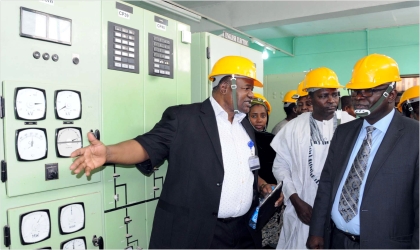
The Transmission Commission of Nigeria has announced electricity disruption in parts of Kano, Katsina, Jigawa, Bauchi, and Yobe States, as well as Gazaoua in the Niger Republic.
The spokesperson of TCN, Ndidi Mbah, disclosed this in a statement yesterday
The outage is due to planned maintenance at Kumbotos’ 330 kilovolt transmission substation on Sunday.
Consequently, electricity customers served by Kano Electricity Distribution Company, Kaduna Electricity Distribution Company, and Yola Electricity Distribution Company will experience power disruption.
“The scheduled maintenance is to enable the TCN contractor to continue the ongoing upgrade of 330kV bus II jumpers and replace the existing 350mm² conductors with 800mm² conductors in order to strengthen the transmission network and improve power reliability.
“As a result, Kano Electricity Distribution Company (KEDCO) and some part of Jos Electricity Distribution Company (JEDC) and Yola Electricity Distribution Company (YEDC) will be unable to off-take power for distribution to their customers in Kano, Katsina, and Jigawa States, as well as Azare in Bauchi State, Nguru in Yobe State, and also Gazaoua in the Niger Republic,” TCN stated.
The Socio-Economic Rights and Accountability Project (SERAP) has called on Senate President, Godswill Akpabio, and Speaker of the House of Representatives, Tajudeen Abbas, to refer allegations of the diversion or non-accounting of over ?6.3 billion in constituency project funds to anti-corruption agencies for investigation and possible prosecution.
The group also urged the National Assembly leadership to ensure that anyone found culpable is prosecuted where sufficient admissible evidence exists, while all diverted or unaccounted public funds are recovered and paid into the treasury.
In a letter dated June 27, 2026, and signed by its Deputy Director, Kolawole Oluwadare, SERAP said the allegations were contained in the Auditor-General of the Federation’s 2022 Annual Report, published on September 9, 2025.
The organisation disclosed this in a statement signed and released by Oluwadare, yesterday.
SERAP also asked Akpabio and Abbas to disclose the identities of contractors and companies, including their shareholders and beneficial owners, that allegedly received constituency project funds but failed to execute the projects.
It gave the National Assembly seven days to act on its recommendations, warning that it would institute legal proceedings should the legislature fail to respond.
“We would be grateful if the recommended measures are taken within seven days of the receipt and/or publication of this letter. If we have not heard from you by then, SERAP shall take all appropriate legal actions to compel you and the National Assembly to comply with our request in the public interest,” the letter stated.
It said, “The allegations involve several federal ministries, departments and agencies, including the Environmental Health Registration Council of Nigeria (EHORECON); the Federal College of Animal Health and Production Technology, Volm; the Federal Polytechnic, Udana; the National Agency for the Prohibition of Trafficking in Persons (NAPTIP); and the National Institute of Legislative and Democratic Studies (NILDS).
“The Auditor-General identified numerous cases of payments into private bank accounts, contracts awarded without due process, payments for contracts not executed or services not rendered, undocumented expenditures, inflated contracts, procurement irregularities and failures to account for public funds, recommending in each case that the funds be recovered and remitted to the treasury.
“According to the 2022 audited report, contained in pages 367 to 396, the Environmental Health Registration Council of Nigeria (EHORECON or Council) Abuja paid over ‘N22 million [N22,944,565.16] into the private account of some members of staff of the Council from the Constituency Projects Fund Account.
“There ‘was no evidence of the utilization of the funds and no explanations on the purpose for the payment of such amount into the individual accounts.”
SERAP added, “The Council (EHORECON) also in 2021 ‘awarded suspicious consultancy contracts of over N12 million [N12,030,818.29] for the development of Modern Abattoirs in Kebbi State and the supervision of 7 projects in Kebbi, Jigawa, and Headquarters Abuja.
“The money was to ‘produce bills of quantity, architectural design, structural design, mechanical design, and electrical designs for the contracts and supervision.’ But ‘the ‘items could not be found.’”
Altogether, SERAP said the Auditor-General’s 2022 report alleged EHORECON paid more than ?1.8 billion in constituency project funds through questionable transactions.
For the Federal College of Animal Health and Production Technology, Vom, SERAP said the institution “in 2022 reportedly ‘paid over N279 million [N279,700,500.00] to 3 contractors to empower and train youths in selected vocational areas in Borgu and Kontagora, Niger State, train women and youths in entrepreneurship in Niger East Senatorial District and to train youths and women in agro production and self-reliance in Barki Ladi/Riyom Federal Constituency, Plateau State.
“But the money was paid to the contractors without any document.’”
Other irregularities involving the college include another ?279.7 million in mobilisation fees allegedly paid without documentation, and more than ?629.4 million paid to unqualified contractors for various constituency projects without evidence of due process, contract advertisements or details of the contractors.
SERAP further alleged that the Auditor-General’s report identified multiple financial irregularities involving the Federal Polytechnic, Ukana, Akwa Ibom State, including over ?407 million allegedly paid as mobilisation fees without supporting documents, more than ?399 million paid to unqualified contractors, contracts allegedly inflated by over ?192 million, over ?279 million paid for projects not fully executed, ?50 million allegedly paid for an unexecuted borehole project, and more than ?83 million disbursed without the required documentation or approvals.
It also alleged that NAPTIP reportedly irregularly awarded contracts worth over ?21.8 million, paid more than ?176.8 million for logistics and consultancy services without supporting documents, and disbursed over ?89.6 million and ?4.4 million for projects that were allegedly not executed.
The report also alleged that NILDS failed to submit audited financial statements for 2012 to 2022, did not remit over ?15 million in stamp duties, and spent ?1.6 million without authorisation from the Office of the Accountant-General of the Federation.
SERAP said the report recommended the recovery of the affected funds and their remittance to the treasury.
It argued that corruption in constituency projects disproportionately affects poor and vulnerable Nigerians by diverting resources meant for public services and development.
It added that the National Assembly, in exercising its oversight responsibilities, should demonstrate leadership by ensuring accountability in the management of constituency project funds.
The organisation further argued that the allegations, if established, would amount to breaches of the Constitution, the Fiscal Responsibility Act 2007 and the Public Procurement Act 2007, which require transparency, accountability and due process in the management of public resources.
-
Rivers3 hours ago
Rivers Police Uncovers Firearm Concealed In Loaf Of Bread
-
Business3 hours ago
Navy Nabs 13 Black Sand Miners In Bayelsa –Impound Two Boats
-
Business3 hours ago
Navy Hands Over Five Suspected Stowaways to NIS
-
Niger Delta2 hours ago
Diri Fetes Bank’s MD, Ex-D’Gov At Diamond Anniversaries … Hails Duo Over Services To Bayelsa
-
Business3 hours ago
FG to Roll Out 10,000 Electric Tricycles By August –Sheittima
-
Business3 hours ago
NIWA Concessions Waterways Clean-Up to Indigenous Coy
-
Nation4 hours ago
Self Help Africa programme expands water access for 320,000 Nigerians
-
Business3 hours ago
Nigeria, Netherlands Partner To Boost Trade And Border Security