
Politics
Let Us Conclude The Inconclusiveness

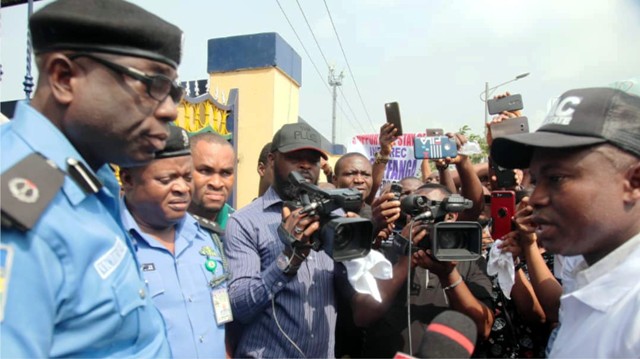
At last, the tension in Nigeria over who becomes President and governor has reduced drastically, as almost all the elections have been concluded and results announced except that of Rivers State.
An overview of what really happened nationwide on the general conduct of the elections really leaves much to be desired. It is true that there were intimidations, this is irrefutable. It is also true that in Nigeria, elections are rigged, there has always been violence but that notwithstanding after much hues and cries some would go to court to get redress, whether they win or lose at the courts or election tribunals that would be decided by the tribunal members after much deliberation.
But the major headache in the electoral system has always been working out modalities on how to checkmate desperate politicians who will go all out to subvert the system. It seems that the politicians in Nigeria are more creative in election rigging than in other clique. Here it has become a profession that sometimes is not done with finess.
The worst of such elections was the supplementary vote in Kano State where election observers were prevented from doing their job, security agents were helpless or indifferent to their primary assignment allowing thugs to hijack the process in full glare of the public.
Reacting to the charade in Kano, The Coalition of United Political parties (CUPP) called for the cancellation of the election following violent activities by thugs who took over the accreditation process. On its part the Nigeria Civil Society situation room, condemned the abuse of the Nations electoral process by politicians inspite of the deployment of top-level police officers to Kano in particular.
Spokesman for the group, Clement Nwankwo said “it was ironic and curious that the level of violence and political thuggery would occur with the quantum of Senior Police Officers deployed to Kano.
Invariably, what this mean is that thuggery can only be stopped if the nations security agents are really serious with their statutory duties. The situation whereby people mandated to protect lives and property shy away from their responsibilities raises more questions than answers and paints such institutions as unrealiable and untrustworthy.
Notable Nigerians apart from social activits including clerics have condemned the inherent disruptive tendencies of some Nigerian politicians, especially the Notion of cutting corners by riggers themselves into power stressing that elections should always be seen as a vehicle for sustainable development. This view is apt as hooligans use the opportunity created by their masters to bring shame to the country.
Politicians continue to blame the past military government and past civilian administrators for the nation’s short-comings, but what have they really done to eliminate the evils of the present day such as electoral malpractices. Are they also offshoots of the military governments?
What Nigerians should be thinking now is how to go out of the whirlpool of primordial politicking and fast forward ourselves to think like 21st century social scientists who have all the modern gadgets to get things right. But this not really hard, the problem has always been the mindset of the average Nigerian politician or those in authority to cheat. Maybe if we continue to wobble and fumble it will get to a situation where we will have to invite our neighbouring counties to assist us especially in conducting our elections as a critical look at the governorship elections has shown that the new slogan “Inconclusive” has become the hallmark of our electoral system.
Collation and announcement of results are now uphill tasks that will take weeks and huge manpower to conduct. No loser is ready to accept defeat even if the collacted results shows that his opponent is leading him with a huge margin. No wonder people describe Nigerian as a country of contradiction. “a society where the best are never given the opportunity to serve but only excel outside the country.
This year marks 20 years of uninterrupted democratic governance but we seem to have learnt nothing, seen nothing and have given out nothing to the younger generation except cheating, riggings, stealing and deceit. For how long can we as a people be honest to ourselves and collectively do what is right?
To be fair to INEC the fallout of the electoral process is not its fault but the problems created by the political class. And for the first time an the country’s political history elections in seven states were declared inconclusive which nobody envisaged.
However in Rivers State INEC is being looked at with suspicion in some quarters that it might not do what is right by announcing the clear winner of the election but rather call for a re-run. From available records it was only in Abua/Odual local government area that collation was not allowed to take place as the army hijacked the process.
INEC should not keep the people in suspense any longer and do the needful by announcing Chief Ezenwo Nyesom Wike as governor re-elected to govern the state. Because to do otherwise would be seen as a conspiracy between the APC led federal government at the centre and INEC to truncate the will of Rivers people.
Why should the case of Rivers State be different that it should be treated last? Are there hidden truths that INEC does not want the people of Rivers State to know? Or is INEC and the federal government perfecting plans so that a scenario would be created whereby the governor’s tenure will expire creating room for the appointment of a Sole administrator?
We hope that INEC will not allow itself to be used to formed injustice and instability in Rivers State.
Tonye Ikiroma-Owiye



The commission announced the extension in a statement issued on Saturday and signed by the National Commissioner and Chairman of its Information and Voter Education Committee, Mohammed Haruna.
According to INEC, the decision followed appeals by political parties for additional time to complete the submission process through the dedicated online portal.
“The submission window, which according to the revised Timetable and Schedule of Activities for the General Election was originally scheduled to close on Saturday, 8th August, 2026, has been extended to Tuesday, 11th August, 2026,” the commission said.
In a a related development, INEC announced the suspension of PVC collection in Osun State ahead of the August 15 governorship election.
The commission said voters who applied for replacement of lost, damaged or defaced Permanent Voter Cards would have until midnight on Sunday, August 9, to print downloadable copies of their cards.
The electoral body explained that the deadline was necessary to enable it compile data on downloaded PVCs and produce final statistics on the total number of cards collected ahead of the election.
INEC said PVC collection in Osun commenced at the Registration Area level from July 22 to 28, 2026, but was extended to July 31 following complaints about large crowds and difficulties experienced by voters at collection centres.
The exercise subsequently moved to the local government level and ran from August 1 to 7.
The commission also disclosed that replacement downloadable PVCs had been made available to voters in Odo-Otin and Ife Central Local Government Areas following the theft of cards during attacks on the two collection centres.
It stressed that the stolen cards could not be used to vote.
INEC reassured Osun residents of its preparedness for the August 15 governorship election.
“The commission reiterates that the stolen cards cannot be used to vote.
“INEC reassures the people of Osun State of its readiness to conduct a free, fair, credible and inclusive governorship election on 15th August, 2026,” the statement said.
The commission said the deadline, initially set for Saturday, 8 August, has been extended to Tuesday, 11 August 2026, following appeals from political parties for more time.
INEC also announced that the window for voters who applied to replace lost, damaged or defaced PVCs to download their replacement cards will close at midnight on Sunday, 9 August.
The move is to enable the commission compile final PVC collection figures ahead of the 15 August Osun governorship election.
INEC said replacement downloadable PVCs have also been provided to affected voters in Odo-Otin and Ife Central Local Government Areas after hoodlums carted away cards from two collection centres, stressing that the stolen cards cannot be used to vote.
The commission reaffirmed its readiness to conduct a free, fair, credible and inclusive election in Osun State.
Gov. Kefas made the remarks over the weekend at the Federal Medical Centre (FMC), Jalingo, during the flag-off of the second phase of the Renewed Hope Medical Outreach in Taraba State, organised as part of activities marking Prof. Yilwatda’s 58th birthday.
The governor commended Prof. Yilwatda for choosing to mark his birthday by providing medical care to people in need.
“What Professor Nentawe did is a powerful demonstration of what leadership should be,” Gov. Kefas said.
He assured that his administration would continue to support initiatives that complement government efforts to improve healthcare delivery and the wellbeing of residents.
Speaking at the event, Prof. Yilwatda called on Nigerian leaders to embrace the culture of giving and use their positions to touch the lives of the less privileged.
He said his decision to celebrate his 58th birthday in Taraba State was deliberate and informed by the needs of underserved communities, particularly people who face difficulties accessing healthcare because of distance and financial constraints.
According to him, the intervention followed a needs assessment and was extended across the three senatorial districts of the state.
He said the exercise commenced on August 3 at Takum General Hospital and covered the Federal University Teaching Hospital, Wukari; First Referral Hospital, Sunkani, Ardo-Kola Local Government Area; General Hospital, Bali; General Hospital, Gembu; and FMC Jalingo.
Prof. Yilwatda said the intervention provided medical services to thousands of beneficiaries, including people who required surgical procedures.
He said sustainable national development could only be achieved when strong institutions placed Nigerians at the centre of development.
“Leadership is about service,” he said, urging political and public leaders to make giving back to society an important part of their responsibilities.
He reaffirmed his commitment to serving Nigeria and its people, saying his personal vision was to make every day of his life useful to humanity.
“Every day that I live, the vision is: let it be useful to humanity,” he said.
The Taraba State Commissioner for Health, Dr. Bordiya Buma, commended the initiative, saying it was consistent with the Renewed Hope agenda and efforts to strengthen healthcare delivery in the state.
Dr Buma said the second phase followed the successful completion of the first phase, which was conducted simultaneously in six local government areas, with two LGAs selected from each of the three senatorial districts.
According to him, more than 10,000 patients were attended to during the first phase, including people with medical and surgical conditions.
He disclosed that 327 general surgeries, 71 eye surgeries and 575 dental procedures were carried out during the exercise.
The commissioner expressed appreciation to President Bola Tinubu for the Renewed Hope Medical Outreach and thanked Prof. Yilwatda for supporting the initiative and choosing Taraba State as a beneficiary.
The Minister of Health and Social Welfare, Prof. Muhammad Ali Pate, also commended Prof. Yilwatda for choosing Taraba State to mark his 58th birthday through a medical outreach.
Prof. Pate said making healthcare the centrepiece of the birthday celebration was significant because health affects everyone.
-

 News3 days ago
RSG Targets Nine Million Residents in Mosquito Net Distribution Campaign
-

 Oil & Energy3 days ago
Aiyedatiwa Signs New Electricity Bill
-

 Oil & Energy3 days ago
NLNG Commissions Research And Innovation Centre In RSU
-

 Maritime3 days ago
Marine Minister Commends President Tinubu On NPERA Bill Assent
-

 News3 days ago
KenPoly Holds Eight Convocations, August 29
-

 News3 days ago
RSG Begins Another Phase of Projects Commissioning Today
-

 News3 days ago
RMAFC Completes Revenue Sharing Review, Proposes New Pay
-

 Maritime3 days ago
NAGAFF Petitions IGP Over Alleged Maritime Police Harassment