
Politics
Saturday’s Polls And Nigerians’ Date With Destiny


Tomorrow is yet another date with our collective destiny as a country. Millions of voters will once more troop out to the various voting units to exercise their franchise. The voters this time are to elect those who will be our governors and state Houses of Assembly men that will preside over the affairs of the various states including Abuja, the Federal Capital Territory for the next four years.
Two Saturdays ago, the nation went on a similar journey to elect a President and members of the National Assembly. However those elections to those who monitored the process leave much to be desired as it was characterised by large scale arrests, intimidation, vote buying, violence, ballot box, snatching and killings.
In Rivers State alone, about 30 persons were allegedly killed by security personnel in Akuku-Toru, Bonny and Degema Local Government Areas.
And in Imo State, the Resident Electoral Commissioner (REC), Prof Francise Ezeonu said in the last election, there were deliberate efforts to frustrate the use of Registration Area Centres (RACs) as even wires used in reticulation of the centres were removed and taken away. In some places, community members disrupted elections at the RAC centres.
According to him, they also battled with thugs for electoral materials, with corps members kidnapped returning officers harassed and intimidated to write false results.
“The maxim was either to play along or be maimed for life”.
Also in Bayelsa State, we heard of reports that INEC was begging politicians and their thugs to return about 61 card readers that they forcibly took away from presiding officers during the elections.
Some independent observers of the last elections including civil society groups described the elections as not something to be proud of and said that to guard against a repeat of the violence and rigging in the last elections all stakeholders must comply with the electoral guidelines. They condemned the killings especially in Rivers State and the conduct of politicians and the military for their role in bringing shame to the country.
No election in Nigeria has taken place without controversy but the recent elections somehow took another dimension as some personalities of the major opposition party-PDP were it on the eve of the election. Some are yet to be released as at yesterday.
Do these people really pose a threat to democracy across the country? Why is it that during the administrations of Olusegun Obasanjo, Musa Yar’ Adua and Goodluck Jonathan, mass arrests of opposition figures were not carried out? But under the Presidency of Muhammadu Buhari, to even whisper is an anathema and will get you detained in a military barracks.
Nobody should think that we are under a real democratic government. To think so, the person must be naïve and not a critical political thinker. What we are under is a full blown dictatorship where even the judiciary is not respected and court orders disobeyed. The government chooses what order to obey and what to ignore.
For there to be a free, fair and credible election, the Presidency must not interfere with the conduct of the elections by deploying the military to do a repeat dance that negates all civilised norms of how an election should be conducted especially with the heating up of the polity in States like Delta, Bayelsa, Rivers Akwu Ibom and Benue.
From all indications, the factors hampering the smooth conduct of elections in Nigeria especially the last election are not the use of smartcard readers or the role of INEC officials but the shameful conduct of the political class.
According to, Prof Francis Ezeonu, “there is the need for Nigerians to create rules, a conducive environment for the ad-hoc staff to do their work and urged those who claimed to be honourable, distinguished and excellent to exhibit honourable conduct.
The experiences of the last election have some shock waves so much so that some ad-hoc staff have given notices that they would not wish to participate in the next election.
The way things are going, we may come to a stage where no person will be willing to participate during election.
These fears expressed by a resident electoral commissioner is not just an isolated one. All INEC officials are human just as the youth corps members recruited to assist the electoral body to conduct elections in 2015 in Rivers State, a serving youth corps member was killed. In 2011 about eight corps members were murdered in cold blood in Bauchi State. So are we sure that in the conduct of tomorrow’s elections, security agencies will play a neutral role and be as professional as possible?
Will the violence that occurred in Akuku-Toru, Bonny, Emohua, Ikwerre, Okrika and Abua/Odual Local Government Areas be replicated? Won’t the military assist politicians to disrupt the voting and collation processes and cart away electoral materials? These are just some of the questions that need to be addressed before people cast their votes tomorrow.
However, hope is not lost as traditional rulers and other political leaders of thought have pleaded for sanity and for politicians to play by the rules.
Meanwhile, the Independent, Electoral Commission has assured Nigerians that it will do a better job tomorrow, Accorders to its spokesman Festus Okoye, the commission is ready to conduct a credible election and as part of its strategy has fine-tuned all the loose ends encountered during the February polls. He said each polling unit will start at 8am and the use of smart card reader, is compulsory adding that any unit where smartcard readers are not used, all votes in such places will be voided.
Probably this assurance is coming on the heels of accusations by opposition parties that there was a deliberate and well orchestrated plan to use smartcard readers only in the strongholds of the PDP especially in the South-South, South-East and North Central zones while leaving out the South West, North East and North West zones and the non deployment of the electronic collation system (E-collation for election results contrary to the provisions of paragraph 10 (a) and (b) of the regulations and guidelines governing the 2019 general election.
Nigerians in general believe in a free and fair election but the major actors have always been the problem. People who are outside the corridors of power and make the most noise about the conduct of the election are even worse than those they accuse of election manipulations. It is quite sad that the APC which claims to parade “holy men” in its rank and file has not shown any form of decency coupled with the utterances and conduct of some of its members which are not encouraging peace in the polity.
We pray the security agencies will not allow themselves to be used to unleash violence tomorrow and allow the will of the people to be thrown to the dogs.
We also hope that the fear of violence or being killed will not deter millions of Nigerians from casting their votes.
The power of the electorate lies in the positive use of their PVCs. There is no way that a government is bad or a person is not living up to expectation without a voter doing his or her duty by voting for his preferred candidate or rejecting such a person on election day.
Our destiny is in our hands, so let us go out tomorrow and make our choice of who will preside over our political and economic fortunes in the next four years.
Tonye Ikiroma-Owiye



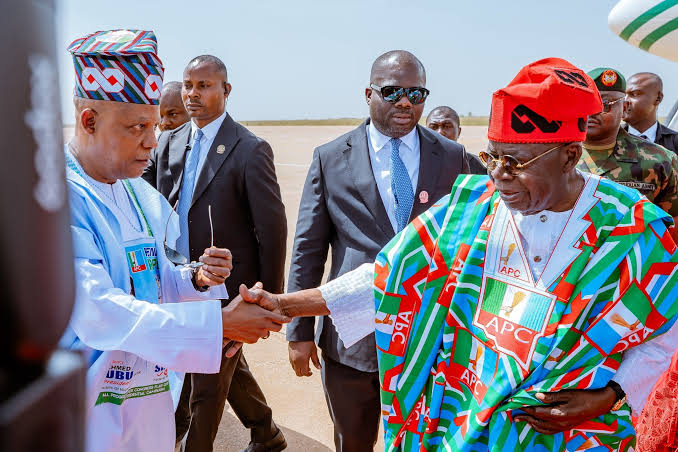
The campaign rally, held at the Kaduna Township Stadium, attracted Vice-President Kashim Shettima, APC governors, party leaders, federal and state lawmakers, political stakeholders and supporters from across the country.
The flag-off marks the beginning of the APC’s drive to secure a second presidential term for President Tinubu, with the party expected to promote its achievements, defend its economic reforms and outline its policy priorities under the proposed Renewed Hope 2.0 agenda.
Kaduna’s selection for the campaign launch underscores the strategic importance of the North-West, a region with a substantial voting population and considerable influence on presidential election outcomes.
The APC faces a significant challenge in Kaduna, where the Peoples Democratic Party’s presidential candidate, Alhaji Atiku Abubakar, defeated President Tinubu in the 2023 election. The rally therefore provides the ruling party an opportunity to strengthen its grassroots structures and regain electoral support in the state.
Addressing supporters, Vice-President Shettima appealed to Northern voters, highlighting President Tinubu’s political relationships with prominent Northern leaders, including Alhaji Abubakar, Mallam Nuhu Ribadu and the late President Muhammadu Buhari.
The Vice-President’s appeal reflects the APC’s determination to consolidate its support in the North as the party intensifies preparations for the presidential contest.
The Renewed Hope 2.0 agenda is expected to feature prominently in the campaign, providing a platform for President Tinubu to explain his administration’s economic policies and outline plans for another term.
However, the President’s record on economic reforms, rising living costs, petrol prices, employment, infrastructure and insecurity is expected to attract considerable scrutiny during the electioneering period.
-

 Education17 hours ago
FCE Yola Graduates 3,555 Teachers , Seeks Upgrade to University
-

 Niger Delta19 hours ago
Diri Restates Stance On Lagos-Calabar Coastal Highway
-

 Sports16 hours ago
Nigerian Trio Target Titles At PFL Africa Finals
-

 Niger Delta19 hours ago
C’River, NUJ Pay Tribute To Late Guardian Editor
-

 News20 hours ago
NDLEA Recovers Tons Of Illicit Drug Consignments In Nine States
-

 Opinion19 hours ago
Checking Voter Apathy In Nigeria’s Electoral Process
-

 Politics16 hours ago
2027: DICKSON’S EX-ALLY VOWS TO WORK AGAINST NDC INTEREST IN BAYELSA
-

 Politics16 hours ago
2027: GROUP PLEDGES 40,000 SUPPORTERS FOR COALITION CANDIDATES IN RIVERS