Connect with us

Education

Lecturer Wants Review Of Derivation Formula

Published

on

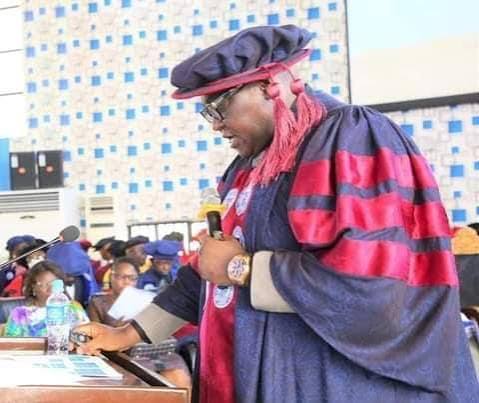
A Professor of African History at the Ignatius Ajuru University of Education (IAUOE), Rumuolumeni, Port Harcourt, Rivers State, Prof Kingdom Eke Orji, has advocate the review of the nation’s derivation formula, with the states receiving 70 percent while the federal government receives 30 percent.
Orji opined that the proposed recommended sharing formula, if approved, would not only boost local production of mineral resources in the States and increase their Internally Generated Revenue (IGR), also will make the political contest, at the “centre” less attractive.
He made this recommendation while delivering his lecture at the 14th inaugural lecture series of IAUOE held at the university’s main auditorium in Port Harcourt, Thursday.
The erudite professor of history who presented his lecture on the topic ‘Signature of the Sands of time: A Legacy for Human Survival Strategy in Nigerian Society” established the link between human labour (????) and the Environment (Sand) all through time (the past which is history) within the pre-colonial and post colonial era.
The discourse x-rayed the role of human labour represented by “signature” in harnessing the natural endowments of our environment and represented by “sand” in building the Nigerian nation through “time” which symbolises the historical dimension.
According to him, “the choice of the topic for investigation, was against the backdrop of his involvement in research and teaching comparative industrial growth and developed in both development and developing nations of the world at ancient and contemporary times which border on national building.
Prof Orji stated that the advent of colonialism marked a watershed in the history of human labour in Nigeria, adding that the reasons for colonial adventure have been subjected to what he described as “crucibles of rigorous scrutiny” with the resuit that economic argument appears more plausible.
“Within the pre-colonial indigenous polity of about 200 ethnic nationalities, the economy was diversified and sustained by human occupations like farming, fishing, hunting, trade and local manufacture, within and across regions”.
The professor of African History recommended among other things value re-orientation, His enthronement of visionary leadership, pursuit of economic diversification, value chain approach must be given attention as well as high premium on the dignity of labour, as factors that will enhance the nation’s economy. Earlier in his speech, the vice chancellor of IAUOE, Prof Ozo-Mekuri Ndimele, lauded Prof Orji for the lecture presentation and described the discourse as a well researched move that would advance and give the nation’s economy, even as he said, the nation development should be a collective responsibility of all citizens.


Continue Reading

Education

K-SAFE Calls for Increased Education Funding, Transparency in Kano

Published

on

The Kano State Accountability Forum on Education (K-SAFE) has called for sustained funding releases, improved transparency, and stronger focus on learning outcomes to consolidate recent gains in the education sector in Kano State.
The appeal was made by Dr. Auwalu Halilu, Co-Chair representing civil society organisations, during a goodwill message at the 2026 Education Sector Joint Steering Committee Meeting held in the state.
Addressing the Commissioner for Education, committee members, development partners, and other stakeholders, Dr. Halilu expressed appreciation for the opportunity given to civil society groups to participate in the high-level policy dialogue.
He commended the Kano State Government and relevant agencies for progress made in expanding access to education, strengthening teacher recruitment, and advancing non-formal and second-chance education programmes.
Dr. Halilu, however, stressed the importance of ensuring consistent release of funds to support ongoing reforms and programmes aimed at improving education delivery. He also urged authorities to enhance transparency in the implementation of education initiatives and place greater emphasis on measurable learning outcomes.
He further highlighted the need to promote safe, inclusive, and supportive learning environments, particularly for vulnerable children, to ensure equitable access to quality education.
Isa Kaita College
According to him, sustained collaboration between government, civil society organisations, and development partners remains essential to strengthening education systems and improving outcomes for learners.
Dr. Halilu reaffirmed K-SAFE’s commitment to constructive engagement and accountability, noting that civil society organisations are ready to work closely with stakeholders to support continuous improvement in education delivery in the state and across Nigeria.
He said the forum remains dedicated to promoting transparency, accountability, and inclusive education policies that will benefit all children.
Continue Reading

Education

Rotary Clubs Advance Literacy, Hygiene, Others at New Haven School

Published

on

The Rotary Club of New Haven, in partnership with the Rotary Clubs of Enugu City Centre and Enugu Metropolis, alongside the Rotaract Club of New Haven and the Interact Club of New Haven, has launched a targeted initiative to promote literacy, hygiene, and career development among students of New Haven Secondary School, Enugu.
The programme, themed “Our Youths, Our Future: Bringing Back the Reading Culture,” engaged students, educators, and community stakeholders through structured learning sessions and practical workshops.
A highlight of the initiative was the reactivation of the school’s Interact Club, with 36 students formally inducted into Rotary’s youth arm. Additionally, 216 students received curated reading materials designed to strengthen literacy and critical thinking skills.
Students also participated in career-focused seminars and practical sessions covering hygiene protocols and digital research skills.
Dr. Chukwudi Madu led demonstrations on proper handwashing techniques, emphasized the role of water in maintaining health, and provided guidance on medical career pathways.
Other facilitators addressed opportunities in art and design, laboratory sciences, and strategic career planning tailored to students’ aptitudes.
Dr. Chukwudi Madu demonstrates proper handwashing techniques to students during the hygiene and health session organized by the Rotary Clubs at New Haven Secondary School.
Complementing the student-centered activities, the clubs conducted a Peace and Conflict Resolution Management session for teachers and staff.
Teachers, staff, and Rotary facilitators of New Haven Secondary School pose for a group photo following the Peace and Conflict Resolution Management session led by Past President Tony Eze and Past Assistant Governor Stella Eneh.
In addition, the clubs donated books to the school library and presented recognition gifts to the principal and vice principal overseeing the Interact Club.
In his response, the principal of New Haven Secondary School, Mr. Charles Obetta, expressed appreciation to the Rotary Clubs for their generosity and urged continued support for future school initiatives, a commitment the clubs have assured.
Organizers described the initiatives as part of a broader strategic framework aimed at advancing education, youth development, and community resilience in Enugu.
Continue Reading

Education

RSU VC  tasks new Deans on quality leadership, team work 

Published

on

The Vice chancellor of the Rivers state university (RSU)Nkpolu Oroworukwu port Harcourt,prof Isaac Zeb -Obipi has tasked the newly inaugurated el Deans to be agents of positive leadership and foster team work in other to promote unity across their various facilities.
 The Vice-Chancellor stated this while inaugurating the newly elected eleven  Deans of the university held recently in port Harcourt and expressed his appreciation to the Committee of Provosts and Deans, led by the Provost, College of Medical Sciences, Prof. Kenneth S. Ordu, for their unwavering support since he assumed office, noting that such commitment was deeply valued.
He also commended the Electoral Committee chaired by the Deputy Vice-Chancellor (Administration), Prof. Blessing R. Jaja, for conducting a free and noted that the committee addressed all issues and concerns with professionalism, a development which has informed Management’s decision to produce formal Electoral Guidelines and Code of Conduct in a Handbook for use in future elections.
The Vice-Chancellor congratulated the newly elected Deans on their emergence, describing their success as a clear indication of the confidence reposed in them by members of their respective faculties.
 He urged them to provide quality leadership, foster unity, uphold mutual respect regardless of status, and ensure inclusive administration in the discharge of their duties.
The newly inaugurated Deans are Prof. John Ohaka (Faculty of Administration and Management), Prof. David Kiin-Kabari (Faculty of Agriculture), Prof. Barigbon G. Nsereka (Faculty of Communication and Media Studies), Prof. Isaac N. Dokubo (Faculty of Education), Prof. Enwuso Aleruchi Igwe (Faculty of Engineering), Prof. Paulinus W. Ihua (Faculty of Environmental Sciences), Prof. Jones M. Jaja (Faculty of Humanities), Prof. Grace Akolokwu (Faculty of Law), Prof. Ebirien-Agana S. Bartimaues (Faculty of Medical Laboratory Science), Prof. Ndokiari Boisa (Faculty of Science), and Prof. Emmanuel B. Okemini (Faculty of Social Sciences).
The highlight of the ceremony was the administration of the oath of office by the Director of Legal Services, Barr. Tamuno Williams, followed by the signing of the Dean’s Register and presentation of appointment letters to the Deans by the Vice-Chancellor.
By: Akujobi Amadi
Continue Reading

Trending