
Politics
CJN’s Non-Asset Declaration: The Frills, Thrills And Implications

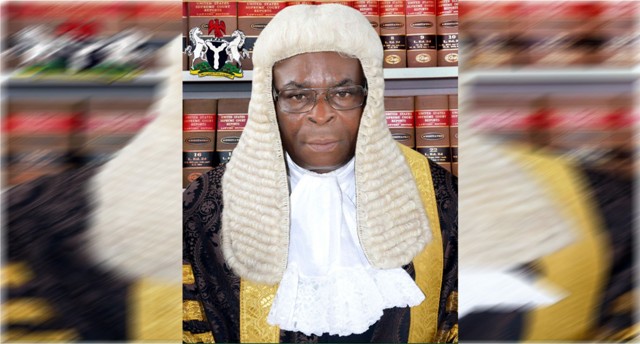
The ongoing matter regarding the trial of the Chief Justice of Nigeria (CJN), Walter Samuel Nkanu Onnoghen, over non-declaration of assets has become one of the most controversial developments to dominate the country’s political space ahead of the 2019 general elections scheduled to hold in February.
The crux of the matter is that a civil society group, Anti-Corruption and Research-Based Data Initiative (ARDI), on the 7th of January 2019, petitioned against the CJN to the Code of Conduct Bureau (CCB) and the Economic and Financial Crimes Commission (EFCC) over his non-compliance to the Nigerian constitution regarding declaration of assets.
The petition reads in parts: “We hereby petition you on suspected violations of the law and the Constitution of Nigeria by the Chief Justice of Nigeria, the Honourable, Justice Walter Samuel Nkanu Onnoghen.
“Specifically, we petition you based on the alarming facts detailed below, all of which indicate that the leader of our country’s judicial branch is embroiled in suspected official corruption, financial crimes and breaches of the Code of Conduct Bureau and Tribunal Act”.
The organisation alleged that Justice Onnoghen made five different cash deposits in dollars into an identified Standard Chartered Bank Account, which was not declared to the CCB as part of his assets, being a requirement for a public office holder, especially of his status.
Following this, on Thursday, January 10, 2019, the Federal Government filed charges against Justice Onnoghen, accusing him of false declaration of assets.
The Federal Government said, against the provisions of the law, the Chief Justice only partially declared his assets in 2016 after the controversial crackdown on judges.
The government further said that the number one judge of the nation still failed to declare a series of bank accounts, denominated in local and foreign currencies, linked to him at a Standard Chartered Bank branch in Abuja.
In his response to the CCB upon receiving the query, the CJN said he forgot to update his asset declaration, after the expiration of his 2005 declaration.
In his words: “My asset declaration form numbers SCN 00014 and SCN 00005 were declared on the same day, 14/12/2016 because I forgot to make a declaration of my assets after the expiration of my 2005 declaration in 2009. Following my appointment as acting CJN in November 2016, the need to declare my assets anew made me realise the mistake.
“I then did the declaration to cover the period in default. I did not include my Standard Charted Bank account in SCN 000014 because I believed they were not opened.
“I did not make a fresh declaration of asset after my substantive appointment as CJN because I was under the impression that my SCN 000015 was to cover that period of four years which includes my term as CJN.”
Meanwhile, the trial which was billed to commence last Monday, had two-key hick-ups: Onnoghen, who was represented by a team of 47 senior lawyers, led by Wole Olanipekun, was absent during the first sitting, and the defence, as presented by Olanipekun, was that the court has no power to hear the charges at all, because due constitutional procedure had not been followed.
The Nigerian Constitution required in Section 292 that a serving judge must first be investigated and indicted by the National Judicial Council (NJC) before dismissal or trial for misconduct in open courts. The NJC regulates the Nigerian judiciary.
Olanipekun also argued that the tribunal summons to Mr Onnoghen was delivered to his personal assistant and not him personally, arguing that this was an anomaly and added to the reasons for his absence.
While the prosecution, led by Umar Aliyu from the Federal Ministry of Justice, views this as a mere distraction, Danladi Umar, the tribunal chairman, adjourned further hearing until January 22. He ordered that Mr Onnoghen must appear to be docked for the charges against him, as well as listen to arguments on whether or not the tribunal could assert jurisdiction.
Expectedly, there have been so many interpretations attached to the first ever trial of the Chief Justice of Nigeria, cutting across interests ranging from political affiliations, through ethnic considerations to professional standpoints, and personal opinions.
Going back memory lane, pundits express the belief that Onnoghen’s present travail may have started from the point of his appointment. Upon the retirement of the former Chief Justice, Mahmud Mohammed, in 2016, at the statutory age of 70, Onnoghen’s appointment suffered unprecedented delay by President Mohammadu Buhari. But he was finally sworn in as Acting Chief Justice of Nigeria (CJN) on the 10th of November 2016.
There was however a prolonged delay in confirming him as the substantive Chief Justice, the position he rightly deserved as the most senior Justice of the Supreme Court.
The delay led to series of speculations from various quarters. Finally, on March 7, 2017, Onnoghen was sworn in as the 17th Chief Justice of Nigeria by Vice President Yemi Osinbajo, in his position as Acting President.
Amidst the cheers from mostly the ruling party, APC, and the holes picked by the opposition led by the PDP in the timing of the allegation and the manner of its execution, certain salient points remain very clear, and hence deserve to be treated cautiously and rightly, if the country must progress without avoidable political ranscour capable of destabilising the current fragile unity of purpose.
Following some body language of the Buhari-led government regarding the execution of the anti-corruption fight, as exemplified by the President’s refusal to assent the amended Electoral Act, close watchers of Nigeria’s political terrain have already indicated that the Federal Government is doing everything possible to gag any suspected decentering voice.
The question is, if the President’s excuse for not assenting to the Electoral Act was to avoid destabilising the electoral process, even when assent would mean less room for rigging, why would he allow the Onnoghen matter to be so pursued unconstitutionally in a hurry and with about a month to elections?
The answer seem, to be in what critics of the administration have adduced from the unfolding scenario: that Mr Buhari was behind the move to remove a Chief Judge of Southern origin in order to replace him with a judge from his northern region who would be more amenable to political influence.
In the words of Charles Omole, in a message to Premium Times, ”The timing of the indictment is suspicious. The speed with which it is being pursued strengthens the suspicion as it is uncharacteristic of the slow approach of this administration to act on even far more crucial matters in the past three years.”
The onus is thus on Mr President to prove otherwise: That his whole heightened drama over Onnoghen is not just for the February 2019 elections, even as non-declaration of asset is against the law. The only way to do this is to allow the law take its full course.
Soibi Max-Alalibo


Mr Ojukwu, who recently returned to the interim National Working Committee led by Senator Esther Nenadi Usman, noted that the party had 34 elected members in the House of Representatives, eight Senators, and 80 members at the state Houses of Assembly after the 2023 general elections.
“Now we lost all of them,” he said. “I don’t think we have as many as five members in the National Assembly.”
The former national officer of the LP talked to journalists in Abuja and said he chose to join the caretaker committee led by Senator Nenadi-Usman because they are now the officially recognized leaders of the Party.
“I chose to work with the caretaker committee to help save the Labour Party, for the benefit of the party. I also want to use this chance to ask my colleagues at the national, state, and local government levels to come together and help rebuild our party.
“Another election is around the corner. We lost everything we have. They have left to other political parties. So I’ll reach out to all my friends in the other group to get together and work on making this party stronger again.
“The caretaker committee has formed a reconciliation committee. Let’s come together and talk so that we can restore the first opposition political party in Nigeria.”
Mr Ojukwu, who was part of the Julius Abure’s group, said there are no more factions in the LP.
He added, “There is a court ruling, and since it is valid, the right people are in the correct positions.”
He urged Barr Abure and others to drop the legal cases they have filed because they are not helping the party.
“Litigations are killing political parties”, he said. “They’ve seen many political parties disappear because of legal battles, and the Labor Party is losing support every day, which makes me feel sad.”
Mr Ojukwu said he did not think joining the Senator Nenadi-Usman’s NWC was a betrayal of the Abure group, describing himself as “the oxygen” of that faction.
“I’m with this group because of the verdict. But I never betrayed anybody. Rather, I was betrayed,” he added.
-
Politics4 days ago
2027: NIGERIANS FAULT INEC ON DIGITAL MEMBERSHIP REGISTER DIRECTIVE
-
Politics4 days ago
LP Crisis: Ex-NWC Member Dumps Dumps Abure Faction
-

 Environment4 days ago
LAWMA Director Says Sweeping Reforms Have Improved Waste Collection
-

 Politics4 days ago
Umahi Dismisses Allegations On Social Media, Insists On Projects Delivery
-

 Sports4 days ago
Abia Not Sure To Secure continental Ticket
-
Politics4 days ago
NATASHA ELECTRIC VEHICLES INITIATIVE IN KOGI CENTRAL
-
Sports4 days ago
La Liga: Yamal Records First Career Hat-trick
-

 Sports4 days ago
PSG Extend Lead In Ligue 1