Connect with us

Editorial

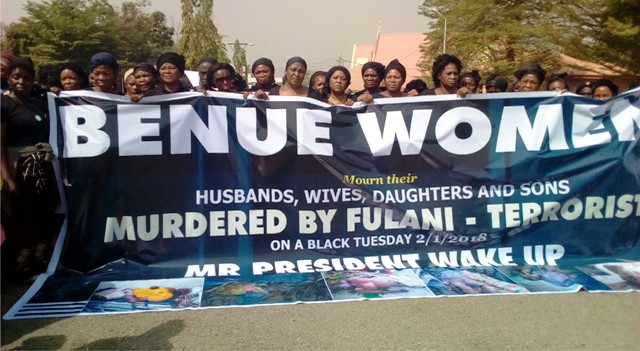
Enough Of Fulanis’ Genocide

Published

on

From all indications, a new terrorist group distinct from the dreaded Boko Haram has emerged in Nigeria as the country continues to grapple with its share of global terrorists attacks.
But the authorities which apparently have not learnt any lesson from the Boko Haram phenomenon appear unwilling to put a stop to the carnage that Fulani herdsmen have inflicted on the nation and are still inflicting on Nigerians coupled with their audacious temerity to unleash mayhem on innocent, law-abiding and peace-loving people.
With the November 2015 reports which rated Fulani herdsmen as deadlier than Boko Haram, the Islamic State in Iran and Syria (ISIS) and Al-Shabah and other militant groups from West Africa, The Tide would have thought the Buhari-led APC government would have immediately arrested the situation by waging a comprehensive war that will lead to a permanent solution to the problem.
Before their recent onslaught, little was known about them in the area of visiting high level of brigandage against local civilian populations.
The Tide wishes to state that the attacks have become fiercer now than before as on daily basis suspected Fulani herdsmen kill at will and are reported to have continually killed defenceless Nigerians, particularly in Benue, Nasarawa, Yobe, Adamawa, and Taraba States, even as other parts of the country have also come under their needless brutality.
The most pathetic aspect of the whole issue is the blatant manner in which the unprovoked attacks are carried out on defenceless, peace-loving and law-abiding members of communities across the geo-political zones of the country as well as the impunity with which the herdsmen operate. Children are not spared in this high level violence as many have been hacked down by the marauders in cold blood.
We recall that Fulani herdsmen move about with sticks and short machetes just as a last resort and for genuine reasons but certainly not to use these to hack down innocent persons. However, these days, herdsmen reportedly move about with high calibre weapons that can do maximum damage to defenceless citizens.
We urge the authorities to checkmate the importing of mercenaries into the country to cause mayhem. That over 4,000 people have been killed by Fulani herdsmen in the past two years, as documented by both local and foreign groups, leaves much to be desired.
It is really disturbing to see children, women and old people being killed in cold blood for no reason or fault of theirs while security agents who are supposed to be the beacon of hope for the oppressed, truamatised, weak, poor and marginalized look the other way as this brigandage goes on daily.
We condemn the move by the Federal Government to create “cattle colonies”, as a solution to the incessant bloodshed. We are of the belief that things may have long gone beyond that era with the rapidly exploding population and climate change.
We wonder why it appears that the Federal Government is much more interested in the lives of cattle than those of human beings, especially when Governor Nasir el-Rufai of Kaduna State was said to have recently paid compensations to the Fulani herdsmen.
Rather than that, we call on the Federal Government to ensure the immediate arrest and prosecution of the masterminds of these dastardly acts visited on the nation. Further handling of the Fulani herdsmen menace with kid’s glove will pose serious threat to the unity and security of the country.
Therefore, security agencies must stand up for the nation and her populace by performing their duties creditably, especially when it comes to fostering national cohesion and quelling insurrection. Enough of this Fulanis’ genocide.
The President Buhari-led Federal Government should wake up from its slumber and squarely face the responsibility of protecting the lives and property of citizens and ensure that those communities that have been ravaged by the Fulani herdsmen are rebuilt and those displaced resettled with immediate effect.

Continue Reading

Editorial

Advancing Women, Humanity, Through IWD 2026

Published

on

On March 8, the world once again commemorated International Women’s Day (IWD) 2026, a global moment dedicated to celebrating the achievements of women and renewing commitment to gender equality. This year’s theme, “Give to Gain,” carries a simple but powerful message: when society gives support to women, society itself gains progress, stability, and prosperity.
International Women’s Day is observed annually to recognise the social, economic, cultural, and political achievements of women. It also serves as a reminder that, despite progress made over the decades, gender inequality remains a persistent global challenge that demands collective action.
The IWD 2026 “Give to Gain” campaign encourages a mindset of generosity and collaboration. It calls on governments, institutions, organisations, and individuals to support women’s advancement, recognising that empowerment grows when opportunities are shared and barriers are removed.
At the heart of the campaign is the principle of reciprocity. When people and institutions give generously—whether through opportunities, encouragement, or resources—the benefits multiply. Giving is not subtraction; it is intentional multiplication. When women thrive, families prosper, communities develop, and nations rise.
The concept of giving extends beyond financial assistance. Support for women can come through donations, knowledge, resources, infrastructure, visibility, advocacy, education, training, mentoring, and time. Each contribution strengthens the foundation for a more inclusive and interconnected world.
In this sense, “Give to Gain” is not merely a slogan; it is a global call to action. Every society, institution, and individual has a role to play in creating pathways for women and girls to realise their full potential.
For individuals, giving support means challenging harmful stereotypes and standing against discrimination wherever it occurs. It means questioning prejudices that limit women’s opportunities and celebrating the successes of women in every field of endeavour.
When people actively support gender equality, they reinforce a shared sense of purpose. This support produces a ripple effect: one act of advocacy encourages another, and collective effort spreads impact far beyond its original point.
The campaign, therefore, reminds us that empowerment is not a solitary journey. It is a shared responsibility that requires continuous commitment from communities across the globe.
Once again, the message is clear: everyone can give something. Through encouragement, advocacy, mentorship, or policy reform, society can help women and girls gain the opportunities they deserve.
In Nigeria, however, the message of “Give to Gain” resonates with particular urgency. Women’s rights remain constrained by deeply entrenched patriarchal norms that shape laws, politics, culture, and everyday life.
Despite decades of advocacy and repeated promises by leaders, the lived reality of many Nigerian women is still defined by systemic inequality, violence, and exclusion.
Statistics paint a troubling picture. Women hold only about 3.9 per cent of seats in Nigeria’s National Assembly, one of the lowest rates of female representation in the world. Nearly 43.4 per cent of Nigerian women aged 20–24 were married before the age of 18, while 13.2 per cent of women aged 15–49 report experiencing physical or sexual violence. These figures reveal the depth of gender inequality that still persists.
To realise the ideals of “Give to Gain” in Nigeria, deliberate action is required at all levels of government. The Federal Government must strengthen laws that protect women’s rights and ensure greater representation in governance. State governments should expand access to education, economic empowerment programmes, and protection against gender-based violence. Local governments must prioritise grassroots awareness, training, and opportunities that enable women to participate fully in community development.
Encouragingly, initiatives have begun to emerge. In Rivers State, Siminalayi Fubara used the 2026 celebration of International Women’s Day to reaffirm support for women’s empowerment, distributing N50,000 grants to 1,000 women. The First Lady, Valerie Fubara, also supported 20 women farmers with N10 million through the Renewed Hope Initiative Women Agricultural Support Programme, demonstrating how targeted support can improve livelihoods.
The responsibility for gender equality does not lie with governments alone. Individuals, organisations, and community groups must sustain the spirit of the IWD 2026 “Give to Gain” campaign throughout the year. By giving support, opportunity, and respect to women and girls, society gains a stronger, fairer, and more prosperous future for all.
Continue Reading

Editorial

Resolve Rumuwoji Market Issues, Others

Published

on

The long-awaited inauguration of the Peter Odili Cardiovascular and Cancer Treatment Centre at Rumuokwuta in Obio/Akpor Local Government Area has been met with widespread relief and excitement by indigenes and residents of Rivers State, many of whom have spent years anticipating access to a facility built to preserve lives and curb the need for medical travel abroad.
Recall that the project was commissioned on November 14, 2022, only to be abandoned shortly afterwards. For a centre equipped to handle cardiovascular and cancer cases, this delay was not merely administrative; it carried real human costs in a country where non-communicable diseases account for about 29 per cent of all deaths, according to public health estimates.
The determination of Governor Siminalayi Fubara to get the centre started has now paid off. Without fanfares, the state-of-the-art hospital is quietly serving patients, proving that effective governance does not always need loud trumpets to announce its presence.
The governor deserves commendation for relentlessly reviving this critical health facility despite orchestrated attempts to clog the wheel of good governance in the state. In the same breath, kudos are due to the former Health Commissioner, Dr. Adaeze Oreh, whose professional input and persistence helped turn policy into practice.
However, this positive development also highlights the ongoing disappointment over the failure to put the Mother and Child Hospital into use nearly five years after it was commissioned. The frustration voiced by the Nigeria Medical Association (NMA) is justified, especially in Nigeria, where maternal mortality remains alarmingly high at about 512 deaths per 100,000 live births.
Although the Mother and Child Hospital was formally inaugurated in 2021, it has continued to remain completely non-functional in the years that followed. Reports indicate that the facility has stayed entirely sealed off and inaccessible to the public, with no signs of operational activity. This is despite renewed assurances given in early 2025 that the hospital would soon open its doors and begin serving the state — promises that have yet to materialise.
Beyond the health sector lies another deeply troubling example of public neglect: the second phase of the Rumuwoji Market, more popularly known as Mile One Market. This facility was completed nearly a decade ago, yet it remains entirely unused and dormant to this day — a situation that continues to baffle and worry a great many Rivers’ residents who had hoped it would serve the growing needs of their communities.
This phase of the market was built and completed by the immediate past administration of Chief Nyesom Wike. It followed the devastating fire that gutted the entire market during the tenure of Chibuike Rotimi Amaechi, whose government earlier completed and opened the first phase.
Sadly, the unused section of the market has begun to deteriorate, a clear waste of public funds. Traders who should be operating within the market now spill onto Afikpo Street, creating traffic bottlenecks, sanitation concerns, and general nuisances for residents.
We are compelled to ask why a market that has already been commissioned has remained unoccupied for so many years. If there are genuine issues preventing its use, then the government must put its foot down and address them squarely, with courage and determination rather than hesitation.
It is unacceptable that this phase of Mile One Market is allowed to decay after so much money has been sunk into it. Across Nigeria, abandoned public projects are estimated to have tied down trillions of naira, resources that could have transformed lives if properly utilised.
Additionally, the economic implications of leaving public infrastructure idle cannot be overstated. Markets are engines of micro and small-scale commerce, which account for over 80 per cent of employment in Nigeria’s informal sector. When facilities like the unused section of Mile One Market are left to rot, government inadvertently chokes livelihoods, reduces internally generated revenue, and deepens urban disorder. A functioning market would not only decongest surrounding streets but also restore dignity and safety to traders who currently operate under harsh and unsanitary conditions.
The government has expended substantial taxpayers’ money in the construction of these facilities, yet they sit idle and unused at a time when the people of the state should be directly benefiting from the services they were designed to provide. It raises a fundamental question that demands honest answers: what is the purpose of investing billions of naira in these projects if they are ultimately left dormant, abandoned, and to fall into a state of neglect? The people deserve better than empty infrastructure that serves no one.
While the political climate within the state has undoubtedly presented its share of challenges over time, that particular chapter now appears to be largely behind us. The focus must shift accordingly. The ball is firmly in the court of the administration to compose itself, buckle down, and get to work — ensuring that completed projects are delivered to the people they were intended to serve, without any further unnecessary delay.
Ultimately, governance is judged not by the number of projects commissioned but by how many are put to meaningful use. As the philosopher Edmund Burke once observed, “Bad laws are the worst sort of tyranny,” and by extension, abandoned projects are the worst form of waste. Rivers State has the opportunity to reverse this narrative. The administration must strike while the iron is hot, ensure that all completed facilities are activated, and prove that public resources are not poured into a bottomless pit but invested for the common good.
We therefore call on the government to redress these challenges with urgency. As the saying goes, “The best time to fix the roof is when the sun is shining,” and the time to act is now. Rivers people are watching, worried, and rightly expect their leaders to turn promises and investments into tangible public good.
Continue Reading

Editorial

As NDG Ends Season 2

Published

on

On 20 February, the second edition of the Niger Delta Games (NDG) kicked off in Benin City, Edo State, with over 3,000 athletes from the nine oil-producing states of the Niger Delta region competing for honours across 16 sporting disciplines. Tagged ‘NDG Edo 2026’, the Games were scheduled to continue until the 27th (today), when the curtain would finally be drawn on proceedings. The event is sponsored by the Niger Delta Development Commission (NDDC) and organised by consultants Dunamis Icon.
Edo State is taking its turn as host following the maiden edition held in Uyo, Akwa Ibom State, the previous year. The inaugural edition was widely hailed as a resounding success, owing to the remarkable competitiveness and excitement it generated amongst the states of the region and, in particular, the young athletes who showcased impressive talent, prowess, and potential across a range of sporting events.
The maiden edition represented, in many respects, a new horizon and a breath of fresh air in efforts to engage and harness the talents and energies of the region’s youth towards positive endeavours that offer genuine prospects for career development. For a full week, young athletes from across the Niger Delta had the opportunity to compete in an environment where they freely expressed and explored their abilities, mingled with one another, and had the chance to connect socially and culturally.
It is for this reason that the NDDC and their consultants, Dunamis Icon, can be said to have hit the bull’s eye with the concept behind the Games. Beyond serving to engage the youth and identify promising athletes for the region, the competition has the capacity to produce athletes well capable of representing the national flag on international and continental stages.
The NDG presents opportunities that the states of the region must embrace wholeheartedly. Beyond venturing into the hinterlands to scout for promising young athletes, sporting facilities across the various states now have the opportunity to be tested and utilised on an annual basis, whilst host states enjoy the privilege of developing, upgrading, and maintaining existing facilities with the support of the sponsors.
As the Games draw to a close at the end of their second season, it is hoped that this regional sporting festival will continue to be guided by the vision and mission upon which it was founded, particularly its commitment to creating opportunities for untapped talents within the region. It is encouraging to note the organisers’ insistence that only athletes within the stipulated age bracket of 20 years and under are permitted to participate. No effort should be spared in ensuring that age falsification and the desperation to win at any cost are firmly discouraged.
Whilst commending the NDDC and Dunamis Icon for the considerable efforts already invested in ensuring that the NDG is not only successful but sustainable, it is expected that this second edition would mark an improvement upon the last, with the shortcomings witnessed in Uyo not being permitted to recur.
The NDG represents both an opportunity and a challenge to a region that prides itself as one of the country’s foremost nurseries of sporting talents. It is a chance to begin producing world-class athletes once again and to introduce names that will not only remind us of, but ultimately succeed the celebrated stars of previous generations across various disciplines — among them Adokiye Amiesimaka, Daniel Igali, Ojadi Oduche, Obisia Nwamkpa, Chioma Ajunwa, and Jeremiah Okorududu, to name but a few.
Just as the leadership of the NDDC has challenged the NDG to begin producing Olympic athletes for the country, we can only wholeheartedly concur that the Games possesses everything necessary to serve as a platform for unearthing future stars, and nothing less should be expected of it.
It is worth noting that the continued growth and credibility of the NDG will depend, in no small measure, on the rigour and transparency with which it is administered. Governance, accountability, and adherence to the founding principles of the competition must remain non-negotiable priorities for all stakeholders involved, from the sponsors and organisers through to the participating state delegations.
The role of the participating state governments in this regard cannot be overstated. Whilst the NDDC and Dunamis Icon provide the structural framework and financial backing that make the Games possible, it is the states themselves that bear the primary responsibility of identifying, nurturing, and presenting their finest young athletes for competition.
Governors and sports commissioners across the nine participating states must therefore treat the NDG not as a mere ceremonial obligation, but as a serious and strategic investment in the human capital of their respective populations. Only through sustained grassroots scouting programmes, well-funded state sports academies, and consistent domestic competitions can the region hope to maximise the full potential of what the NDG offers.
The private sector, too, has a meaningful role to play in the long-term sustainability of the Niger Delta Games. Whilst the NDDC’s sponsorship provides an essential foundation, the involvement of corporate organisations — particularly those with significant commercial interests in the region — would serve to deepen the financial base of the competition and reduce its vulnerability to the funding uncertainties that have historically plagued sporting initiatives in Nigeria.
Partnerships with brands, media organisations, and international sports bodies could further raise the profile of the Games, attract wider coverage, and open doors for the region’s most gifted athletes to access exposure, training opportunities, and platforms that extend well beyond the Niger Delta itself.
Ultimately, the Niger Delta Games carries with it the hopes and aspirations of an entire region and its young people. If nurtured with care, integrity, and sustained investment, it has every potential to become one of the most significant youth sporting platforms on the continent, and a genuine conveyor belt for the next generation of Nigerian sporting greatness.
Continue Reading

Trending