
News
Senators Slam FG’s 2018 Budget – Say Projections Unrealistic

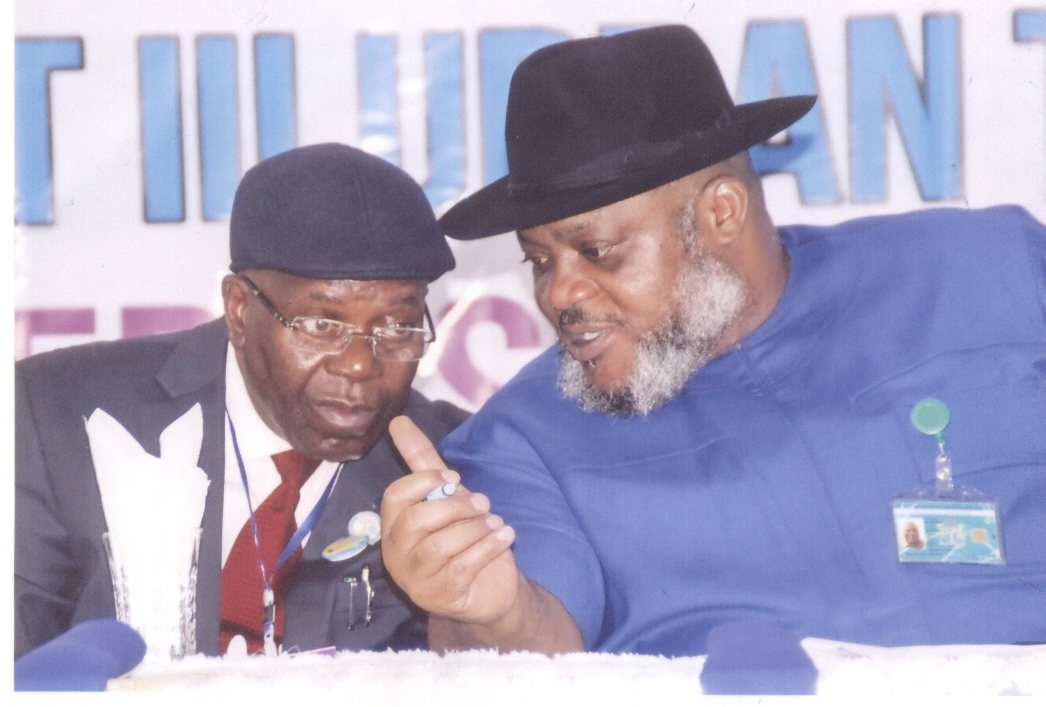
Senators yesterday rejected the projections upon which the 2018 budget is based, declaring the projections as unrealistic.
The lawmakers, who commenced the debate on the general principle of the budget said that the implementation of the 2017 budget left so much to be desired.
Senator Enyinnaya Abaribe (PDP, Abia South) who opened the floor of the debate caused an uproar when he declared that the 2018 budget was ‘fictitious, adding that the budget is not consolidating on the 2017 budget.
The Senator said that the N8.612 trillion 2018 budget does not consolidate on the 2017 and 2016 budgets as claimed by President Muhammadu Buhari during the 2018 budget presentation.
The lawmakers also decried what they called the abysmal implementation of the N1.2 trillion capital component of the 2017 budget. The Senators also faulted the parameters contained in the 2018 budget especially the oil benchmark of $45 per barrel, adding that it should be jerked up to about $50. Senator Abaribe drew the ire of some senators, especially Senate Leader, Senator Ahmed Lawan who stated that the use of the word ‘fictitious’ was unparliamentary.
The Abia Senator then agreed to withdraw the contentious word but replaced the same with the word ‘imaginary’ even as he maintained that the implementation of the budget was very low.
He said: “I am just quoting the Senate Leader from his speech, which said the 2018 budget was designed to consolidate on the achievements of the 2016 and 2017 budgets. What was done in 2017 when less than 15 per cent of that budget was released? Nothing was done and that was why I called it (2018 budget proposal) fictitious. I am very sorry if that is the word he is bothered about. I will withdraw the word ‘fictitious’ and use ‘totally imaginary.” According to Abaribe, the receivables (revenue) in the budget were being exaggerated, adding that the revenues were only one-tenth of the figures being claimed by the government. He stated that the budget was being predicated on parameters that have been destroyed by facts available.
Senator Ben Murray Bruce (PDP Bayelsa East) in his own contribution said that the 2018 budget proposal is a “budget of active imagination,” as according to him, the budget is already committing 25 percent to debt servicing.
He said: “We have to decide what the exchange rate really is. Is it N305 (to US$1) or N365?” Murray Bruce stated that the cost of governance in Nigeria remains very high, adding that agencies that have outlived their usefulness still remain on government’s payroll.
He said: “FRCN (Federal Radio Corporation of Nigeria) has 8000 workers. Sell it to the staff. Who listens to the Voice of Nigeria (VoN)?” He said that while it was commendable that the Ministry of Transport and Chinese Firms were working on the multi-billion dollar rail projects, the Senate should take deep looks at the intricate details.
“We have steel, Ajaokuta is there. Why don’t we use that facility and create jobs through that,” he said.
Senator George Akume, who also contributed said that the oil benchmark should be increased to $50 because crude oil price has increased to between 58-$62 per barrel.
Deputy Senate Whip, Senator Francis Alimekhena (APC Edo North) told the Senate that the 2016 and 2017 budgets were bloated, adding that they lacked impact on the people.
He stated that it was unrealistic to assume that about N2 trillion would be realised from oil revenue and N4 trillion from non-oil revenue.
He also supported the increase of the budget benchmark to $50 while output is maintained at 2million barrels per day as in the 2017 budget.
The senator said: “There is no need to raise the hope of Nigerians and execution is zero. Let’s cut our coat according to our cloth. If the budget size is N3 trillion and execution is N3 trillion (100 percent), we will be happier than to say it is N8 trillion and execution is just N2 trillion.”
Senator Gbenga Ashafa (APC Lagos East) who also contributed said that only the sum of N450 billion has so far been released in the capital votes of 2017 budget.
He stated that the key issue with the 2016 and 2017 budgets was the question of funding which he said made the budgets less impactful.
He said: “A budget can be big and bloated, but when you do not have enough funds for capital projects which are more impactful, then the budget is going nowhere.” The senator cited the example of the Federal Roads Maintenance Agency (FERMA), which he said only N800 million has so far been released out of its 2017 appropriation of N25 billion.
Ashafa said: “What impact would that make on roads,” adding that only N500 million has so far been released out of the N11 billion budget of the Nigeria Railways Corporation (NRC).
Deputy Senate President, Senator Ike Ekweremadu, who presided over the sitting, said that there is an urgent need to reconsider the budget deficit projections.
He said: “I thank everyone for their contributions, I commend my colleagues for keeping their language clean and speaking their mind on the 2018 budget debate. “Some research agencies are not researching anything and are still being funded, we need to point them out so we don’t spend money on them.”
Meanwhile, the House of Representatives has announced that it will suspend plenary from tomorrow.
This is to allow members proceed on oversight assessment of the 2017 budget and hold defence sessions for the 2018 budget.
The suspension will last for three weeks.
The Deputy Speaker of the House, Mr. Yussuff Lasun, who presided over proceedings, yesterday, made the announcement as debate on the budget began at the floor of the House, yesterday.



The Rivers State chapter of the All Progressives Congress Christian Leaders Forum has expressed strong confidence in the capacity of All Progressives Congress (All Progressives Congress) candidates in the state to deliver effective governance if elected into office in the coming elections.
The State Coordinator of the forum, Archbishop Lucky Aroh, made this known during a breakfast and thanksgiving meeting held in Port Harcourt, where leaders gathered to pray for the stability of the party and the safety of its candidates ahead of the 2027 general elections.According to him, the meeting was convened to seek divine intervention for peace, unity, and security among APC candidates across Rivers State.
“Today we are praying for APC stability in Rivers State and the security of our candidates that have been elected to contest the 2027 elections. It is a breakfast meeting,” Aroh said.
He further expressed optimism that the party’s candidates would not disappoint the people if entrusted with leadership responsibilities.
“They will not fail when elected into office. We are here as fathers of the land to let them know, and I must tell you the truth that these are the authentic people that will do well in Rivers State,” he added.
Speaking earlier, the National Chairman of the forum, Professor Olanrewaju Abraham, commended the Rivers State chapter for organizing the programme, noting that the national body of the forum believes strongly in the power of prayer.
He stated that political leadership provides an opportunity to influence society positively, including advancing moral and spiritual values, while expressing confidence that APC candidates at all levels would emerge victorious in the upcoming elections.
Also speaking, the Rivers State Women Leader of the APC, Hon. Darling Amadi, praised the forum for its commitment to prayers for peace, stability, and the protection of party candidates.
Represented by the Deputy Women Leader of the party in the state, she described the initiative as commendable and urged other political and support groups within the party to emulate the gesture in promoting unity and stability.
By: John Bibor, Menebe Emmanuel & Fortune Paibi
Prominent businessman and philanthropist, Elder Anthony Osagwe-Ogo, was celebrated in grand style as he marked his 70th birthday anniversary, with distinguished Nigerians, business leaders, and golf enthusiasts gathering to honour his remarkable contributions to society.
The colourful celebration took place at the Port Harcourt Golf Club, where friends, associates, and well-wishers converged to pay tribute to the revered elder statesman.
Chairman of the occasion, High Chief (Dr.) Ikenna Okafor, described the celebrant as a detribalised Nigerian whose generosity, humility, and commitment to humanity have earned him admiration across different communities and backgrounds.
According to Dr. Okafor, Pa Osagwe-Ogo’s impact on society and the development of his community remains unparalleled. He noted that members of the golfing community are proud to be associated with a father figure who consistently promotes the welfare and well-being of those around him.
He further stated that the history and growth of the Port Harcourt Golf Club cannot be told without acknowledging the significant role played by the celebrant, whose wisdom, encouragement, and leadership have helped sustain the club over the years.
“We are here to celebrate a man who has impacted humanity positively, a peace-loving individual and an epitome of hope for the younger generation. We pray to emulate his virtues. Today, we celebrate a bridge-builder, a trailblazer, and an iconic leader whose life continues to inspire many,” Dr. Okafor said.
He expressed delight at the large turnout of guests from various walks of life, describing it as a testament to the respect and affection Pa Osagwe-Ogo commands within and beyond Rivers State.
In his response, the celebrant, Pa Anthony Osagwe-Ogo, expressed profound gratitude to God for preserving his life and granting him the privilege of attaining the milestone age of 70.
He also thanked members of the Port Harcourt Golf Club, family members, friends, and associates for identifying with him during the celebration and for their unwavering support over the years.
The event featured the cutting of the birthday cake, presentation of awards to deserving members of the club, goodwill messages, and moments of celebration among guests.
The ceremony was attended by notable personalities from the business community, the golfing fraternity, and other sectors, all of whom joined in celebrating the life and legacy of the respected elder statesman.
Rivers State Governor, Sir Siminalayi Fubara, and the Permanent Secretary of the Rivers State Ministry of Information and Communications, Dr. Honour Kuru Sirawoo, have been honoured with awards of recognition in connection with the 2026 Democracy Day celebrations held in Port Harcourt.
The awards, which formed part of activities marking Nigeria’s Democracy Day on June 12, were formally presented on Tuesday at the Ministry of Information and Communications in Port Harcourt.
Presenting the awards was Hon. Abdul Hameed Oladipupo Alli, popularly known as “Mr. Nigeria,” Publisher of Asiwaju Trumpet Magazine and Achievers World International Magazine.
Governor Fubara was recognised for his efforts in sustaining peace, stability, and a conducive political atmospherJohn Bibor / Menebe Emmanuel / Fortune Paibie in Rivers State. The organisers noted that his administration has fostered harmony and strengthened civic participation across the state.
Dr. Sirawoo, on the other hand, was honoured for his exemplary administrative leadership and significant contributions to effective information management within the Ministry of Information and Communications.
Representing Dr. Sirawoo at the presentation ceremony, Dr. Christian Davies received the award on his behalf and expressed gratitude for the recognition. He described the honour as a reflection of Dr. Sirawoo’s unwavering commitment to professionalism, excellence, and dedicated public service.
Dr. Davies assured the organisers that the award would be formally conveyed to the Permanent Secretary.
The event also featured the presentation of commemorative publications highlighting major governance and civic milestones in Rivers State, including Easter celebrations, Workers’ Day activities, the Governor’s third anniversary in office, and Democracy Day programmes.
Organisers of the awards commended the Rivers State administration for what they described as sustained peace, political stability, and improved civic engagement, noting that these achievements have contributed significantly to the state’s continued development.
By: Jessica Sambol