
Environment
Illegal Oil Bunkering: Between Lewe and Bomu

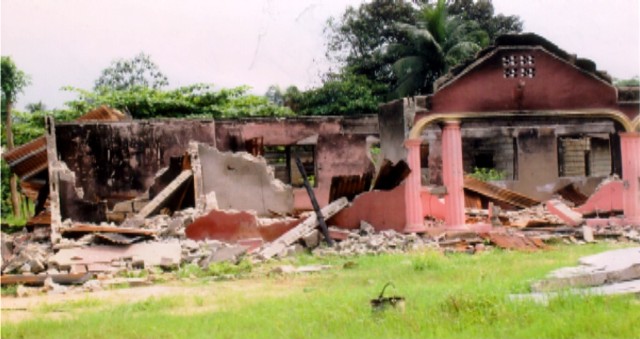
Illegal oil bunkering is doing much more harm than good to communities in the Niger Delta region of Nigeria.
Apart from the destruction of the environment, communities are now in the war path as a result of the huge sums of money accruing from the business.
Recently, the face-off between Bomu and Lewe communities in Gokana local government area has shown that if left unchecked, the illegal business will eventually destroy more communities in the region.
Although, the two communities had been having disagreements in the past, the current level of devastation as a result of this renewed hostilities has been described as very inhuman and unparrelled in the history of both communities.
Residents of the area are now counting their loses which run into millions of naira with 14 persons reported killed in the mayhem.
Sources within the communities informed The Tide that the present crisis was caused by a disagreement between two illegal oil bunkering gangs at their site.
According to the source, one Sunday Barinem Tupor, from Bomu allegedly led his gang members to the bunkering site of his friend, Barinem Opnwin Doopa of Lewe and carted away his products.
In Retaliation, on the 15th of November, 2016, Sunday Barinem Tupor was attacked by the gang loyal to Barinem Opnwin Doopa at Lewe and his car snatched as payback.
The Tide also learnt that the mather was later reported to the police at Kpor.
Corroborating the stories in separate interviews with The Tide, the paramount ruler of Bomu, HRH Mene Charles Tenalo, and his Lewe counterpart H.R.H Mene Sibe Lebaton, confirmed that the crisis was caused by illegal oil bunkering.
Mene Tenalo who is a second class traditional ruler in Rivers State however said that following the incident on the 15th of November 2016, a meeting of the council of chiefs of the two communities was convened on the 16th of November 2016 on how to find a solution to end the crisis.
The traditional ruler said progress was made following the meeting but on the first of December 2016, his attention was drawn to an incident which involved the discovery of the corpse of an indigene of Lewe at the outskirt of the community close to Boue in Khana local government arae.
He said he immediately instructed the paramount ruler of lewe to report the matter to the police, for investigation and arrest of the culprits.
King Tenalo also alleged that youths from Lewe community also went on rampage attacking and killing Bomu indigenes coming from Mogho neighbouring community.
He specifically said that two Bomu youths who were coming from Mogho on motorcycles were killed and buried by Lewe youths.
However in a paper titled; “Lewe community’s Explanation on the Current Bomu – Lewe crisis”, the Menebon of Lewe H.R.H Lebaton Sibe, said “ the whole episode started on the 15th of November, 2016 as a result of the misunderstanding or disagreement between two cult groups led by one Mr Barinaaoowin Doppa – Bira of lewe and Mr Barinem Sunday Tupoi from Bomu.
“Mr Barinem Sunday Tupoi is gangster, a dreaded cultist and a self acclaimed elder in the Iceland cult group who allegedly led a gang of robbers to attack Lewe youths at their oil bunkering site in our fishing port and carted a way all their properties after infliching on their body injuries in May 2016”.
Meanwhile, the Rivers State Government has waded into the crisis.
The Special Adviser to the State Governor on conflict resolution, Chief Okorie Abelekum on his past condemned the crisis in the strongest terms and warned that government will not fold its arms and watch people take the laws into their hands.
Chief Abelekum told the people during an interactive session at Kpor, headquarters at Gokana local government area that if the youths in the area refuse to toe the path of peace, they will only have themselves to blame as government will take drastic action to checkmate any further act of criminality in both communities.
He said the era when illegal oil bunkerers and cultists hold communities to ransom are over adding that under the present administration, all forms of lawlessness will be nipped in the bud.
The special Adviser to the state Governor on Amnesty, Hon Ken Chinda, who was at the interactive session also called on cultists and illegal bunkerers in the area to surrender their arms without delay.
Hon Chinda said community elders and well meaning individuals in the area should come together and assist government in the strive towards a better society.
The Tide observed that given the large army of refugees created by the crisis and the scale of destructions, the people are ready for peace.
The two paramount rulers also confided in The Tide that they are really for peace.
The paramount ruler of Lewe, Lebaton Sibe said his people can no longer go to their farms or fishing and appealed to government to wade into the crisis with a view to ensuring a final and peaceful resolution to end the conflict.
In a letter addressed to the Rivers State Governor through the Special Adviser on conflict Resolution, Chief Sibe called for the establishment of a security post between the two communities to forestall further attacks by his Bomu neighbours.
He also appealed for relief materials for his people.
On his part, the Menebon of Bomu, H.R.H King Charles Tenalo, urged the government to take note of the following which will help in establishing an enduring peace between Bomu and Lewe.
“That Lewe people should report all criminal offenses to the police for investigation and legal actions instead of taking rash and primitive decisions.
“That they should stop all forms of aggression against law abiding citizens of Bomu.
“That the Lewe people should stay away from our land.
Illegal oil bunkering is indeed a problem to the Niger Delta. The entire water source of the region is now polluted.
Today, it is Bomu and Lewe, tomorrow it could be another community. The effects of illegal oil bunkering is spreading like a bush fire across the region and that is why government must find solution to the problem.



This was disclosed in a keynote address by the Minister of Water Resources and Sanitation, Engr Joseph Utsev, at the AFO public presentation at the Presidential Banquet Hall, Abuja, organised by the Nigeria Hydrological Services Agency, NiHSA, with the theme ‘Smart Water Resources Management: Moving from Oil to Water-Based Economy’.
Utsev acknowledged that early information saves lives, livelihoods, protects infrastructure, and reduces economic losses, saying that, as part of the Federal Government’s commitment to improving flood forecasts and preparedness, is the modernisation of the national hydrological monitoring networks.
The minister also said his ministry is strengthening collaboration with the Nigerian Meteorological Agency, NiMet, to ensure better integration of weather and water information, as it is critical for delivering reliable forecasts that support farmers, disaster managers, urban planners, and other key sectors of the economy.
He said AFO is therefore not just a scientific report, it is a call to action by all in terms of preparation ahead of the flood season, as early information saves lives, livelihoods, protects infrastructure, and reduces economic losses.
However, the minister acknowledged that forecasts alone are not sufficient if the information does not translate into action at the community level, which he said his Ministry is working with other relevant government agencies to mitigate the impacts of flooding.
Meanwhile, the 2026 AFO presentation had in attendance President Bola Tinubu, represented by the Minister of Environment, Balarabe Lawal.
Others present were the federal ministries: Water Resources and Sanitation; Livestock Development, Environment and Women Affairs.
Others include the Speaker of the House of Representatives, State Governments, Service Chiefs, development partners and the media.
He said: “The 2026 flood forecast presented today provides us with the following general highlights: High Flood Risk: 14,118 communities in 266 Local Government Areas (LGAs) in 33 States and FCT fall within the high flood risk areas. The States are: Abia, Adamawa, Anambra, Bauchi, Bayelsa, Benue, Borno, Cross River, Delta, Ebonyi, Edo, Enugu, Gombe, Imo, Jigawa, Kaduna, Kano, Kebbi, Kogi, Kwara, Lagos, Nasarawa, Niger, Ogun, Ondo, Osun, Oyo, Plateau, Rivers, Sokoto, Taraba, Yobe, Zamfara and the FCT.
“Moderate Flood Risk: 15,597 Communities in 405 LGAs, 35 states except Ekiti State, will experience moderate flood risk.
“Low Flood Risk: Incidences of minimal flood is expected in 923 communities in 77 LGAs in 24 States. The States are Adamawa, Anambra, Bauchi, Bayelsa, Benue, Borno, Cross River, Delta, Ebonyi, Edo, Jigawa, Kaduna, Kano, Kebbi, Kogi, Nasarawa, Niger, Ogun, Ondo, Osun, Oyo, Sokoto, Taraba and Zamfara.
“Flash and Urban Flooding: Flash and urban flooding are projected in major cities in the country due to high rainfall intensities, low attention to management of water facilities including drainage systems, waterways and lack of flood resilience structures. Cities such as Abakaliki, Abeokuta, Abuja, Asaba, Benin City, Birnin–Kebbi, Calabar, Ibadan, Kaduna, Kano, Lagos, Makurdi, Nguru, Onitsha, Oshogbo, Port Harcourt, Sokoto, Warri and Yola, among others are to experience these categories of flood incidence.
“Coastal and Riverine Flooding: Bayelsa, Cross River, Delta, Lagos, Ogun, Rivers and Ondo are to experience coastal flooding due to rise in sea level and tidal surge and this would impact on fishing, wildlife habitation and river navigation.”
He also emphasised that, “As we transition toward a water-based economy, we must recognize that water security is national security. Effective water governance will play a critical role in ensuring food security, supporting economic diversification, and improving the overall well-being of our citizens.”
However, the Minister called on State andand Local Governments including communities to start preparation to mitigate the impacts of the predicted flood.
“I therefore call on state governments, local authorities, disaster management agencies, farmers, and community leaders to carefully study the findings and advisories contained in this document and take the necessary steps to prepare for the coming flood season.
“Furthermore, we are encouraging state governments to integrate flood risk considerations into land-use planning, urban development, and infrastructure design.
“Floodplains must be properly managed, drainage systems must be improved, and communities must be empowered to adapt to changing climate conditions.
“Preparedness remains the most effective strategy for reducing flood risks. When we plan ahead, we protect lives, safeguard infrastructure, and preserve economic gains. Let us commit to building a safer, more resilient and more water-secure nation.”
Earlier, the Director General/Chief Executive Officer, Nigeria Hydrological Services Agency, Umar Ibrahim Mohammed, NiHSA, said the 2026 AFO aligns with the Renewed Hope Agenda in terms of economic diversification, infrastructure development, climate resilience, food security and sustainable water management.
Mohammed also explained that, “The AFO has evolved into an important national planning instrument that provides early scientific prediction of flood risks in the country, evidence-based guide for decision-makers and platform for emergency coordination among stakeholders.
“In producing this year’s forecast, the Agency undertook a comprehensive and data-driven process to provide tailored information for high-risk flood zones and flash floods in urban cities and towns.
“Building on the success achieved through AFO publications, we have upgraded from reporting flood forecast to Flood Risk Intelligence Architecture and from the traditional modelling to Hybrid AI-Integrated Modelling system to improve forecast reliability, reduce false alarms and improve the lead time accuracy.
“Not these alone, the modelling for the 2026 forecast have been conducted in-house. This marks a strategic shift toward enhancing capacity building, manpower development and institutional resilience.”
-

 Featured4 days ago
WASSCE: RSG Distributes Science Materials To Secondary Schools
-
News4 days ago
Xenophobic Attacks: Nigerian Lives More Important Than Foreign Investment – Oshiomhole
-
Rivers4 days ago
MBA Forex Trial Adjourn To June 3, Amid Bereavement … As Court Declines Cost Application
-
News4 days ago
ActionAid Demands Probe Of Govs Using Public Funds For Campaign
-
Aviation4 days ago
Passengers Stranded As Delta Airline From Atlanta Route Back Eight Hours After
-
Business4 days ago
Customs Impound N2.35bn Cocaine, 15 Trailers of Rice
-
Politics4 days ago
2027: Bayelsa Senator Gets Critical Endorsement For Second Term
-
 Politics4 days ago
INEC Sets Rivers South-East Senatorial By-Election For June 20