
Business
CBN To Sanction Banks Over Non-Remittance Of Content Dev Funds

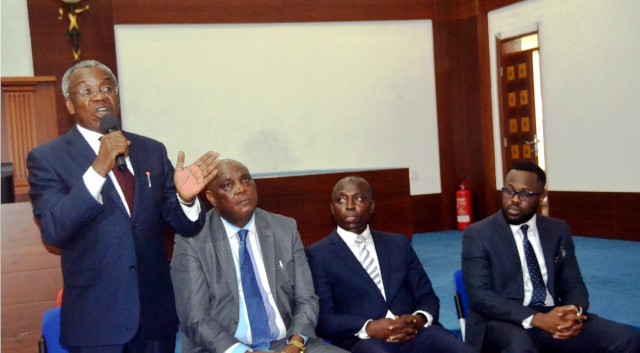
The Central Bank of Nigeria (CBN) said on Monday that it would sanction Money Deposit Banks (MDBs) still collecting payments under the Nigerian Content Development Fund without remitting same to dedicated account opened for the fund at the apex bank.
The Tide source reported that the Governor of the CBN, Mr Godwin Emefiele, issued the threat in Lagos on Monday at the stakeholders’ forum, organised by the Nigerian Content Development and Monitoring Board (NCDMB).
Emefiele, who was represented by Mr Jack Ukitefu, Deputy Director, Banking and Payments Systems Department, said the bank would collaborate with the agency to identify the defaulting banks.
He warned them to close such accounts and remit the funds at their disposal to the dedicated account with the CBN.
He said that the infraction by the bank was a violation of the Treasury Single Account (TSA) policy and promised to punish such banks.
The bank boss said that the operations of the TSA began in 2015 and that all ministries, departments and agencies should have complied.
He added that commercial banks still collecting funds under the NCDF should have remitted such funds collected.
According to him, CBN will not hesitate to sanction any of the banks identified in the act because it is viewed as a very serious offence.
Mr Simbi Wabote, the Executive Secretary of the NCDMB, said the NCDF was established by Section 104 of the Nigerian Oil & Gas Industry Content Development (NOGICD) Act of 2010.
Wabote said that the Act provided that one per cent of every contract in the upstream sector of the Nigeria oil and gas industry shall be deducted at source and paid into the fund.
The Act also gives the board the mandate to manage the fund and employ it for projects, programmes and activities directed at increasing Nigerian Content in the Oil and Gas industry.
The executive secretary said that the agency had been working to create the operating model for utilisation of the fund and had established the NCDF Advisory Committee for efficient governance of the fund, creating confidence and trust of industry stakeholders.
“The board opened up the fund for utilisation from 2013, based on the approved operating model that segmented 70 per cent of the fund to finance commercial interventions and 30 per cent for developmental initiatives and activities carried out by the board on behalf of the industry.
“Under commercial interventions, the fund was leveraged to provide 30 per cent partial guarantee to commercial banks for loans granted to oil and gas service companies towards financing project execution.
“Asset acquisition or facility upgrade. It also provided 50 per cent interest rebate on performing loans, beneficiaries of the fund include Ladol, Starz and Vandrezzer,” Wabote explained.
He said the introduction of the TSA policy by the Federal Government and the need to deepen accessibility of the fund for critical activities created the need to re-engineer the operating model of NCDF
He said the board had fully complied with the TSA policy by opening Naira and foreign currency accounts in CBN, into which all NCDF remittances were to be made.



-

 News2 days ago
Navy Destroys Illegal Refinery In Rivers, Intercepts Stolen Fuel In C’ River
-

 News2 days ago
You’re The Backbone Of Our Society, Fubara Salutes Mothers On Mothering Sunday
-

 Rivers2 days ago
County Grammar School Old Boys Elect New Executive
-

 Environment2 days ago
Illegal Buildings On Embassies’ Land Will Be Demolished – Wike
-

 Politics2 days ago
HUNDREDS OF LATE BAYELSA DEP GOV’S KINSMEN DUMP PDP FOR APC
-

 Politics2 days ago
A’Court Voids Rep’s Sack Over Defection To APC
-

 Politics2 days ago
You’re Misleading Nigerians, APC Slams ADC Over Poverty Rate Report
-

 Niger Delta2 days ago
Lawyer X-rays Consequences Of Court Injuction Suspending INC Polls … As Diri Intervenes