
Sports
U-20 AFCON: Five Reasons Why F’Eagles Crashed Out

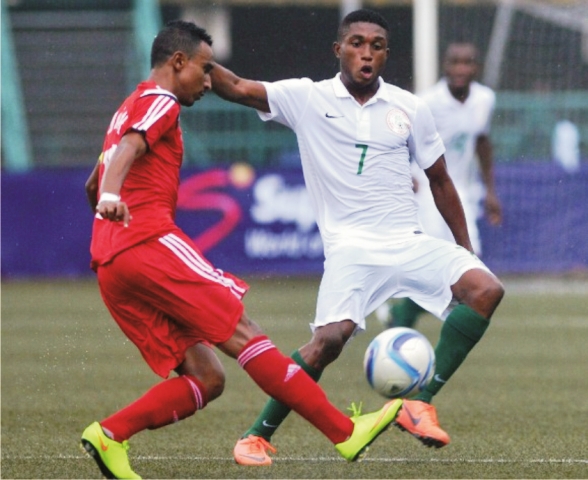
Nigeria’s Flying Eagles
will not be in Zambia next year to defend the U20 AFCON trophy they won last year after they were shocked out of the qualifiers by Sudan.
After beating the Sudanese 2-1 away, the Flying Eagles on Saturday fell 3-4 to the visitors, who finished the game with 10 players in Lagos to lose out on away goal rule with 5-5 aggregate scores.
Below are perhaps, five major reasons behind yet another monumental disaster in Nigeria football.
Again, the U17 World Cup curse
The excitement of having won a record fifth U17 World Cup in Chile in November got the better of coach Emmanuel Amuneke, his assistants and even the players, who felt they have arrived on the world football stage after what they had achieved in South America.
They probably equated the demands of U17 football to what is expected of a team at a higher U20 level, where the players are a lot more matured with some even knocking on the door of the full international side.
Such thinking almost derailed coach Manu Garba last year, before he welcomed superior ideas to open his team to players outside those he has previously worked with at the U17 cadre.
The wrong assumption that there is not much difference between U17 and U20 has affected over time the appointment of the coaches for the Flying Eagles as well as the faulty selection of players for the country’s youth team.
Poor tactics
On a day the rains poured down on Lagos, Amuneke got his tactics totally wrong by still insisting on the boys playing his passing game on a waterlogged pitch, while the more experienced and bigger Sudanese chose the more practical kick and rush style to their advantage.
The Flying Eagles lack of size certainly did not help their cause as they always played second best to their opponents even after they were reduced to 10 men midway in the second half.
When it was 3-3, Amuneke should have shut the game down as a draw was enough to qualify Nigeria.
Is Amuneke really the tactical genius he has been packaged as?
Team not good enough
The Flying Eagles Class of 2016 did not have the quality and had they managed to advance to Zambia 2017, they would have been badly exposed by better teams at the AFCON finals.
Even at the U17 level, what got them going was their raw determination, the goals of Victor Osimhen as well as their conditioning.
The team were shut out from other players even after a much-advertised screening exercise as Amuneke insisted on working with only the players he tinkered at the U17 level.
This killed the competitive spirit in the team as players in Amuneke’s U17 pool were always considered ahead of those who were outside this group.
Team selection was biased and there was hardly a serious consideration for the physical size of the players especially in key positions like goalkeeper, defensive midfield and central defence.
It must say something about the quality in this team that after all the hype and expectations, only a handful of these players have since secured contracts overseas.
Goalkeeper Akpan Udoh was safe at U17 level, but was clearly exposed at a higher level, the team’s defence was below average, skipper Kelechi Nwakali failed to shine after he was named MVP at the U17 level and Osimhen could not reproduce the magic that fetched him a pro deal a top Bundesliga club Wolfsburg.
Both players, coaches lost focus
At last year’s U17 World Cup, these same boys had fought like wounded lions to make a name for themselves even when they had not received any allowances and bonuses.
Their character and focus were praised, but only eight months later, it was a different story altogether after it got out to the media that they threatened to boycott Saturday’s match over unpaid monies.
Attitude and discipline were sacrificed for immediate financial gains.
“They lost the game even before they kicked the ball because suddenly they lost their focus and drive,” a top former international told newsmen.
It was also understood that several of these players openly challenged the instructions of their coaches with Amuneke also angling to be Super Eagles coach after he was brought on board in an interim capacity for the AFCON qualifiers against Egypt in March.
For Amuneke, it was not about qualifying for the AFCON, but winning the elusive U20 World Cup in South Korea next year.
It is possible nobody really told him that you first have to qualify for the AFCON before you could start targeting the World Cup.
Inexperience and lack of exposure
At the U20 level, experience is a major factor and these Flying Eagles lacked it because most of the players are still with academies with not one of them playing even in the lower Nigeria National League.
It was only three years ago that the likes of Paul Pogba and Kurt Zouma helped France to win the U20 World Cup in Turkey and today they have established themselves at Juventus and Chelsea, respectively.
Amuneke’s team prepared for these qualifiers by playing mediocre academies around Abuja with their only tough test games being against the country’s U23 team.
Matches against Premier League sides like FC IfeanyiUbah, which could have toughened them and got them the much-needed experience and exposure, were rejected outrightly.
The Nigeria Football Federation (NFF) would have done better by arranging for test matches in neigbouring countries like Benin and Ghana as was the case in previous years.
Probably, these big wins in their friendlies mostly at their training base deluded them into thinking they were unbeatable until Sudan delivered the sucker punch right in front of their home fans.
Culled from
Africanfootball.com


A well-known football pundit in the State, Chief Christopher Okonkwo has lauded the efforts and vision of the Super Eagles Coach Eric Chelle for going from one venue of the Nigeria Domestic Nigeria Professional Football League match to the other in monitoring Nigerian players, with a view to invite some exceptional good one discovered into the main stream of the Super Eagles team.
Okonkwo, who made the commendation in an interview at the Port Harcourt Club recently, described the positive move by Coach Chelle as a good step in the right direction, noting that the practice was how its been done in the past among any contracted coach assigned to tinker the Super Eagles team.
“Truly, it has been an old tradition in the country seeing any newly engaged Coach to lead the National team, visiting some our Nigeria League venues during the league matches to spot light some good talents that could be used to beef up some grey areas in the department of Eagles team”
He, however, frowned at the current situation where our coaches had continously been over depending on the use of foreign based players during invitation of players to the National camp, thereby, relegating the domestic home based league players to the background as if they have nothing much to offer to the team.
“I can vividly recall that the likes of great players in the mode of Finidi George, Taribo West, Kanu Nwankwo, Austin Okocha, Richard Owobokiri, Emmanuel Osuigwe among others started from Nigeria football league before they graduated to play in Europe through which they later invited to Super Eagles camp to represent Nigeria”
“Besides, I’m also of the view that going to secondary school football competitive games could equally serves as a a good platform to discover budding talents that could be nurtured to become great stars in near future”, Okonkwo frankly added.
Okonkwo, therefore, prayed that any football coach to be engaged by the Nigeria Football Federation (NFF) to tinker the Super Eagles should be told not to confine himself in staying in big hotel alone but to be visiting some of our local league match venues, with a view to discover some good players that can be drafted into the Super Eagles team.
“Indeed, I stand to be challenged that there some young good players in the Nigeria Professional League. If spotted and exposed, could give the some of the invited foreign based players a stiff competitive fight in securing a postion in the team”, Okonkwo emphatically stated.

Ezechukwu, one of the youngest members of the Nigerian contingent at the championship in Ghana, said her ambition was to win the 100m title in style and cap it with a new personal record.
The fresh secondary school graduate explained that she is fully focused on contributing to Team Nigeria’s medal hopes and is determined to deliver strong performances across her events.
“My main objective in Ghana is to clinch the 100m title and the 4×100m,” Ezechukwu told Tidesports source.
“Nigeria can be assured of my very best and my commitment to the Team. I would love to set a new personal best in Ghana, but anything that comes, I will take it. The spirit in the team is high, and I think we are ready to go,” she said.
Ezechukwu, who was part of Nigeria’s women’s 4x100m relay squad at the World Relays in Botswana, said the experience gained from that competition has strengthened her mindset heading into the continental championships.
She admitted that she learned valuable lessons from her previous outing, including a difficult moment during the relay where an early error affected the team’s rhythm, but said she has used the experience to improve her discipline and composure.
“The secret is just being disciplined, training hard and trusting my coach and believing in God, and the result will show,” she added.
The teenager is part of a 41-member Nigerian team comprising 24 female and 17 male athletes competing at the championships, which begin today at the University of Ghana, Legon.
Nigeria are expected to compete across multiple track and field events as they aim for a strong finish against the continent’s elite athletes.
-

 Featured4 days ago
WASSCE: RSG Distributes Science Materials To Secondary Schools
-
News5 days ago
Xenophobic Attacks: Nigerian Lives More Important Than Foreign Investment – Oshiomhole
-
Rivers5 days ago
MBA Forex Trial Adjourn To June 3, Amid Bereavement … As Court Declines Cost Application
-
News5 days ago
ActionAid Demands Probe Of Govs Using Public Funds For Campaign
-
Aviation5 days ago
Passengers Stranded As Delta Airline From Atlanta Route Back Eight Hours After
-
Business5 days ago
Customs Impound N2.35bn Cocaine, 15 Trailers of Rice
-
Politics5 days ago
2027: Bayelsa Senator Gets Critical Endorsement For Second Term
-
 Politics5 days ago
INEC Sets Rivers South-East Senatorial By-Election For June 20