
News
66 Soldiers On Death Row Over Mutiny, Saved

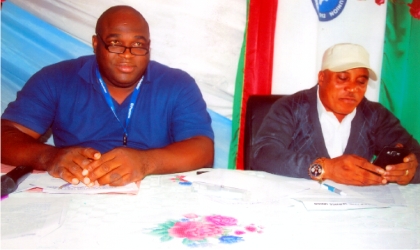
Rivers State Chairman, Nigeria Civil Service Union (NCSU), Comrade O. T. Lilly-West (right), with the State Secretary, Comrade Dan Otakpo, during the inauguration of the executives of the Women Committee of the union in Port Harcourt on Thursday.
For the 66 soldiers sentenced to death for mutiny and other offences in the fight against Boko Haram terrorists in the North-East, the good news is that they will no longer face the firing squad.
The Army authorities announced, yesterday, that their death sentences had been commuted to terms of 10 years imprisonment.
“The death sentences by firing squad, passed on 66 soldiers in January and March, 2015, by separate General Court Martials (GCMs), have been commuted to 10 years imprisonment each”, the Acting Director, Army Public Relations, Colonel Usman Sani, said yesterday.
After the sentencing of 12 soldiers to death for shooting at a vehicle conveying the General Officer Commanding (GOC), 7 Division of the Nigerian Army, Maiduguri, Borno State, Major-General Ahmed Mohammed, the Army authorities, on October 2, 2014, at the Defence Headquarters (DHQ) Garrison, inaugurated another nine-man GCM to try about 100 soldiers.
The soldiers were charged with offences ranging from mutiny to assault, misconduct and tampering with military property.
Of the lot, 77 were accused of committing mutiny, punishable by death.
The charge said the soldiers attached to the 7 Division, conspired to commit mutiny, saying they refused to join 111 Special Forces Battalion, led by Colonel E.A. Aladeniyi, to the Maimalari Barracks for an operation (against Boko Haram fighters).
The mutinous soldiers had blamed the GOC and other officers for the death of four of their colleagues allegedly ambushed while on a special operation against Boko Haram in Kalabalge LGA, near Chibok, Borno State; where over 200 school girls were abducted by terrorists in April, last year.
One of the CGMs was headed by Brigadier General Chukwuemeka Okonkwo.
The Army spokesperson, Sani, in a statement announcing the reversal of the death sentences handed to the 66 soldiers, yesterday, to 10 years imprisonment, said: “It will be recalled that 71 soldiers were arraigned on several charges in joint trials. The soldiers were arraigned on several count charges that included Criminal Conspiracy, Conspiracy to commit mutiny and Mutiny.
“Others were Attempt to Commit an Offence (Murder), Disobedience to Particular Orders, Insubordinate Behaviour and False Accusation, amongst others.
“They (soldiers) were tried, discharged on some charges but found guilty and convicted on other charges which included mutiny.
“Out of the number, 66 were found guilty on some of the charges and sentenced to death, while 5 were discharged and acquitted and one was given 28 days Imprisonment with Hard Labour (IHL).
“However, following series of petitions, the Chief of Army Staff Lieutenant General Tukur Yusufu Buratai, ordered a legal review of the cases. The directive was carried out to examine the merit of each case.
“It was on the basis of the review and recommendations that the Chief of Army Staff commuted the death sentences of the 66 soldiers to 10 years jail terms. The sentences are to run concurrently.
“The cases of other soldiers are being reviewed and will be made public once the appropriate reviews are completed.”
The reprieve for the convicted soldiers, yesterday, elicited jubilation from their families.
Family members of some of the convicts, who spoke newsmen on phone, were full of praises for the Army authorities and the Chief of the Army Staff (COAS), but would have preferred that their kinsmen were outrightly pardoned and possibly reabsorbed into the military.
Meanwhile, the Conference of Nigerian Political Parties has asked President Muhammadu Buhari to use his powers of prerogative order of mercy to pardon and reinstate the soldiers convicted over the fight against Boko Haram insurgents in the North East zone of the country.
The Nigerian Army had commuted the death sentences passed on 66 soldiers by separate court martial to 10 years imprisonment.
A statement by the Acting Director of Army Public Relations, Sani Usman, a colonel, said 71 soldiers were arraigned on several charges in joint trials in January and March.
The soldiers were arraigned on several count charges that include Criminal Conspiracy, Conspiracy to commit mutiny, Mutiny, Attempt to Commit an Offence (Murder), Disobedience to Particular Orders, Insubordinate Behaviour and False Accusation, amongst others.
While thanking the army authorities for squashing the death sentences, the CNPP, in a statement by its spokesperson, Osita Okechukwu, said soldiers convicted over the fight against insurgents had been vindicated by the revelation from ongoing trial of the former National Security Adviser, Sambo Dasuki, and others and should be reinstated.
“In addition to the review of some of the sentences by the Chief of Army Staff, we still appeal to Mr President and Commander-in-Chief to as a matter of urgent national importance to pardon and reinstate the mutinied soldiers,” it said.
“Our appeal is anchored on the premise that they were starved of equipment as evidenced by their pleadings in the court martial that they were ill-equipped. Indeed the only allegation charge proved against them at the trial was that they had the temerity to ask for equipment to combat the insurgency.
“Fortunately or unfortunately, the reasons for the sordid scenario of dearth of equipment which led to the mutiny are clearly gazetted by the unpatriotic, callous, unconscionable and utter greed of Col Sambo Dasuki (rtd), erstwhile National Security Adviser and his clan.
The group said the Federal Government should urgently commence the trial of Mr. Dasuki and others for criminal conspiracy, murder and subversion of the Nigeria State, for allegedly “engaging in crass primitive accumulation and unpatriotic diversion of arms fund to private pockets”.
It argued that their trial should not only be done on the basis of alleged money laundering and other quasi charges, but also treason.
It said, “They declared state of emergency serially yet paid deaf ears to the wanton killing of soldiers and the Maiduguri Barack protest march of the wives of soldiers.
“A protest some pundits posit could have been a wakeup call to the kleptomaniacs. The soldiers’ wives protest is rated to be the first and only one in the history of the Nigeria Army.”
The CNPP said it recalled that after a meeting with former President Goodluck Jonathan at the Presidential Villa sometime ago, Governor Ibrahim Shettima of Borno State shouted at the top of his voice that Boko Haram was better equipped and better motivated more than the Nigeria Army, but that the governor “was called all sorts of unprintable names by the cash and carry clique”.
It added, “Similarly, the then Chief of Defense Staff, Air Marshal Alex Barde (rtd), also testified like Pontus Pilate to the truism that the soldiers were ill-equipped and ill-motivated. Though medicine after death from a Defence Overall Boss who looked the other way, while the Bazaar was going on.
“In spite of our collective amnesia, we cannot forget easily how the erstwhile Jonathan’s regime botched the covert negotiations of Dr Steve Davies with Boko Haram, and chased him away. He was an innocent Australian clergy who took the risk and volunteered to negotiate with Boko Haram.
“Your Excellency, for God’s sake, how else or better evidence can we assemble to convince that the military mutineers were vindicated given the avalanche of evidence on the ground?”


The Rivers State Government has commended the Church of Nigeria (Anglican Communion) for its outstanding contributions to the development of Rivers State, particularly in the areas of peacebuilding, education, healthcare, and moral development.
Governor of Rivers State, Siminalayi Fubara, stated that the Church has remained a dependable partner in promoting peace, unity, justice, moral discipline, and social harmony across society.
The Governor, who was represented by the Secretary to the State Government, Dr. Dagogo Wokoma, made the remarks during the thanksgiving service marking the 30th Anniversary and First Session of the 11th Synod of the Diocese of Niger Delta North, held at St. Peter’s Anglican Church on Sunday.
Governor Fubara described the Synod’s theme, “Kingdom Advancement: The Priority of Every Believer,” as timely and relevant, considering the prevailing realities in society.
According to him, the Church continues to play a vital role in shaping societal values and inspiring hope among citizens.
“The Church remains a vital partner in promoting peace, unity, justice, and moral discipline. Its role in shaping values and inspiring hope cannot be overemphasized,” he stated.
The Governor further acknowledged the Anglican Communion’s contributions in education, healthcare delivery, youth empowerment, humanitarian services, and spiritual guidance across communities in Rivers State.
“The Rivers State Government appreciates the invaluable contributions of the Anglican Communion in education, healthcare, youth development, humanitarian support, and spiritual guidance. Your impact across communities in Rivers State continues to strengthen families and promote peaceful coexistence among our people,” he added.
Governor Fubara reaffirmed his administration’s commitment to building a peaceful, united, and prosperous Rivers State where all citizens can thrive irrespective of religion, ethnicity, or social background.
He also urged the Synod to continue praying for sustainable development and progress in Rivers State and Nigeria at large.
Earlier in his sermon, the Guest Minister, Joseph Olushola, spoke on the topic, “Kingdom Investment and Internal Rewards,” urging Christians to remain faithful stewards of God’s blessings and committed to advancing God’s kingdom through service and generosity.
The cleric emphasized that believers are custodians of the virtues and resources entrusted to them by God, stressing that divine rewards are based on faithfulness and impact rather than material possessions.
The Shell Nigeria Gas Limited, in partnership with the Manufacturers Association of Nigeria (MAN), has reaffirmed support for efforts to expand gas distribution infrastructure in Rivers State as part of initiatives aimed at improving access to affordable, cleaner and more reliable energy for industries across the South-South region.
The commitment was highlighted during the SNG–MAN Business Forum held in Port Harcourt, where stakeholders from the industrial and public sectors examined the role of natural gas in driving industrialisation, boosting local production and strengthening energy security.
Speaking at the forum on behalf of the Managing Director of Shell Nigeria Gas Limited, the company’s Head of Gas Distribution, Mr. Chukwuka Amos Ejesi, described natural gas as a critical component of Nigeria’s energy mix and a key driver of sustainable industrial growth.
According to him, Nigeria’s gas development agenda has reached a stage where policy direction must be matched with practical implementation capable of addressing the energy challenges confronting manufacturers.
He noted that pipeline gas offers industries a cleaner, more dependable and cost-effective energy alternative capable of supporting uninterrupted operations, reducing emissions and improving production efficiency.
“Gas is the backbone of manufacturing, and we are encouraged by the growing recognition among stakeholders of the need for cleaner and more reliable energy solutions,” he said.
Ejesi stressed the need for sustained collaboration among energy providers, government institutions and industrial stakeholders to maximise the country’s gas resources for economic development.
He added that improved gas infrastructure would strengthen manufacturing value chains, enhance productivity and promote more competitive industrial operations across Rivers State and the wider South-South region.
Participants at the forum also emphasised the importance of expanding energy infrastructure as a pathway to unlocking industrial capacity, reducing operating costs and promoting sustainable industrial development.
Representing Governor Siminalayi Fubara, the Director-General of the Rivers State Investment Promotion Agency, Dr. Chamberlain Peterside, reaffirmed the state government’s commitment to partnering with private sector investors to revitalise industrial activities in the state.
He identified key projects targeted under the initiative to include the revival of the Ahoada Industrial Park, the New Port City project and the proposed Bonny Industrial Park, all aimed at stimulating economic growth and expanding industrial opportunities along the Bonny corridor.
According to the governor, the long-term vision is to position Rivers State as a leading manufacturing hub in Southern Nigeria through strategic public-private partnerships.
Governor Fubara also commended Shell Nigeria Gas and MAN for sustaining engagements geared towards improving industrial energy access, noting that gas infrastructure development remains central to the state’s economic recovery plans.
He further observed that the gas sector presents enormous opportunities for economic growth, especially as global energy systems continue to shift towards cleaner energy sources.
The governor called on stakeholders to work collectively towards developing a practical and sustainable gas framework capable of supporting the state’s industrial and energy development objectives.
By; Kevin Nengia
Rivers State Deputy Governor, Prof. Ngozi Nma Odu, has charged newlywed couples to build their marriages on the virtues of love and submission as taught in the Word of God.
Prof. Odu gave the charge at the wedding ceremony of Amblessed Favour Sunny-Cookey and Samson Jesuganji at Lifegate Power Ministries, Dominion Cathedral, in Port Harcourt on Saturday, 16th May 2026.
The Deputy Governor congratulated the couple on beginning a new phase of life together and prayed for God’s blessings upon their union, noting that the couple had been raised by godly parents and encouraged them to uphold the Christian values instilled in them.
Referring to the sermon delivered during the ceremony, Prof. Odu emphasized that the principles of love and submission remain fundamental to a successful marriage.
According to her, genuine love reflects the nature of God, stressing that love should remain the foundation of the couple’s relationship as they journey through life together.
Prof. Odu further prayed for enduring peace, happiness, and progress in the home, expressing confidence that the marriage would continue to flourish under God’s guidance.
The Deputy Governor also commended the families of the couple for their support and upbringing, while urging the newlyweds to always remember the significance of the day and the commitment they had made before God and witnesses.
In his sermon at the wedding, the Founder and Presiding Pastor of Salvation Ministries, Pastor David Ibiyeomie, stated that marriage did not originate from Western culture, traditions, or human ideas, but from God, whom he described as the “manufacturer” of marriage.
According to the cleric, couples seeking lasting and peaceful homes must rely on biblical principles rather than societal trends or assumptions.
He explained that many marital crises and rising divorce rates stem from ignorance and failure to apply scriptural teachings in family life.
Drawing from the biblical parable of building a house on a rock, Pastor Ibiyeomie said the Word of God remains the only solid foundation capable of sustaining marriages through challenges and difficult times.
He noted that marriage naturally comes with unexpected realities and pressures, stressing that religious ceremonies or cultural practices alone are not enough to sustain a home without proper understanding of God’s instructions.
The pastor further warned that ignorance of scripture remains one of the greatest weapons against believers, urging Christians to study and practice the Word of God rather than merely attending church services.
It would be recalled that the bride is the daughter of Pastor Sunny Cookey the Founder and Presiding Pastor of Lifegate Ministries. The Ceremony had lots of Ministers in attendance which includes Apostle Zilly Aggrey, Pastor George Izunwa, and Bishop Winston Iwo
-

 Editorial2 days ago
Enough Of Xenophobic Attacks On Nigerians
-

 Nation1 day ago
RSU, Otonti Nduka Foundation Holds Centenary Conference, Unveil Book on Values in Nigeria
-

 Oil & Energy1 day ago
Rivers PETROAN Elects 12-Member Executive
-
Politics2 days ago
APC Group Protests Ex–Presidential Aspirant’s Disqualification From Rivers Senatorial Race
-

 Environment2 days ago
MOSOP – Tinubu Not Sincere With Ogoni People For Oil Resumption
-
Politics2 days ago
Reps Speaker Secures APC Return Ticket For Fifth Term
-

 Sports2 days ago
Oparaodu Urges Rivers United To Win Katsina United
-

 News2 days ago
Fubara, Wife Hail Tinubu’s Renewed Hope Initiative …As Over 6,800 Families Benefit From Largesse In Rivers