
Business
Shippers Association Urges Closure Of Lagos Ports

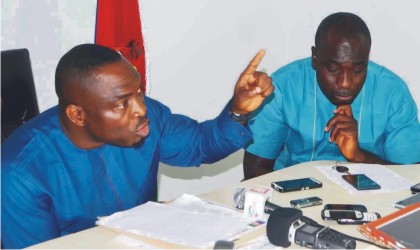
President, Ijaw Youths Council, (IYC), Mr Udengs Eradiri (left), addressing a news conference in support of the ongoing restructuring of the oil and gas sector, in Yenagoa on Tuesday. With him is the IYC spokesman, Mr Eric Omare.
Shippers’ Association in Lagos State, has called for temporary closure of Tin-Can and Apapa ports until the bad spots on the access roads leading to the ports are repaired.
President of the association, Mr Jonathan Nicol, made the call on Saturday in Lagos in an interview with newsmen.
He said that the bad state of the access roads leading to the two ports was a clear demonstration of insensitivity to the plight of Nigerian shippers (importers and exporters).
He suggested that the two ports should be shut temporarily until the bad spots on the roads are repaired.
He said that shippers had been paying demurrage on trucks and containers as a result of the poor state of the roads.
“The Nigerian Ports Authority needs to respect its pledge to repair the roads.
“This is an SOS (Save Our Soul) call To Whom It May Concern, ’’ Nicol said.
The president said that the APM Terminal in Apapa had a hectic time on Friday as trucks which loaded in the morning could not leave because the roads were blocked.
“Drivers stayed overnight in the terminal and managed to exit the port at 4 a.m. on Saturday,’’ he said.
He said that the access road leading to Tin-Can Island port was no longer motorable, adding that truck drivers now get to Apapa port through Liverpool road.
Nicol said the association of Maritime Truck Owners (AMATO) had given the Federal Government strike notice.
He said that the impending strike would have adverse effects on operations at the ports.



-

 Editorial4 days ago
Enough Of Xenophobic Attacks On Nigerians
-

 Sports4 days ago
Oparaodu Urges Rivers United To Win Katsina United
-

 Education4 days ago
UNIPort Senate Grants Two-Year Amnesty to U2010–U2018 Students
-

 Nation4 days ago
RSU, Otonti Nduka Foundation Holds Centenary Conference, Unveil Book on Values in Nigeria
-

 Oil & Energy4 days ago
Rivers PETROAN Elects 12-Member Executive
-
Politics5 days ago
APC Group Protests Ex–Presidential Aspirant’s Disqualification From Rivers Senatorial Race
-

 Sports4 days ago
” Nigeria’s best domestic players are not in NPFL”
-
Politics5 days ago
Reps Speaker Secures APC Return Ticket For Fifth Term