
Politics
Constitutional Amendment: Another Lacuna To Resolve

The recent hullabaloo
over President Goodluck Jonathan’s vetoing of the proposed constitution amendment by the National Assembly (NASS) has attracted so much reactions based on different interpretations in the quagmire of political manipulations. As usual, most of the deducible interpretations are based on which side of the divide the interpreter pitches tent – for or against the President’s veto.
Proponents seem to be of the view that the President’s veto amounts to an unnecessary delay in a genuine effort to salvage the Nigerian state from imminent under developmental power tussle warranted by an ill-conceived constitution. Meanwhile, those in support of it express the belief that the manner in which the amendment was made, and the reaction of the lawmakers to the veto smirks of a deliberate intent to not only undermine the Presidency, but to also institute their personal or group interest.
In the face of the foregoing, the essence of a constitutional amendment, which should rightly be developmental, seem to either be de-emphasised or deliberately ignored, for whatever reason, or made to look as though the status quo, in terms of the majority always having their way, should not be tampered with, even when the majority wittingly or unwittingly does not bother about what their actions or inactions portend for the populace.
Unarguably, the first time a major lacuna was truly noticed, and seen as one, was the revelation that the constitution did not make provision for who should succeed the President of Nigeria at the demise of the incumbent. This only came to the fore following the death of late President Musa Yar’ Adua. All the body language and sundry intrigues that played out in the ensuing episode is now history, but the message was clear – there are likely to be more lacunas to fill, as confirmed by the on-going constitution amendment.
President Jonathan’s reason for vetoing the amendment, according to a seven-page letter addressed to Senate President, David Mark, and the Speaker of the House of Representative, Hon Aminu Tambuwal, was warranted by what he called “deliberate attempts by federal lawmakers to whittle down presidential powers”.
The President highlighted the flaws he discovered in the amendment to include non-compliance with Section 9(3) of the 1999 Constitution on amendments; mere use of voice votes to alter the constitution without being supported by the votes of not less than four-fifths majority members of the National Assembly as well as two-thirds of all the 36 state Houses of Assembly; imposition of the right to free basic education and primary and maternal care services on private institutions; as well as perceived violation of the doctrine of separation of powers.
Other flaws, according to the president, were the decision to whittle down executive powers as contained in Section 5(1) of the 1999 Constitution; 30 days limitation provided for president’s assent; reduction of the time frame of expenditure in default of appropriation from six months to three months; and the creation of the Office of the Accountant-General of the Federal Government with different functions from those of the Auditor-General of the Federation.
President Jonathan also picked hole in the decision to transfer the President’s powers to appoint the Accountant-General of the Federation as well as the Attorney-General of the Federation to the National Economic Council and National Judicial Council, respectively; and the decision to whittle down the discretionary powers of the Attorney-General of the Federation as its separation from Minister of Justice. He described the amendment on the separation of the Office of Attorney-General of the Federation from the Minister of Justice as ambiguous.
According to him, the alterations encapsulate a wide-ranging provision that seek to separate the office of Attorney-General of the Federation (AGF) from the Minister of Justice and the Attorney-General from the Commissioner for Justice in the respective states of the federation. They also provide for the independence of the Office of Attorney-General by guaranteeing tenure and funding.
The President noted that the first noticeable setback of potential challenging provisions of the amendment is that the Fourth Alteration Act 2015 is silent on who is the Chief Law Officer of the Federation/State, noting that this is a serious lacuna capable of creating implementation challenges.
He noted that the AGF and Minister of Justice and the Attorney-General and Commissioners for Justice in the respective states of the federation are under Sections 150 and 195 of the 1999 Constitution, the Chief Law Officers respectively.
“Apparently, the AGF is the Chief Law Officer and has the power to guide the MDAs on legal issues by way of legal advice, and represent the government on other legal matters including civil litigations, contract, treaty obligations, legal drafting, etc.,
“With this amendment, which limits the power of the AGF to criminal prosecution and is silent on who is the Chief Law Officer, it appears to erode the constitutional and legal basis for the current structure and functions of the Ministry of Justice and the Law Officers employed therein, in the absence of a statute that provides for the exercise of these powers and functions.
“Consequently, if it is the intendment of the National Assembly to make the Minister of Justice the Chief Law Officer, it should be expressly stated. This will enable these functions to continue to be traditionally performed by the Ministry under the supervision of the Minister of Justice while the Office of the AGF, which is to be independent and separated from the Ministry, concentrate on prosecutions”, President Jonathan stated in the letter.
Finalising, the President said, “In view of the foregoing and absence of credible evidence that the Constitution of the Federal Republic of Nigeria (Fourth Alteration) Act 2015 satisfied the strict requirements of Section 9(3) of the 1999 Constitution, it will be unconstitutional for me to assent to it.
“I therefore withhold my assent and accordingly remit the Constitution of the Federal Republic of Nigeria (Fourth Alteration) Act 2015 to the Senate/House of Representatives of the Federal Republic of Nigeria”, the letter concluded.
In a nutshell, the proposed amendment by the NASS approved the creation of additional states (Section 3 Sub Sec.1); guaranteed creation of more Local Government Areas, LGAs (Subsection 6); approved that every citizen of Nigeria has right to live, work, attend educational institutions and enjoy all the rights and privileges enjoyed by other Nigerians accordingly (Section 42 subsections 1b).
The amendment also include that whatever is allocated to the NASS in the revenue fund of the Federal Government shall be paid directly to the NASS (Section 81 Sub-section 5); Allocation to the INEC in the Revenue Fund of the FG shall be paid directly to INEC (Section 81 Sub-sections 6); making rotation of the office of the president a constitutional matter, and hence ensuring that the constitution guarantees the right of every Zone to aspire to the presidency (Section 130).
Compulsorily, every state shall have at least one Minister in the FEC (section 147 subsection 3); the office of the Attorney-General shall be separated from the office of the Minister of Justice (Section 150 subsection 3); the constitution also proposes the establishment of the National Advisory Council on traditional Rulers (Sect 153 Sub. Section 1); Local Government Council will receive their money directly from the Federation Account (Section 162, subsection 5).
The Office of the Governor of a state shall rotate among the senatorial zones of the state (Section 176, Subsection 3); people can contest elections without belonging to a political party (Section 221); there shall be a National Industrial court to handle all labour, employment and industrial disputes (Section 254); Matter of chieftaincy shall be transferred to Customary Court of Appeal of a State (Section 282, Subsection 1).
The amendment also reviewed derivation formula up from 13% to 18% (Section 162, Sub section 2); and stated clearly that there will be no more Immunity for Governors or the President on criminal cases (section 308).
Taken from its manifest content, these amendments could hardly be said to be un-developmental. If this is so, would it be considerate to declare inordinate the President’s veto, and hence condemn him for the gallows for insisting that even as the proposed amendment is genuine, it should be in accordance with laid-down procedures of the constitution?
Looked from other perspective, would insistence by the lawmakers on anything different from abiding by the constitution not contravene the essence of them being members of the NASS? Besides, if there is need to make amendments to the constitution, would it not be pertinent, important and expedient to start the amendment at the point it is most needed, order than going contrary to the dictates of the constitution, which gives them the right to be?
Soibi Max-Alalibo
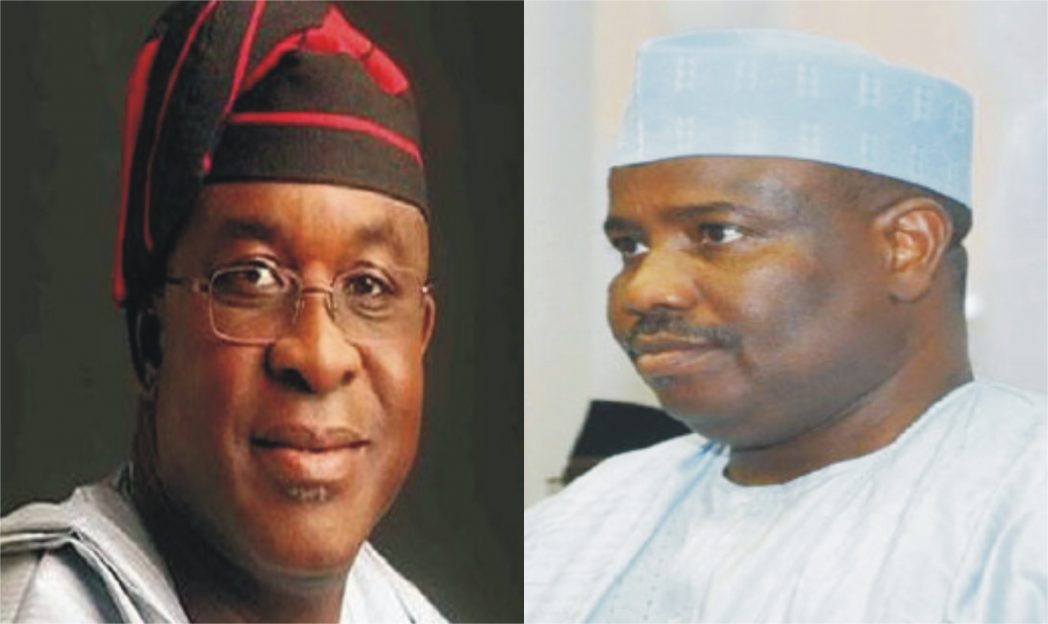
Senate President, David Mark and Speaker, House of Representatives, Aminu Tambuwal


A senator who represented Taraba Central, Mr Abubakar Yusuf, has declared that the economic policies of President Bola Tinubu are not yielding the expected results.
His comment is one of the strongest internal critiques yet from within the ruling All Progressives Congress (APC).
The comment underscores the growing dissatisfaction within sections of the ruling party over the direction and impact of the administration’s economic reforms amid rising living costs and fiscal pressures across the country.
Mr Yusuf, who served in the Senate between 2015 and 2023 under the platform of the APC, made the remarks during an appearance on national television.
Responding to a question on whether the administration’s economic direction, often referred to as Tinubunomics, was working, Mr Yusuf answered in the contrary.
“For me, it is not working. I am a member of the APC. I would be the last person to hide the facts”, he said.
He said while the government might be operating diligently within its policy structure, the framework itself is ill-suited to Nigeria’s current realities
“Within the policy framework, yes, they are doing their best, but it is not the framework that is suitable for Nigeria at the point in time that President Asiwaju came into power,” he said.
Mr Yusuf criticised the immediate removal of fuel subsidy on the day the president was sworn in, arguing that the decision lacked sufficient consultation and planning.
“I am one of those who say President Asiwaju ought to have waited. Not on the day he was sworn in to say subsidy is gone. On what basis?”, he asked.
He urged broader engagement before major fiscal decisions are taken.
“Sit down with your cabinet, sit down with your ministers, sit down with your advisers,” he said, dismissing the argument that subsidy removal was justified solely on grounds of corruption.
The former lawmaker identified “structural flaws” in the country’s budgeting system, particularly the envelope budgeting model.
“One of the basic problems is that before you budget, you should have a plan. The envelope system we have been operating has been you budget before you plan. That has been a major issue”, he said.
He argued that allocating spending ceilings without aligning them to concrete development strategies inevitably weakens implementation and delivery.
“If you give me an envelope which is contrary to my plan, whether it is plus or minus, there is no way I am going to implement my plan. It is bound to fail,” he said.
Mr Yusuf called for the scrapping of the envelope budgeting system, noting that he had consistently opposed it even during his years in the National Assembly.
“It is not good for us. It is not going to work well for us,” he said.
He further blamed poor capital releases and persistent deficit financing for undermining budget performance over the years.
“We could not meet 60 percent of our capital budget in all these years. No releases. If you make a budget and the release is very poor, there is no way the budget will be executed”, he stated.
According to him, weak fund disbursement mechanisms and reliance on deficit financing have entrenched a cycle of underperformance.
“Our budget ought to have been a surplus budget, but all our budgets have always been deficit financing budgets,” Mr Yusuf added.

The Nigerian House of Representatives has resolved to reconvene for an emergency session tomorrow February 17, 2026, to deliberate on issues arising from the Independent National Electoral Commission’s (INEC) release of the timetable for the 2027 general elections.
The decision was disclosed in a statement issued by the House Spokesman, Rep. Akin Rotimi, who described the electoral body’s announcement as one of “constitutional and national significance.”
INEC had fixed February 20, 2027, for the Presidential and National Assembly elections.
According to the statement, members of the Green Chamber were notified of the emergency sitting through an internal memorandum from the Speaker’s office.
The session is expected to focus on legislative matters connected to the newly released timetable, reflecting the House’s resolve to act promptly on issues affecting the nation’s democratic process.
Rep. Rotimi noted that all related businesses would be treated with urgency and urged lawmakers to prioritise attendance in view of the importance of the deliberations.
INEC had on Friday formally unveiled the comprehensive schedule for the 2027 polls, including timelines for party primaries slated for July to September 2026, as well as the commencement of Continuous Voter Registration in April 2026.
The development comes amid ongoing consultations and proposed amendments to the Electoral Act ahead of the 2027 general elections.

As the controversy over the transmission of election results continues across the country, the Defence For Human Rights And Democracy (DHRD), a pro democracy organisation in the country, has criticised the National Assembly for not giving express approval to real time transmission of elections results.
To this end, the group is calling on all civil society organisations in the country to mobilise and push for a better Electoral Reform in the country.
This was contained in a press statement titled, “Defence For Human Rights and Democracy Demands Real Time Election Transmission of Result”, a copy of which was made available to newsmen in Port Harcourt.
The group described the refusal of compulsory real time transmission of result results by the Senate as undemocratic, adding that the situation will give room for election manipulation, rigging and voters apathy.
It said that the provision of mandatory real time transmission of election results would have significant improvement on the nation’s democracy.
According to the statement, “Since the return of democracy in 1999 to date, it is 27 years, so our Democracy has metamorphosed from being nascent and as such significant improvement should have been recorded.
“Defence For Human Rights And Democracy (DHRD), is really disappointed at the National Assembly, especially the upper chamber (Senate) for not approving ‘Real Time Electronic Transmission of Election Result’.
“This undemocratic act of theirs, if not tamed, will give room for election manipulation and rigging’”.
Signed by Comrade Clifford Christopher Solomon on behalf of the organisation, the statement further said, “The Defence For Human Rights and Democracy unequivocally supports real time transmission of election result”, stressing that his group will resist any act by the National Assembly to undermine the nation’s democracy.
“DHRD,unequivocally supports ‘True Democracy’, which is Government of the people, by the people and for the people.
“Therefore, anything that will crash the hope of Nigerians to Freely, Fairly and Transparently elect candidates of their choice in any given election should and will be vehemently resisted because good governance begins with leaders elected through credible process. By so doing, leaders have entered a social contract with the citizens to equitably manage their affairs and abundant resources”, the statement added.
It urged the National Assembly to revisit the issue in order to avoid civil unrest.
According to the DHRD, “To avoid civil unrest,voters apathy, election rigging and manipulation, rather to promote citizens participation, advancing our Democracy and entrenching free, fair, credible and acceptable electoral outcome, the National Assembly should amend the electoral act in a manner that will deepen our democracy and boost citizens confidence.
“On this note, The Defence For Human Rights And Democracy (DHRD), is calling on all other civil society organisations (CSOs) to mobilise, organise and push for a better electoral act amendment by the National Assembly”.
By: John Bibor
-

 Sports4 days ago
2026 WC: Nigeria, DR Congo Awaits FIFA Verdict Today
-
Politics4 days ago
ADC, PDP, LP Missing As INEC Set For By- Elections In Rivers
-

 Environment4 days ago
Oxfam, partners celebrate 5 years of climate governance programmes in Nigeria
-
Politics4 days ago
FG’s Economic Policies Not Working – APC Chieftain
-

 Politics4 days ago
2027: Diri Unveils RHA LG Coordinators, APC Congress Panel
-

 News4 days ago
Victory Over Insurgency Certain, Tinubu Assures
-
 Politics4 days ago
Reps To Meet,’Morrow Over INEC’s 2027 Election Timetable
-
 Politics4 days ago
Group Continues Push For Real Time Election Results Transmission