Politics
Constitutional Amendment: Another Lacuna To Resolve

The recent hullabaloo
over President Goodluck Jonathan’s vetoing of the proposed constitution amendment by the National Assembly (NASS) has attracted so much reactions based on different interpretations in the quagmire of political manipulations. As usual, most of the deducible interpretations are based on which side of the divide the interpreter pitches tent – for or against the President’s veto.
Proponents seem to be of the view that the President’s veto amounts to an unnecessary delay in a genuine effort to salvage the Nigerian state from imminent under developmental power tussle warranted by an ill-conceived constitution. Meanwhile, those in support of it express the belief that the manner in which the amendment was made, and the reaction of the lawmakers to the veto smirks of a deliberate intent to not only undermine the Presidency, but to also institute their personal or group interest.
In the face of the foregoing, the essence of a constitutional amendment, which should rightly be developmental, seem to either be de-emphasised or deliberately ignored, for whatever reason, or made to look as though the status quo, in terms of the majority always having their way, should not be tampered with, even when the majority wittingly or unwittingly does not bother about what their actions or inactions portend for the populace.
Unarguably, the first time a major lacuna was truly noticed, and seen as one, was the revelation that the constitution did not make provision for who should succeed the President of Nigeria at the demise of the incumbent. This only came to the fore following the death of late President Musa Yar’ Adua. All the body language and sundry intrigues that played out in the ensuing episode is now history, but the message was clear – there are likely to be more lacunas to fill, as confirmed by the on-going constitution amendment.
President Jonathan’s reason for vetoing the amendment, according to a seven-page letter addressed to Senate President, David Mark, and the Speaker of the House of Representative, Hon Aminu Tambuwal, was warranted by what he called “deliberate attempts by federal lawmakers to whittle down presidential powers”.
The President highlighted the flaws he discovered in the amendment to include non-compliance with Section 9(3) of the 1999 Constitution on amendments; mere use of voice votes to alter the constitution without being supported by the votes of not less than four-fifths majority members of the National Assembly as well as two-thirds of all the 36 state Houses of Assembly; imposition of the right to free basic education and primary and maternal care services on private institutions; as well as perceived violation of the doctrine of separation of powers.
Other flaws, according to the president, were the decision to whittle down executive powers as contained in Section 5(1) of the 1999 Constitution; 30 days limitation provided for president’s assent; reduction of the time frame of expenditure in default of appropriation from six months to three months; and the creation of the Office of the Accountant-General of the Federal Government with different functions from those of the Auditor-General of the Federation.
President Jonathan also picked hole in the decision to transfer the President’s powers to appoint the Accountant-General of the Federation as well as the Attorney-General of the Federation to the National Economic Council and National Judicial Council, respectively; and the decision to whittle down the discretionary powers of the Attorney-General of the Federation as its separation from Minister of Justice. He described the amendment on the separation of the Office of Attorney-General of the Federation from the Minister of Justice as ambiguous.
According to him, the alterations encapsulate a wide-ranging provision that seek to separate the office of Attorney-General of the Federation (AGF) from the Minister of Justice and the Attorney-General from the Commissioner for Justice in the respective states of the federation. They also provide for the independence of the Office of Attorney-General by guaranteeing tenure and funding.
The President noted that the first noticeable setback of potential challenging provisions of the amendment is that the Fourth Alteration Act 2015 is silent on who is the Chief Law Officer of the Federation/State, noting that this is a serious lacuna capable of creating implementation challenges.
He noted that the AGF and Minister of Justice and the Attorney-General and Commissioners for Justice in the respective states of the federation are under Sections 150 and 195 of the 1999 Constitution, the Chief Law Officers respectively.
“Apparently, the AGF is the Chief Law Officer and has the power to guide the MDAs on legal issues by way of legal advice, and represent the government on other legal matters including civil litigations, contract, treaty obligations, legal drafting, etc.,
“With this amendment, which limits the power of the AGF to criminal prosecution and is silent on who is the Chief Law Officer, it appears to erode the constitutional and legal basis for the current structure and functions of the Ministry of Justice and the Law Officers employed therein, in the absence of a statute that provides for the exercise of these powers and functions.
“Consequently, if it is the intendment of the National Assembly to make the Minister of Justice the Chief Law Officer, it should be expressly stated. This will enable these functions to continue to be traditionally performed by the Ministry under the supervision of the Minister of Justice while the Office of the AGF, which is to be independent and separated from the Ministry, concentrate on prosecutions”, President Jonathan stated in the letter.
Finalising, the President said, “In view of the foregoing and absence of credible evidence that the Constitution of the Federal Republic of Nigeria (Fourth Alteration) Act 2015 satisfied the strict requirements of Section 9(3) of the 1999 Constitution, it will be unconstitutional for me to assent to it.
“I therefore withhold my assent and accordingly remit the Constitution of the Federal Republic of Nigeria (Fourth Alteration) Act 2015 to the Senate/House of Representatives of the Federal Republic of Nigeria”, the letter concluded.
In a nutshell, the proposed amendment by the NASS approved the creation of additional states (Section 3 Sub Sec.1); guaranteed creation of more Local Government Areas, LGAs (Subsection 6); approved that every citizen of Nigeria has right to live, work, attend educational institutions and enjoy all the rights and privileges enjoyed by other Nigerians accordingly (Section 42 subsections 1b).
The amendment also include that whatever is allocated to the NASS in the revenue fund of the Federal Government shall be paid directly to the NASS (Section 81 Sub-section 5); Allocation to the INEC in the Revenue Fund of the FG shall be paid directly to INEC (Section 81 Sub-sections 6); making rotation of the office of the president a constitutional matter, and hence ensuring that the constitution guarantees the right of every Zone to aspire to the presidency (Section 130).
Compulsorily, every state shall have at least one Minister in the FEC (section 147 subsection 3); the office of the Attorney-General shall be separated from the office of the Minister of Justice (Section 150 subsection 3); the constitution also proposes the establishment of the National Advisory Council on traditional Rulers (Sect 153 Sub. Section 1); Local Government Council will receive their money directly from the Federation Account (Section 162, subsection 5).
The Office of the Governor of a state shall rotate among the senatorial zones of the state (Section 176, Subsection 3); people can contest elections without belonging to a political party (Section 221); there shall be a National Industrial court to handle all labour, employment and industrial disputes (Section 254); Matter of chieftaincy shall be transferred to Customary Court of Appeal of a State (Section 282, Subsection 1).
The amendment also reviewed derivation formula up from 13% to 18% (Section 162, Sub section 2); and stated clearly that there will be no more Immunity for Governors or the President on criminal cases (section 308).
Taken from its manifest content, these amendments could hardly be said to be un-developmental. If this is so, would it be considerate to declare inordinate the President’s veto, and hence condemn him for the gallows for insisting that even as the proposed amendment is genuine, it should be in accordance with laid-down procedures of the constitution?
Looked from other perspective, would insistence by the lawmakers on anything different from abiding by the constitution not contravene the essence of them being members of the NASS? Besides, if there is need to make amendments to the constitution, would it not be pertinent, important and expedient to start the amendment at the point it is most needed, order than going contrary to the dictates of the constitution, which gives them the right to be?
Soibi Max-Alalibo
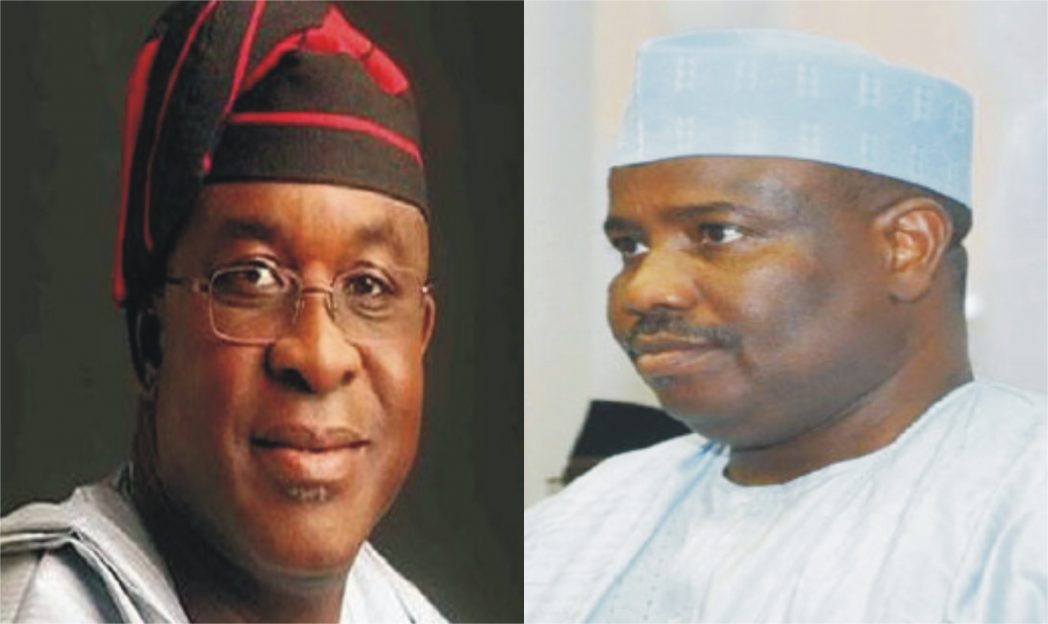
Senate President, David Mark and Speaker, House of Representatives, Aminu Tambuwal