
Business
New Oil Price Benchmark, Beneficial To 2015 Budget – Expert

An associate Professor of Finance, Nassarawa State University, Dr Uche Uwaleke, said the reduction of oil price benchmark by the National Assembly would aid the implementation of the 2015 budget.
Uwaleke said this in an interview with newsmen in Abuja.
He said the reduction of the oil price benchmark reflected a careful approach to the implementation of the budget.
It would be recalled that both the lower and upper chambers of the National Assembly had adopted different oil price benchmarks for the 2015 budget.
Both chambers of the National Assembly had pegged the price at 52 and 54 dollars per barrel respectively, against the initial 65 dollars proposed by the executive arm of government.
Uwaleke said adopting a higher oil benchmark for the 2015 budget would translate to lower budget deficit and by extension lower budget deficit to Gross Domestic Product (GDP) ratio.
He said a higher benchmark would also lead to less borrowing to finance the deficit.
He said that it was more beneficial to adopt a lower conservative benchmark given the mono-product nature of the economy.
Uwalake said the unpredictable nature of oil price in the international market and the country’s shrinking foreign reserves as well as weakening domestic currency were responsible for the low benchmark.
He said that the adoption of a lower benchmark, however, required conscious effort at increasing the Internally Generated Revenue (IGR) of the country.
Uwalake advocated for a decrease in the disproportionate share of recurrent expenditure for the achievement of the development expenditure estimates.
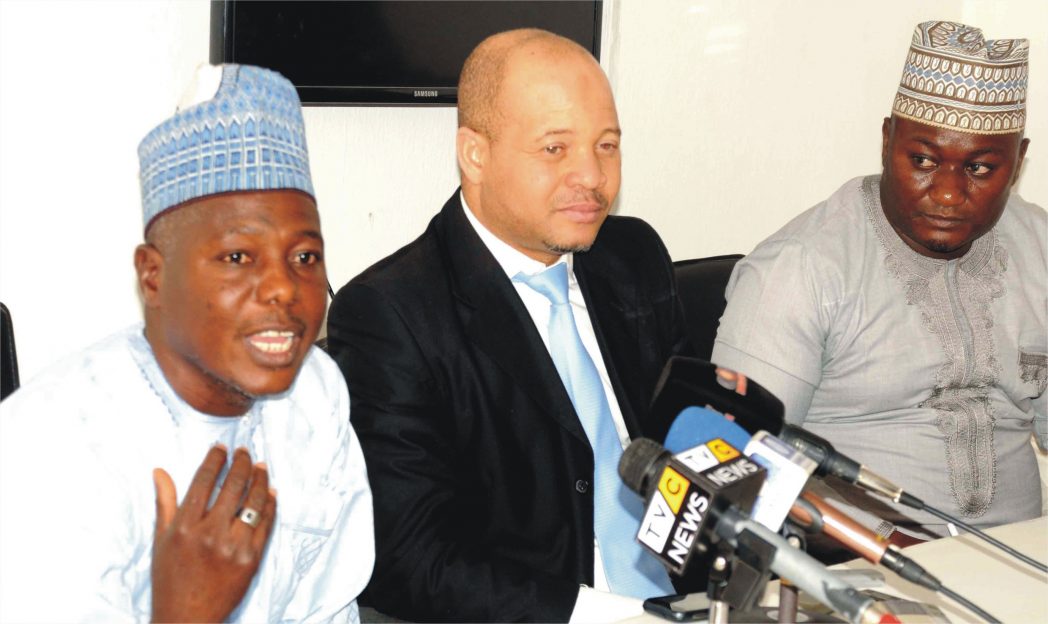
L-R: Corporate Communications Officer, Kaduna Electricity Distribution Company, Malam Mohammed Eibo, Head, Corporate Communications, Mr Abdulazeez Abdullahi and Corporate Communications Officer, Malam Idris Muhammad, at a news conference on Power Efficiency in Kaduna, recently.



-
Politics2 days ago
2027: NIGERIANS FAULT INEC ON DIGITAL MEMBERSHIP REGISTER DIRECTIVE
-

 Environment3 days ago
LAWMA Director Says Sweeping Reforms Have Improved Waste Collection
-
Politics2 days ago
LP Crisis: Ex-NWC Member Dumps Dumps Abure Faction
-

 Politics2 days ago
Umahi Dismisses Allegations On Social Media, Insists On Projects Delivery
-

 Sports2 days ago
Abia Not Sure To Secure continental Ticket
-
Sports2 days ago
La Liga: Yamal Records First Career Hat-trick
-
Politics2 days ago
NATASHA ELECTRIC VEHICLES INITIATIVE IN KOGI CENTRAL
-
Politics2 days ago
IT’S A LIE, G-5 GOVS DIDN’T WIN ELECTION FOR TINUBU – SOWUNMI