
News
Jonathan Orders NNPC To Refund $1.48bn …Visits Troops In Adamawa

President Goodluck Jonathan has ordered the Nigerian National Petrolium Corporation (NNPC) to pay the controversial $1.485billion into the account of Federation Account Allocation Committee (FAAC) for disbursment.
This was disclosed at the monthly FAAC meeting held yesterday in Abuja.
Meanwhile, the sum of N500.130 billion was shared among the three tiers of government for the month of January.
In a statement issued by the technical sub-committee of the Federation Account Allocation Committee (FAAC), at the meeting, the amount shared represents a short fall of N80.248 billion from N580.378 billion shared in the previous month.
According to the committee, the reduction was due to drop. In crude oil prices from $77.53 million in November to $52.34 million in December, 2014.
Also, the drop was attributed to a 33 per cent decrease in export volume between November and December, 2014, which translated to a loss of $159.88 million.
Of the amount shared, state governments received the lion share of N30.689 billion, representing 50 per cent, while Federal Government and local government councils received 15 and 35 per cent, respectively.
It was stated that additional N4.419 billion payment was made by NNPC with N6.330billion refund to Federal Government purse.
Additionally, the sum of N776 million was also added to the shared money as residual balance, while N63.935 billion was added from Value Added Tax (VAT).
However, the Minister of State for Finance, Ambr. Bashir Yuguda debunked the rumour making rounds that Nigeria is broke, insisting that the economy is resilient and strong as evidenced in all the economic indices.
According to him, the domestic account of the country stands at $19 million, while the excess crude account is $2.60 million.
Bashir, who blamed the current economic challenges on devaluation of naira as occasioned by hostility in the oil market, assured that the situation will soon better as government has decided to cut down travel and expenses.
However, the House of Representatives has for the second time on Wednesday asked the Minister of Finance, Ngozi Okonjo-Iweala, to submit the full version of the forensic audit report on the alleged missing Nigerian National Petroleum Corporation $20billion to it.
The House gave the first directive on Thursday last week, following a motion moved by its Minority Leader, Femi Gbajabiamila.
On Wednesday (yesterday), the House again asked the minister for the report after Gbajabiamila complained that almost one week following the first resolution, Okonjo-Iweala had not responded.
He said, “Mr. Speaker (Emeka Ihedioha, presiding), we request the Clerk of the House to formally write the Minister to produce that report to every member of this House.
“She has not produced the report, irrespective of the standing resolution of this House. We want to have the full report, not the snippets that they have been flying about.”
The House endorsed his submission and directed the minister a second time to comply.
An auditing firm, PriceWaterHouse Coopers, had carried out the forensic investigation on behalf of the Federal Government.
The Chairman, House Committee on Public Accounts, Mr. Solomon Olamilekan, told reporters shortly after the House rose that the Office of the Auditor-General of the Federation only presented a “highly-condensed version” of the report to the public.
He recalled that in the condensed version, the NNPC was directed to remit a “minimum of $1.4billion into the Federation Account.”
The lawmaker said that, as the committee overseeing public accounts, PAC was duty-bound to ensure that the minister produced the report.
He ordered Okonjo-Iweala to submit the report not later than one week from Wednesday.
Olamilekan added, “The PAC, cognisant of the provisions of the Constitution (1999), and empowered by the resolution, hereby requests that the full report on the forensic audit by PWC, which must include the initial raft report, the executive summary, management /internal control letters, should be forwarded to the National Assembly not later than one week from today(Wednesday).”
Meanwhile, the Federal Government has, in spite of the drop in its oil revenue and dwindling allocations to the three tiers of government, insisted that Nigeria is not broke.
“The country is not broke, we have been meeting our obligations despite the challenges we have had with oil revenue streams but we have been doing the best that we can to improve our revenue from the non-oil sector,” the Minister of State for Finance, Bashir Yuguda, said.
Yuguda spoke with journalists after this month’s Federation Accounts Allocation Committee meeting in Abuja on Tuesday night.
The minister who, put the excess crude account at about $2billion, also spoke briefly on the forensic audit report and the amount to be refunded by the NNPC to the federation account.
“I have engaged the minister of petroleum and we have discussed the time frame on the refund of that amount,” he said.
However, the All Progressives Congress Vice-Presidential candidate, Yemi Osinbajo, has said that the biggest problem facing Nigeria is corruption and not dwindling oil prices.
Osinbajo stated this in Uyo, Akwa Ibom State, on Wednesday during the presentation of APC’s 2015 manifesto on Securing Nigeria’s Future.
He said, “Nigeria problem, as you know, is not lack of resources. The government of today has tried to give the impression that the problem of the country is that of falling oil prices, which is now below $50 per barrel.
“That is not true, that is not the problem. The problem is the corruption or the theft of resources.”
The former Lagos State Attorney-General and Commissioner for Justice, added that the Federal Government itself had confirmed that over 400,000 barrels of oil are stolen every day from Nigeria.
He put the value of the stolen oil at N3.1trillion a year.
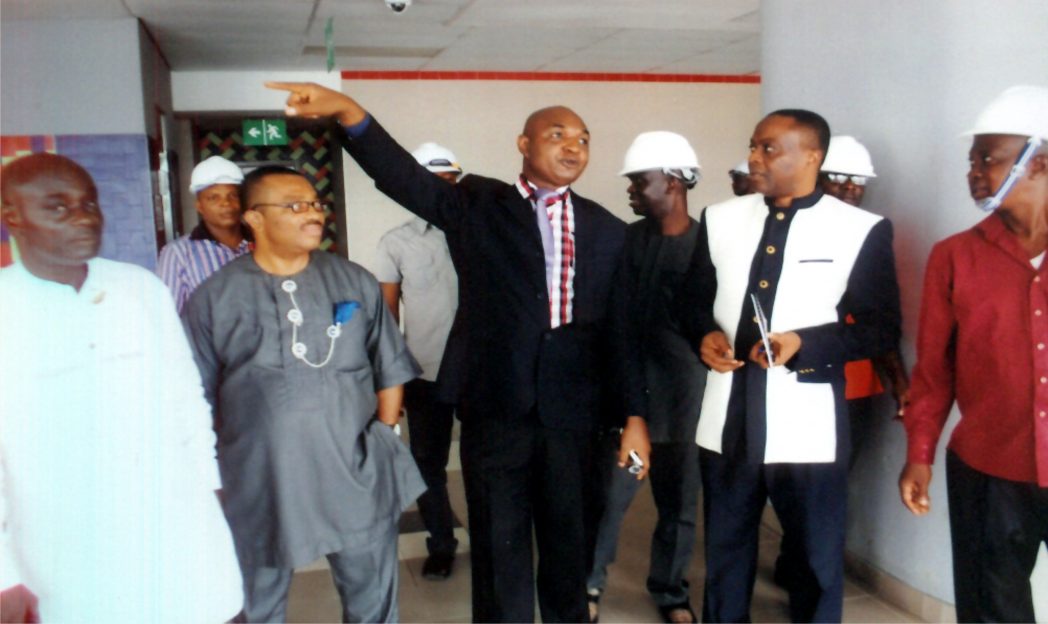
Permanent Secretary, Rivers State Ministry of Information and Communications, Sam Woka (middle) explaining a point during an inspection of the state monorail project at UTC station, last Wednesday. With him are General Manager, RSNC, Mr Celestine Ogolo (2nd left),a Director in the Ministry of Information and Communications, Pastor Paulinus Nsirim (left), and other dignitaries.

News
Fubara Reaffirms Commitment To Peace, Unity And Development As Rivers State Marks 59TH Anniversary


Governor of Rivers State, His Excellency, Sir Siminalayi Fubara, has reaffirmed the unwavering commitment of his administration to peace, unity, security, and inclusive development as Rivers State marks its 59th anniversary.
In a goodwill message issued on Wednesday to commemorate the anniversary, Governor Fubara stated that despite the challenges faced over the years, the people of Rivers State have continued to demonstrate resilience, strength, and an enduring spirit of unity that has sustained the state since its creation.
The Governor noted that the strong bond of brotherhood among the various ethnic nationalities of the state, including the Ijaw, Ikwerre, Ogoni, Etche, Ekpeye, Andoni, Kalabari, and others, remains one of Rivers State’s greatest strengths and a critical foundation for peace, stability, and progress.
He further observed that Rivers State has remained a major driver of Nigeria’s economy for decades, not only because of its abundant oil and gas resources, but also because of the exceptional contributions of its people across diverse sectors including academia, jurisprudence, business, entertainment, public service, and sports.
Governor Fubara assured the people that his administration will continue to prioritize policies and programmes that promote peace, protect lives and property, and expand development across all parts of the state. He emphasized that governance must be people centered and impactful, with equal attention given to every Local Government Area of the state.
The Governor also paid tribute to the elders and founding leaders of the state for preserving the spirit of unity and coexistence over the years, while urging the youths to remain hopeful, responsible, and actively committed to building a greater Rivers State through innovation, hard work, and patriotism.
He equally acknowledged the invaluable role of women in strengthening families, communities, and society, describing them as indispensable partners in the continued growth and stability of the state.
Governor Fubara called on all Rivers people to use the occasion of the anniversary as a moment of reflection and renewed commitment to peaceful coexistence, mutual respect, dialogue, and collective progress, stressing that the unity and future of Rivers State must always rise above personal interests and political differences.
Rivers State was created on May 27, 1967, when the administration of General Yakubu Gowon (Rtd.) created twelve states out of the former four regions of Nigeria, with Rivers State carved out of the defunct Eastern Region.

Rivers State Governor, Sir Siminalayi Fubara, has commended the leadership of the All Progressives Congress (APC) in Rivers State over the outcome of last Saturday’s presidential primary election that saw President Bola Ahmed Tinubu sweeping the poll with a total of 280,082 votes.
Fubara, who served as the State Collation Officer for the primary election, said that while the APC had a total of 297,068 registered members, the number of those accredited for the election was 280,082.
According to him, all those accredited for the election, cast their ballot for Tinubu, leaving Stanley Osifo, his only opponent, with no votes.
Fubara expressed delight at the peaceful and seamless process which he said was as a result of good planning by the party.
“I feel that this process has recorded one of the most organised outings of our great party in recent times. The only reason it came out this way has to do with good planning. In all, I want to say that I’m really impressed with the process.
“So, I can say here that having taken time to go through the figures diligently, I, Siminalayi Fubara, who is standing as the State Collation Officer, hereby certify that the information contained in my own spreadsheet represents the true, correct and accurate record of the summary of results from the 23 LGAs of Rivers State,” he said.
The governor said that while it was evident that President Tinubu defeated his opponent in the primary election in the State, the report would be sent to the APC headquarters in Abuja where the results will be formally declared.

The Federal Government has called for increased private sector participation and donor funding to sustain ongoing gains in the Ogoni environmental restoration project under the Hydrocarbon Pollution Remediation Project.
Speaking at a conference on donor facilitation and diplomatic support for HYPREP in Abuja, yesterday, the Minister of Environment, Balarabe Lawal, stressed that the Ogoni cleanup programme was designed as a long-term intervention requiring sustained funding, technical support, and international cooperation.
“The project is supposed to be a lifespan project. We must move towards achieving its main aim, which is environmental restoration and sustainable development,” he added.
Lawal acknowledged the contributions of the United Nations Environment Programme, describing its assessment as the scientific foundation of the ongoing remediation efforts in Ogoni land.
“We are all here because of that UNEP report. It provided the scientific foundation for what has become one of the world’s most ambitious environmental remediation programmes,” he said.
According to him, hundreds of hectares of hydrocarbon-polluted land have been remediated, while additional sites are currently undergoing cleanup operations.
“We have remediated hundreds of hectares of polluted land, and more sites are still being worked on. Water schemes have also been delivered to affected communities,” he stated.
He added that ecosystem restoration, livelihood support programmes, and healthcare projects were ongoing across affected communities.
“Body health facilities are being constructed, livelihood programmes are empowering thousands, and we are also restoring access to safe drinking water because the first victim of pollution is water,” he said.
The minister also disclosed that the Centre of Excellence for Environmental Restoration was nearing completion, describing it as a major milestone in the project.
“If you go there, you will see one of the biggest edifices being constructed under HYPREP. It will serve as a postgraduate and research institute for environmental remediation,” Lawal said.
Despite the progress, he warned that funding challenges remain a major threat to sustaining the project.
“While substantial progress has been made, the journey is not yet complete. The implementation of UNEP recommendations requires long-term commitment and sustained financial and technical support,” he said.
Lawal therefore, appealed to development partners, donor agencies, international financial institutions, foundations, and private sector players to scale up their support.
“We need your support—financial, technical, scientific, and strategic. No organisation or government can do it alone,” he said.
He further described the Ogoni cleanup as a global model for environmental recovery, climate resilience, and international cooperation.
“The restoration of Ogoni land is not merely a Nigerian undertaking; it is a global model. Its success will show what is possible when governments, communities, and partners work together,” he added.
Also speaking, the Chairman of the Board of Trustees of the Ogoni Trust Fund, Emmanuel Deeyah, said the conference was organised to attract financial, technical, and institutional support for the cleanup exercise.
“We are looking for resources, financial support, expertise, partnership, and collaboration. Government cannot do everything alone,” he said.
Deeyah said the agitation for environmental justice in Ogoni dated back to 1991 when residents drew global attention to the environmental degradation caused by oil exploration activities.
“We farm in Ogoni land and we also fish, but our waters were polluted and the land could no longer support farming activities,” he said.
He explained that the UNEP report recommended that oil companies should contribute $1bn every five years for 30 years to support the remediation programme.
“We have done 10 years now and we have not even received the full $1bn that was supposed to be contributed. The refineries and local operators have not contributed a dime,” he stated.
Last week, the Hydrocarbon Pollution Remediation Project announced the closure of 30 contaminated sites in Ogoniland, Rivers State, while investigations have commenced on 18 high-risk polluted locations in residential communities.
-

 News1 day ago
Court Sentences Seven To Death Over Murder Of Cleric In Rivers
-
 Politics1 day ago
APC PRIMARIES: FUBARA’S WITHDRAWAL, HISTORIC SACRIFICE FOR NATIONAL STABILITY ……. GROUP
-

 Sports1 day ago
PH Arsenal Community Set For Streets Procession, Saturday
-

 News2 days ago
Group Hails Tinubu, Chinda Emergence
-

 Politics1 day ago
IPAC Flays INEC Over Election Guidelines Judgement
-

 Politics1 day ago
NDC To Adopt Electronic Voting For Future Primaries
-

 Sports1 day ago
NPFL: Rivers United Finishes Second, Secures Continental Ticket
-

 Sports1 day ago
Stakeholders Laud GTI On NPFL Partnership