
Nation
THE STATES

Adamawa
Despite the public holiday declared by the Adamawa
State Governor, Admiral Murtala Nyako (retd.), the seven-man panel set up by the outgoing Acting Chief Judge, Justice Ambrose Mammadi, began sitting in Yola last Monday.
Though the public holiday was to cover Monday and Tuesday but members of the panel commenced sitting at the popular Hotel J&J Holiday Villa in Yola, the state capital, amid tight security provided by both land and air troops.
When the governor announced the public holiday on Sunday, he said the period would be devoted to prayers by the citizens and civil servants in view of the insecurity in the state but many had believed the move was to stave off the impeachment process against him.
Mammadi had last Friday set up the panel to investigate allegations of gross misconduct levelled against the governor and his deputy, Mr. James Ngilari. The acting CJ set up the investigative panel as requested by the Adamawa State House of Assembly.
Bauchi
Troops have taken the battle to Boko Haram insurgents,
destroying their bases in Balmo Forest, the Defence Headquarters (DHQ) said yesterday. Balmo is on the fringes of Sambisa Forest where over 200 Chibok girls are believed to be in captivity.
The military also confirmed that 44 insurgents were killed in encounters with troops in Kerenoa. The Director of Defence Information, Maj.-Gen. Chris Olukolade, in a statement in Abuja, said the encounters between troops and the insurgents occurred at the weekend.
The statement said: “Troops have cleared and taken over Balmo Forest in a military operation that lasted throughout the weekend. Prior to the operation, Balmo Forest, stretching from Bauchi through Jigawa states, with links to the fringes of Sambisa Forest, was used by terrorists as bases and hideouts for launching attacks.
“Terrorists and armed gangs operating in the forests were completely routed out while some were captured during the operation. Among those captured were two foreigners who are suspected to be mercenaries. Also captured are several weapons and equipment, including power generating sets, communication equipment, vehicles, motorcycles, foodstuff and kitchen utensils.” It added.
Benue
Primary school teachers in Benue State, last Monday,
resumed classes after nine months of strike.
Our source who went round some public primary schools in the capital city of Makurdi also learnt that pupils abandoned classes. Teachers who resumed work sat in groups to share their experiences during the prolonged strike.
Speaking on their resumption, the head teachers of the visited schools, Mrs Esther Zaaya, Rebecca Yugh and Laadi Ngbegha respectively expressed optimism that the pupils might turn up before the week runs out.
The chairman of Parents/Teachers Association (PTA), CAC Nursery/Primary School, Wadata, Samson Oga, said he and other members had been going around to sensitise parents to ensure that their children/wards returned to school.
Gombe
Nigerian police recently uncovered a plot to bomb a
secondary school in the restive northeastern city of Gombe by defusing a car laden with explosives that had been abandoned there, a spokesman said.
Police bomb experts found 12 improvised explosives concealed in a car that was abandoned on the premises of the state-run Pilot Secondary School, following a tip-off, Fwaje Attajiri told newsmen.”Our ordnance experts discovered 12 IEDs (improvised explosive devices) in the trunk of the car left in the vicinity of the school after we were alerted,” he said.
“The explosives had the capacity of causing maximum damage and would have caused huge casualty had they detonated in the school with a high student population,” he said.
Attajiri said an investigation had been launched to establish who was behind the foiled attack, refusing to say if Boko Haram Islamists can be blamed.Boko Haram, which means Western education is forbidden in local Hausa, has carried out deadly attacks on schools in the volatile northeast as part of a five-year insurgency aimed at establishing an Islamic state in the north.
Kaduna
Kaduna State Deputy Governor, Nuhu Bajoga, has said
no opposition party, including, the All Progressives Congress (APC), can win governorship and other elections in the state in 2015, saying the Peoples Democratic Party (PDP) will sweep all elections in the state in 2015.
The deputy governor., who stated this at the weekend in Kwoi, Jaba Local Government Area of the state, during the party’s stakeholders’ meeting, said no opposition could challenge the PDP in the state.
He said despite moves by the new opposition party to obstruct the growing influence of the PDP, the ruling party had strategised on the modalities to counter the opposition.
He pointed out that the feat recorded by PDP since the return of democracy would be repeated because the party had remained the same since it was formed about 16 years ago.
Oyo
At least six persons, including a pregnant woman, were
crushed to death in an auto crash that occurred at Agbala junction area of Ibadan in Egbeda Local Government Area of Oyo State, recently.
Three vehicles were said to be involved in the accident that occurred some minutes past 7am.Although, the Federal Road Safety Commission, FRSC, confirmed that three people, including a woman died, eyewitnesses said there were six casualties. There were also four people, including a child, who were seriously injured.
The accident happened on the ever-busy Ife Ibadan Road when a commercial car, with number plate, YNF 963 AA, reportedly crossed the road unexpectedly while the on coming vehicles ran into it.Confirming the accident, Mr. Abiodun Akinlade, the Egbeda Unit Commander of the FRSC said:
“The accident happened around 7:30 am on Ife Ibadan road at Agbala junction. It involved three vehicles, including Nissan Micra with number plate.
Osun
Some traditional rulers from Osun State have given
reasons why Oduduwa State must be listed among the 19 states recommended by the National Conference for creation by the Federal Government.
The proposed states listed by the conference to be created are Aba, from the present Abia State, Katagum from Bauchi State, Ijebu from Ogun State, Amana from former Sardauna Province, Apa from Benue State, Anioma State from Delta State, Savannah from Borno, Etiti from South-East, Njaba/Anim from Anambra and Imo States, Gurara from Kaduna, Ghari from Kano State, Adada, New Oyo from Oyo State, Orachi from Rivers State, Ogoja from Cross River State and Kanji from Kebbi and Niger States.
But the traditional rulers, in their memo to the leadership of the conference, said it would amount to injustice if states were created in the country without acceding to their demand.
Ondo
Academic and commercial activities at Rufus
Giwa Polytechnic, Owo (RUGIPO) and the entire Owo town were halted following a protest by students of the institution over hike in school fees.
It was gathered that the students resolved to protest the conditions attached to writing exams and the recent unified test introduced by the management of the institution, after a students’ union stakeholders meeting held last Sunday.
Following the new fees introduced by the management, full time students, who are natives are expected to pay over N60,000, non-natives are to pay over 70,000, while newly admitted students are expected to pay over 90,000.
It was learnt that the management had directed that the students should commence a unified test effective from yesterday with the condition that only students who had paid their school fees would be allowed to write the test.
The development, however, provoked the students, who took to the streets yesterday morning, blocking the institution’s gate and preventing lecturers and other members of staff from gaining entry into the school premises.
Sokoto
The Sultan of Sokoto, Alhaji Muhammad Sa’ad
Abubakar III, said politicians were the main problem of Nigeria, stressing that the rising violence in the country had been caused by the undue struggle by politicians to position themselves ahead of the 2015 elections.
Speaking during a chat with reporters at a Ramadan dinner held in his palace in Sokoto Sunday night, the monarch maintained that the rising wave of violence and wanton killing of innocent citizens was geared towards the 2015 elections.
He pointed out that the incessant killing of innocent citizens was all politics, saying politicians were behind the myriad of problems ravaging the country.
“We are shedding too much blood of innocent Nigerians and God will not be pleased with us when we keep on shedding innocent blood because their cries mean a lot,” he said.
He said Nigerians must put aside their religion and ethnicity and come together to tackle the problems of the country.
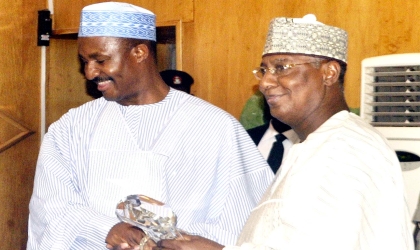
Executive Secretary, National Christian Pilgrims Commission (NCPC), Mr Kennedy Opara (left), presenting a gift to Governor Saidu Dakiingari of Kebbi State, last Monday. Photo: NAN



The Hydrocarbon Pollution Remediation Project (HYPREP) has announced that the mangrove wetlands in Ogoniland have been officially designated a Ramsar Site of International Importance by the Secretariat of the Ramsar Convention on Wetlands.
The designation, according to HYPREP, underscores the global ecological significance of Ogoniland’s mangrove wetlands and highlights ongoing restoration efforts aimed at addressing environmental degradation in the area.
In a press statement issued by the Project Coordinator of HYPREP, Prof Nenibarini Zabbey, the recognition was described as a major milestone for the agency, the people of Ogoni and other stakeholders working towards environmental restoration in the region.
Zabbey explained that the mangrove wetlands, which cover more than 31,700 hectares, consist of islands, tidal creeks, mudflats and mangrove forests that support a wide range of biodiversity. The ecosystem provides habitat for several species including fin fish, shellfish, crustaceans, crocodiles, turtles and the endangered grey parrot.
He noted that beyond biodiversity conservation, the wetland also provides essential ecosystem services such as fisheries production, flood control, water purification and carbon storage. According to him, the international recognition will further support local livelihoods, promote ecotourism and bring global attention to the region.
The HYPREP coordinator disclosed that the designation followed a meticulous process that began in 2024 when the project submitted a memorandum to the National Council on Environment seeking support for the recognition of the Ogoni wetlands as a Ramsar site.
Following the council’s review and approval, the Honourable Minister of Environment and Chairman of HYPREP’s Governing Council, Balarabe Abbas Lawal, formally wrote to the Ramsar Convention Secretariat requesting international recognition of the wetlands.
After a comprehensive ecological assessment, the Ramsar Secretariat granted the designation, officially recognising the Ogoniland wetlands as one of the world’s sites of international importance.
Zabbey said the recognition would strengthen ongoing environmental restoration efforts in the area and encourage stronger conservation measures and sustainable management of the wetlands for the benefit of present and future generations.
He added that the designation also fulfils a key recommendation of the United Nations Environment Programme (UNEP) Environmental Assessment Report on Ogoniland, marking another significant step in the implementation of the report’s recommendations.
The HYPREP project coordinator reaffirmed the agency’s commitment to restoring the Ogoni environment through the remediation of oil-polluted land, shorelines and mangrove ecosystems.
He also called for collective responsibility and stakeholder support to sustain the progress of the Ogoni cleanup programme and facilitate the development of a comprehensive and sustainable management plan for the Ogoni mangrove wetlands.

The Permanent Secretary, Rivers State Ministry of Social Welfare and Rehabilitation, Mrs Lauretta Davies-Dimkpa, has attributed the successes of the 12-day programme organised for adolescent girls aimed at eliminating Female Genital Mutilation(FGM) in some parts of the State to the ability of the respective stakeholders to take ownership of the programme.
Mrs Davies-Dimkpa, who dropped the hint in an interview at the end of the programme in Elele-Alimini Community in Emohua Local Government Area on Saturday, said the event had a buy-in component, an ownership mentality, whereby facilitators, staff, and everyone involved took ownership of the project.
She explained that the Rivers State Ministry of Social Welfare and Rehabilitation, in collaboration with the United Nations Children’s Fund (UNICEF) and the United Nations Population Fund (UNFPA) had packaged a series of training sessions for adolescent girls aimed at ending the practice of Female Genital Mutilation (FGM) in some communities across the State.
According to her, the initiative was designed to educate young girls on the harmful effects of the practice and empower them to become advocates against it within their communities.
She noted that the programme, which lasted for several weeks, targeted adolescent girls from different local government areas where the practice is still prevalent, stressing that
data collected by UNICEF and the Ministry revealed that Female Genital Mutilation is still practised in some parts of the State, prompting the need for intensified sensitisation and community engagement.
Mrs Davies-Dimkpa explained that the programme adopted a “train-the-trainer” approach where adolescent girls were educated on the dangers of the practice and encouraged to share the knowledge with their peers, families and communities.
“This is a programme by the Rivers State Ministry of Social Welfare and Rehabilitation with support from UNICEF and UNFPA to train adolescent girls towards ending Female Genital Mutilation, which is still practised in some local government areas,” she said.
She further explained that each participating local government area had a three-day training session, with the exercise running for a total of 12 days.
The local government areas, where the programme took place, she noted, included Ahoada West, Abua-Odual, and Emohua, adding that the initiative is part of broader efforts by the state government and development partners to eliminate harmful traditional practices and protect the rights and wellbeing of girls.
She revealed that prior to the training of the adolescent girls, the Ministry and its partners had also engaged community facilitators, including older women and men, to sensitise them on the dangers associated with Female Genital Mutilation.
According to her, the involvement of community leaders and adults is essential in addressing the cultural and social factors that sustain the practice.
Speaking on the response of the participants, the permanent secretary expressed satisfaction with the level of engagement and enthusiasm shown by the girls throughout the training sessions.
She noted that many of the participants said they were learning about the harmful effects of Female Genital Mutilation for the first time.
“The girls are between the ages of 12 and 17 and from the interactions we had with them, they were very excited. Some of them are hearing these things for the first time and never knew that the practice is harmful,” she said.
She expressed optimism that the knowledge gained from the training would enable the girls to serve as advocates for change within their communities.
She added that the Rivers State Government, alongside its partners, would continue to intensify efforts and expand community-based interventions aimed at ending the practice across the State.
Meanwhile, the participants for Emohua Local Government Area were drawn from Elele-Alimini, Egbeda, Rumuji, Ibaa, Rumuekpe, Rumuakunde, Eligbarada, and Ogbakiri Communities.
The participants,who spoke in separate interviews described the training as eye-opening, noting that it helped them better understand issues surrounding adolescent health, personal hygiene, reproductive health, and the harmful consequences of Female Genital Mutilation.
Favour Azukwu from Rumuekpe community, said the programme provided a deeper understanding of the dangers associated with the practice, particularly its impact on the health and wellbeing of girls and women.
She explained that the training sessions exposed participants to the medical, social and psychological effects of Female Genital Mutilation, including severe bleeding, infections and complications during childbirth.
She revealed that she personally experienced the practice at the age of 12 and suffered heavy bleeding afterwards, an experience that has strengthened her determination to advocate for its eradication.
According to her, many communities still practise Female Genital Mutilation because it is perceived as a cultural tradition, despite the dangers associated with it.
“I do not support Female Genital Mutilation because there are many dangers involved. I experienced severe bleeding when it was done to me as a child.
Another participant, Glory Ken, a 16-year-old secondary school student from Rumuji community, said the programme broadened her understanding of several important topics affecting adolescents.
She explained that beyond the discussion on Female Genital Mutilation, the training also focused on issues such as personal hygiene, reproductive health, peer education, and self-care.
According to her, the sessions helped participants understand the importance of making informed health decisions and supporting one another as peer educators.
“I learned about many things that affect young people in society and how to take care of myself. I also learned that Female Genital Mutilation is harmful to our health. The message I am taking back to my community is that this practice should stop,” she said.
Also speaking, Goodness Kenjika Nyeche described the programme as very impactful.
She noted that the training equipped participants with the skills and confidence to educate others about the harmful effects of Female Genital Mutilation.
She said she plans to organise sensitisation among adolescents in her community, particularly girls between the ages of 10 and 19, to ensure they understand the dangers associated with the practice.
“I learned many things from this programme and I feel very good about it. I will educate other young girls in my community and help them understand why Female Genital Mutilation should not continue,” she said.
For Queen Dike from Ibaa community, the programme helped clarify misconceptions surrounding the practice.
She explained that in some communities, the practice is still referred to as circumcision and is viewed as part of cultural identity.
She said the training helped participants understand that Female Genital Mutilation involves the cutting or removal of parts of the female genital organs and that it has serious health consequences.
She stressed that awareness and education are key to ending the practice, especially among communities that continue to uphold it as tradition.
“I think the programme is very helpful because many people still believe it is part of culture. More awareness is needed so people can understand why it should stop,” she said.
Another participant, MyJoy Echika Amadi, said the programme provided critical information about adolescent health and the dangers associated with Female Genital Mutilation.
She described the initiative as enlightening and said it encouraged young people to become advocates for change in their communities.
According to her, participants were encouraged to use various platforms such as churches, peer groups, schools and community gatherings to spread awareness about the harmful effects of the practice.
“This programme has enlightened us about the dangers of Female Genital Mutilation. I will do my best to create awareness in my community and encourage people to stop the practice,” she said.
Many of the participants emphasised that the knowledge gained during the programme has empowered them to challenge harmful traditions and promote healthier practices among young people.
They also called on the Rivers State Government, development partners and civil society organisations to sustain the sensitisation campaigns and extend the training to more communities across the State.
According to them, empowering young people with the right information will play a critical role in eliminating Female Genital Mutilation and protecting the rights, health and dignity of girls in Rivers State.
The participants expressed appreciation to the Rivers State Ministry of Social Welfare and Rehabilitation, UNICEF and UNFPA for organising the programme and for investing in the wellbeing and future of adolescent girls in the State.
