
Politics
National Confab: Nigeria At It Again

In the next three months,
beginning from today, 492 ‘wise men’ who are believed to be the true representatives of over 160 million Nigerians will be putting the soul of Nigeria on the slab, courtesy of the national conference. The national dialogue which kicks off today in the nation’s capital, Abuja with the inauguration of 492 delegates is a platform that affords Nigerians yet another opportunity to agree on the basis of their togetherness.
The state of the nation which has been held captive by the nation’s main fault lines – politics, religion and ethnicity, has made the conference compellingly appealing to many Nigerians, even though some others have questioned the timing of the conference and the motive behind the Federal Government’s sudden romance with a national dialogue it had consistently rejected as unnecessary.
This year’s talkshop will be one in a series of discussions that would take place since the amalgamation of the Southern and Northern protectorates by the British colonialists in 1914 to form a single entity known as Nigeria. The first discussion which took place in 1922 gave birth to Clifford Constitution which introduced the principle of election in Nigerian politics. This was followed by another talkshop which produced the 1946 Richard Constitution that recognised regionalism in Nigeria, and then the 1951 Macpherson Constitution which was a bye-product of a conference that recognised federalism and expanded the frontiers of regional autonomy.
In 1953, there was yet another constitutional conference in London that produced a federal constitution known as the 1954 Lyttleton Constitution. That constitution allocated limited but specific powers to the federal government while allowing the three regions that made up Nigeria at that time – North, West and East, to develop at their own pace.
The 1957 constitutional conference also in London, prepared Nigeria for independence and gave birth to the 1960 Constitution; while the conference that produced the 1963 Republican Constitution formally freed Nigeria from the apron strings of the British colonialists. The year 1978 saw Nigeria organising a constituent Assembly which produced the 1979 Constitution and the presidential system of government, while 20 years later, Nigeria achieved another constitution – 1999 Constitution which is now in place, and currently undergoing amendment.
With the exemption of the 1995 and 2005 national confabs held under General Sani Abacha and former President Olusegun Obasanjo, respectively, and whose outcome were not effected, other national dialogues produced results and made clear impacts in moving Nigeria forward. This year’s talk shop is expected to produce similar results, depending however on how the 492 delegates canvass and aggregate their views at the confab.
Most of the discussions that will feature in the conference are already in the public domain, as have been canvassed by several ethnic groups in the country. But the most central and perhaps most thorny ones are issues of true federalism and resource control. Given the cacophony of voices trailing these two issues over the years, with the South-West and South-South leading the campaign in favour of true federalism and resource control as against the North’s retention of the status quo, it will require a political savvy on the part of the delegates to resolve the impasse these contentious issues might create.
Rising from a Pan-Niger Delta conference organised by the Social Development Integrated Centre in collaboration with other civil society and community groups in Port Harcourt on January 28, the South South demanded a structuring of the country into a truly federal state where the component ethnic nationalities own and control their natural resources with residual powers residing in the constituent units.
Also on February 24, the various ethnic nationalities in Southern Nigeria met in Calabar to articulate their positions in the national conference. The Southern leaders summit which was attended by delegates from the three southern geopolitical zones – South-West, South-East and South-South deliberated extensively on the issue of resource control as the only way to make the federating units look inward by exploring and exploiting their natural resources under the economic principle of comparative advantage. It also recommended an increase in the percentage of revenue allocation from oil and gas production under the derivation principle.
In a separate position, the Committee of Benin Elders, just like their counterparts in the South-West, proposed regional governments. The Benin Elders Committee particularly proposed the structuring of the country into eight regions with four regions each for Northern Nigeria and Southern Nigeria. The committee also proposed that the regions should be allowed to control their resources and pay a royalty tax of 25 per cent to the Federal Government.
For the Northern Nigeria, however, there was the need for a review of the revenue sharing formular. Although the North held no mini or pre-national conference to articulate a common position to be presented at the national conference, its leaders have consistently opposed the idea of resource control, just as they have always argued that the huge allocations to the South South, where the bulk of the nation’s revenue comes from through oil exploration, amount to an injustice. The Arewa Consultative Forum which is regarded as the mouthpiece of the North, at a public hearing in Sokoto, called for the abolition of onshore/offshore dichotomy in the calculation of revenue accruing to the littoral states.
While it may be difficult to predict the outcome of the confab, there are two issues that are germane to the success or otherwise of the talkshop. The first is the issue of whether or not Nigeria should remain as one indivisible entity. And if the answer is yes, what will be the term of reference of living together peacefully?
Although President Goodluck Jonathan had during the inauguration of the Presidential Advisory Committee on National Dialogue, last year, foreclosed any discussion on the unity of the country, the objection of some delegates to the President’s no-go-area, calls for utmost caution, especially against the backdrop of secession threat by a section of the South East, as represented by the Movement for the Actualisation of the Sovereign State of Biafra (MASSOB).
There is also a groundswell of objections to some recommendations of the Senator Femi Okunrounmu-led Presidential Advisory Committee which designed the modality for the national conference. While the committee recommended that the outcome of the conference be ratified by the National Assembly, many Nigerians, including some of the delegates prefer that the outcome of the confab be subjected to a referendum.
Whatever option the confab chooses to ratify its decisions, it is expected that the outcome will promote unity and peace among all ethnic nationalities, and above all assuage the feelings of ordinary people who have over the past 100 years of existence as Nigerians been held down by socio-economic, political and ethno -religious challenges that were recently exarcerbated by the seemingly intractable Boko Haram insurgency.
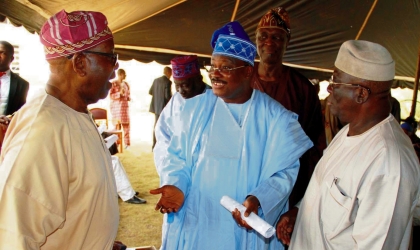
L-R: Afenifere Chieftain, Sir Olaniwun Ajayi, Governor Abiola Ajimobi of Oyo State and Chief Ayo Adebanjo, during the preliminary meeting of the Yoruba Committee on National Conference in Ijebu Ode last Monday
Boye Salau



The Independent National Electoral Commission (INEC) has extended the deadline for political parties to submit the list of candidates for the 2027 governorship and state Houses of Assembly elections from Saturday, August 8, to Tuesday, August 11, 2026.
The commission announced the extension in a statement issued on Saturday and signed by the National Commissioner and Chairman of its Information and Voter Education Committee, Mohammed Haruna.
According to INEC, the decision followed appeals by political parties for additional time to complete the submission process through the dedicated online portal.
“The submission window, which according to the revised Timetable and Schedule of Activities for the General Election was originally scheduled to close on Saturday, 8th August, 2026, has been extended to Tuesday, 11th August, 2026,” the commission said.
In a a related development, INEC announced the suspension of PVC collection in Osun State ahead of the August 15 governorship election.
The commission said voters who applied for replacement of lost, damaged or defaced Permanent Voter Cards would have until midnight on Sunday, August 9, to print downloadable copies of their cards.
The electoral body explained that the deadline was necessary to enable it compile data on downloaded PVCs and produce final statistics on the total number of cards collected ahead of the election.
INEC said PVC collection in Osun commenced at the Registration Area level from July 22 to 28, 2026, but was extended to July 31 following complaints about large crowds and difficulties experienced by voters at collection centres.
The exercise subsequently moved to the local government level and ran from August 1 to 7.
The commission also disclosed that replacement downloadable PVCs had been made available to voters in Odo-Otin and Ife Central Local Government Areas following the theft of cards during attacks on the two collection centres.
It stressed that the stolen cards could not be used to vote.
INEC reassured Osun residents of its preparedness for the August 15 governorship election.
“The commission reiterates that the stolen cards cannot be used to vote.
“INEC reassures the people of Osun State of its readiness to conduct a free, fair, credible and inclusive governorship election on 15th August, 2026,” the statement said.
The commission said the deadline, initially set for Saturday, 8 August, has been extended to Tuesday, 11 August 2026, following appeals from political parties for more time.
INEC also announced that the window for voters who applied to replace lost, damaged or defaced PVCs to download their replacement cards will close at midnight on Sunday, 9 August.
The move is to enable the commission compile final PVC collection figures ahead of the 15 August Osun governorship election.
INEC said replacement downloadable PVCs have also been provided to affected voters in Odo-Otin and Ife Central Local Government Areas after hoodlums carted away cards from two collection centres, stressing that the stolen cards cannot be used to vote.
The commission reaffirmed its readiness to conduct a free, fair, credible and inclusive election in Osun State.
Gov. Kefas made the remarks over the weekend at the Federal Medical Centre (FMC), Jalingo, during the flag-off of the second phase of the Renewed Hope Medical Outreach in Taraba State, organised as part of activities marking Prof. Yilwatda’s 58th birthday.
The governor commended Prof. Yilwatda for choosing to mark his birthday by providing medical care to people in need.
“What Professor Nentawe did is a powerful demonstration of what leadership should be,” Gov. Kefas said.
He assured that his administration would continue to support initiatives that complement government efforts to improve healthcare delivery and the wellbeing of residents.
Speaking at the event, Prof. Yilwatda called on Nigerian leaders to embrace the culture of giving and use their positions to touch the lives of the less privileged.
He said his decision to celebrate his 58th birthday in Taraba State was deliberate and informed by the needs of underserved communities, particularly people who face difficulties accessing healthcare because of distance and financial constraints.
According to him, the intervention followed a needs assessment and was extended across the three senatorial districts of the state.
He said the exercise commenced on August 3 at Takum General Hospital and covered the Federal University Teaching Hospital, Wukari; First Referral Hospital, Sunkani, Ardo-Kola Local Government Area; General Hospital, Bali; General Hospital, Gembu; and FMC Jalingo.
Prof. Yilwatda said the intervention provided medical services to thousands of beneficiaries, including people who required surgical procedures.
He said sustainable national development could only be achieved when strong institutions placed Nigerians at the centre of development.
“Leadership is about service,” he said, urging political and public leaders to make giving back to society an important part of their responsibilities.
He reaffirmed his commitment to serving Nigeria and its people, saying his personal vision was to make every day of his life useful to humanity.
“Every day that I live, the vision is: let it be useful to humanity,” he said.
The Taraba State Commissioner for Health, Dr. Bordiya Buma, commended the initiative, saying it was consistent with the Renewed Hope agenda and efforts to strengthen healthcare delivery in the state.
Dr Buma said the second phase followed the successful completion of the first phase, which was conducted simultaneously in six local government areas, with two LGAs selected from each of the three senatorial districts.
According to him, more than 10,000 patients were attended to during the first phase, including people with medical and surgical conditions.
He disclosed that 327 general surgeries, 71 eye surgeries and 575 dental procedures were carried out during the exercise.
The commissioner expressed appreciation to President Bola Tinubu for the Renewed Hope Medical Outreach and thanked Prof. Yilwatda for supporting the initiative and choosing Taraba State as a beneficiary.
The Minister of Health and Social Welfare, Prof. Muhammad Ali Pate, also commended Prof. Yilwatda for choosing Taraba State to mark his 58th birthday through a medical outreach.
Prof. Pate said making healthcare the centrepiece of the birthday celebration was significant because health affects everyone.
-

 News2 days ago
RSG Targets Nine Million Residents in Mosquito Net Distribution Campaign
-

 Oil & Energy2 days ago
Aiyedatiwa Signs New Electricity Bill
-

 Oil & Energy2 days ago
NLNG Commissions Research And Innovation Centre In RSU
-

 Maritime2 days ago
Marine Minister Commends President Tinubu On NPERA Bill Assent
-

 News2 days ago
KenPoly Holds Eight Convocations, August 29
-

 News2 days ago
RMAFC Completes Revenue Sharing Review, Proposes New Pay
-

 News2 days ago
RSG Begins Another Phase of Projects Commissioning Today
-

 Maritime2 days ago
NAGAFF Petitions IGP Over Alleged Maritime Police Harassment