
Politics
End Poverty, Okowa Urges Political Appointees

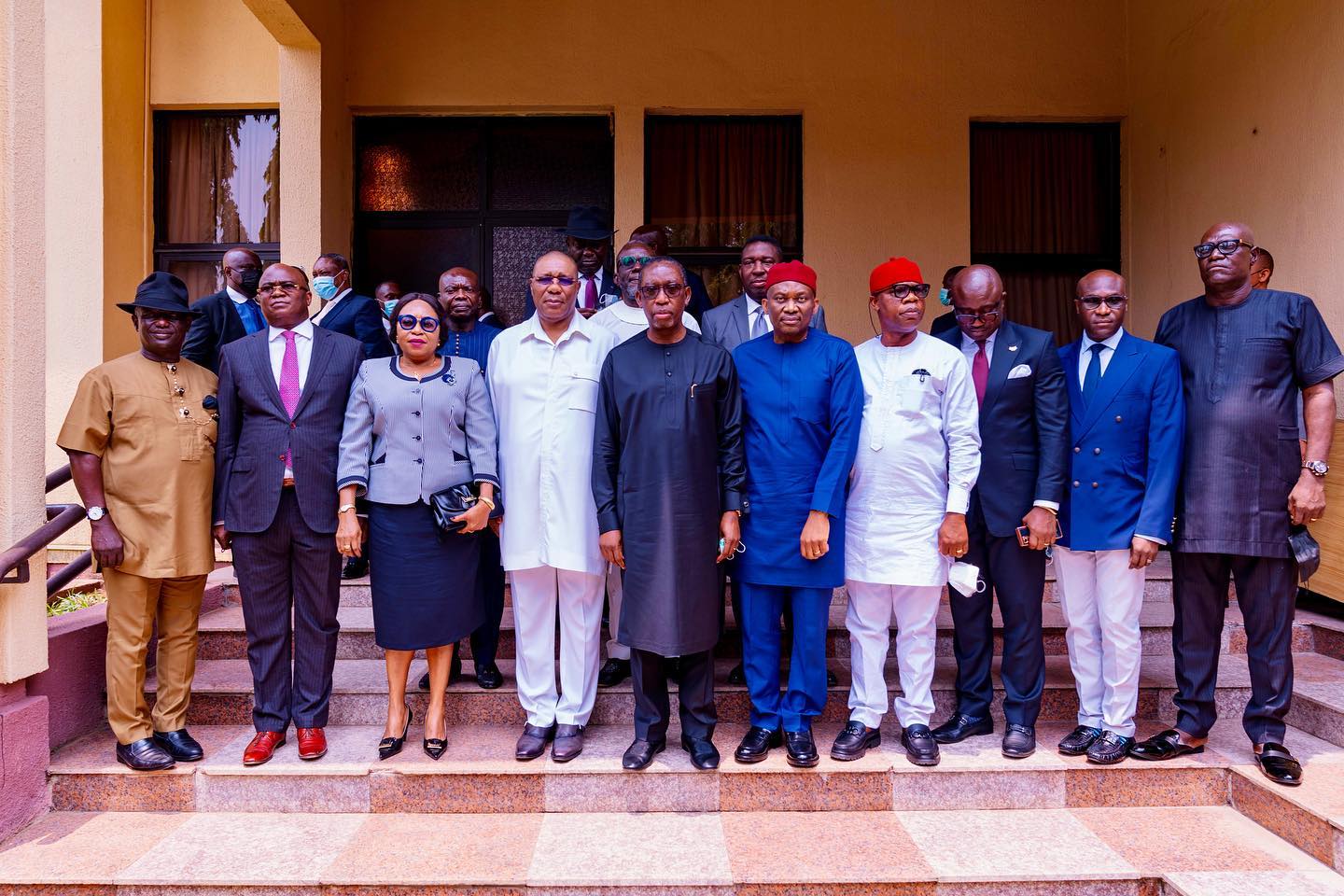
Governor Ifeanyi Okowa of Delta State has urged political appointees to be repository of ideas that will end poverty and social vices in the country.
The governor stated this yesterday, while inaugurating eight newly appointed Special Advisers at Government House, Asaba.
He noted that the times were difficult for Nigerians and that this was not the time for them to be lazy in their duties.
Okowa urged political appointees to commit themselves to more work to revive the economy and create opportunities for the younger generation.
He decried the high rate of youth unemployment which, he said, had driven many into self-help, leading to the current social vices in the country.
The governor said that his administration had created jobs through various empowerment programmes, which had greatly impacted many, with its great multiplier effect.
“Available records indicate that we have so far trained and resourced over 100,000 persons to become successful entrepreneurs.
“Yet, our cities and communities continue to brim with many youths who have yet to find succor, while some, regrettably, have chosen the path of infamy by embracing underhand methods to personal success that now pose danger to the rest of us.
“The signs are ominous and we cannot afford to play the ostrich or even be deluded into thinking that all is well. All is not well,’’ he said.
Okowa urged leaders to work with the consciousness that leadership was service.
“Service to the people for whom we hold our positions in trust. Thus, it is incumbent on appointees to devise means and methods of discharging their callings and responsibilities.
“Leaders and political appointees, at whatever level, should be repository of ideas that will proffer solutions to the problems of unemployment, poverty, anti-social vices, suspicion and distrust that breed inter-ethnic feuds in our communities,’’ he said.
The governor stressed the urgent need for mindset reorientation among the people.
While congratulating the appointees, Okowa urged them to consider it their duties to connect with their communities and engage in regular advocacy that would remold the youth and set them on the right path.
“Where there is a will, there must be a way.
“This administration is of the belief that the stability, peaceful coexistence and prosperity of the state depend on ability to run an all-inclusive government, powered by men and women of competence, capacity and character.
“Hence the new Special Advisers are additional key resources in our governance team, painstakingly assembled to be architects and builders of a stronger Delta.
Responding on behalf of his colleagues, Mr Johnson Erijo, thanked God for the opportunity given them to serve the state.
He expressed appreciation to the governor for finding them worthy of the appointment, while pledging to work and sustain the Okowa-led administration’s agenda of service of the people.
The Tide reports that the new Special Advisers are: Messrs Ignatius Ziakegha, Matthew Tsekiri, Chukwudi Dafe, Martins Okonta, Dan Yingi, Ernest Ogwuezzy, Johnson Erijo and Edward Ekpoko.
The Tide also reports that the appointment brings the number of special advisers in government to 16, following the devolution of the State Executive Council on May 18.
Meanwhile, the Delta House of Assembly has screened and confirmed additional 11 nominees as Commissioners in the state.
Those confirmed are Prof. Patrick Muoboghare, former Commissioner for Higher Education; Mr Chika Ossai, former Commissioner for Trade and Investment and Mr Basil Ganagana, former Commissioner for Energy.
Also confirmed is Mr Emmanuel Amgbaduba, former Commissioner for Oil and Gas. The others are Dr Mordi Ononye, former Commissioner for Health; Mr Ovie Oghoore; Mrs Bridget Anyafulu; Mr Solomon Golley; Mr Isaiah Bozimo; Mr Henry Dakota; and Mrs Jennifer Anderson.
The motion for the confirmation of the nominees was unanimously adopted yesterday, by the Assembly when the Speaker, Chief Sheriff Oborevwori put it to a voice vote and seconded by the Minority Leader, Mr Innocent Anidi.
The Tide reports that Gov. Ifeanyi Okowa on July 1, sworn in 18 confirmed nominees as commissioners.
The governor dissolved the state Executive Council on May 18.



The commission announced the extension in a statement issued on Saturday and signed by the National Commissioner and Chairman of its Information and Voter Education Committee, Mohammed Haruna.
According to INEC, the decision followed appeals by political parties for additional time to complete the submission process through the dedicated online portal.
“The submission window, which according to the revised Timetable and Schedule of Activities for the General Election was originally scheduled to close on Saturday, 8th August, 2026, has been extended to Tuesday, 11th August, 2026,” the commission said.
In a a related development, INEC announced the suspension of PVC collection in Osun State ahead of the August 15 governorship election.
The commission said voters who applied for replacement of lost, damaged or defaced Permanent Voter Cards would have until midnight on Sunday, August 9, to print downloadable copies of their cards.
The electoral body explained that the deadline was necessary to enable it compile data on downloaded PVCs and produce final statistics on the total number of cards collected ahead of the election.
INEC said PVC collection in Osun commenced at the Registration Area level from July 22 to 28, 2026, but was extended to July 31 following complaints about large crowds and difficulties experienced by voters at collection centres.
The exercise subsequently moved to the local government level and ran from August 1 to 7.
The commission also disclosed that replacement downloadable PVCs had been made available to voters in Odo-Otin and Ife Central Local Government Areas following the theft of cards during attacks on the two collection centres.
It stressed that the stolen cards could not be used to vote.
INEC reassured Osun residents of its preparedness for the August 15 governorship election.
“The commission reiterates that the stolen cards cannot be used to vote.
“INEC reassures the people of Osun State of its readiness to conduct a free, fair, credible and inclusive governorship election on 15th August, 2026,” the statement said.
The commission said the deadline, initially set for Saturday, 8 August, has been extended to Tuesday, 11 August 2026, following appeals from political parties for more time.
INEC also announced that the window for voters who applied to replace lost, damaged or defaced PVCs to download their replacement cards will close at midnight on Sunday, 9 August.
The move is to enable the commission compile final PVC collection figures ahead of the 15 August Osun governorship election.
INEC said replacement downloadable PVCs have also been provided to affected voters in Odo-Otin and Ife Central Local Government Areas after hoodlums carted away cards from two collection centres, stressing that the stolen cards cannot be used to vote.
The commission reaffirmed its readiness to conduct a free, fair, credible and inclusive election in Osun State.
Gov. Kefas made the remarks over the weekend at the Federal Medical Centre (FMC), Jalingo, during the flag-off of the second phase of the Renewed Hope Medical Outreach in Taraba State, organised as part of activities marking Prof. Yilwatda’s 58th birthday.
The governor commended Prof. Yilwatda for choosing to mark his birthday by providing medical care to people in need.
“What Professor Nentawe did is a powerful demonstration of what leadership should be,” Gov. Kefas said.
He assured that his administration would continue to support initiatives that complement government efforts to improve healthcare delivery and the wellbeing of residents.
Speaking at the event, Prof. Yilwatda called on Nigerian leaders to embrace the culture of giving and use their positions to touch the lives of the less privileged.
He said his decision to celebrate his 58th birthday in Taraba State was deliberate and informed by the needs of underserved communities, particularly people who face difficulties accessing healthcare because of distance and financial constraints.
According to him, the intervention followed a needs assessment and was extended across the three senatorial districts of the state.
He said the exercise commenced on August 3 at Takum General Hospital and covered the Federal University Teaching Hospital, Wukari; First Referral Hospital, Sunkani, Ardo-Kola Local Government Area; General Hospital, Bali; General Hospital, Gembu; and FMC Jalingo.
Prof. Yilwatda said the intervention provided medical services to thousands of beneficiaries, including people who required surgical procedures.
He said sustainable national development could only be achieved when strong institutions placed Nigerians at the centre of development.
“Leadership is about service,” he said, urging political and public leaders to make giving back to society an important part of their responsibilities.
He reaffirmed his commitment to serving Nigeria and its people, saying his personal vision was to make every day of his life useful to humanity.
“Every day that I live, the vision is: let it be useful to humanity,” he said.
The Taraba State Commissioner for Health, Dr. Bordiya Buma, commended the initiative, saying it was consistent with the Renewed Hope agenda and efforts to strengthen healthcare delivery in the state.
Dr Buma said the second phase followed the successful completion of the first phase, which was conducted simultaneously in six local government areas, with two LGAs selected from each of the three senatorial districts.
According to him, more than 10,000 patients were attended to during the first phase, including people with medical and surgical conditions.
He disclosed that 327 general surgeries, 71 eye surgeries and 575 dental procedures were carried out during the exercise.
The commissioner expressed appreciation to President Bola Tinubu for the Renewed Hope Medical Outreach and thanked Prof. Yilwatda for supporting the initiative and choosing Taraba State as a beneficiary.
The Minister of Health and Social Welfare, Prof. Muhammad Ali Pate, also commended Prof. Yilwatda for choosing Taraba State to mark his 58th birthday through a medical outreach.
Prof. Pate said making healthcare the centrepiece of the birthday celebration was significant because health affects everyone.
-

 News4 days ago
RSG Targets Nine Million Residents in Mosquito Net Distribution Campaign
-

 Oil & Energy4 days ago
Aiyedatiwa Signs New Electricity Bill
-

 Maritime4 days ago
Marine Minister Commends President Tinubu On NPERA Bill Assent
-

 Oil & Energy4 days ago
NLNG Commissions Research And Innovation Centre In RSU
-

 News4 days ago
KenPoly Holds Eight Convocations, August 29
-

 News4 days ago
RSG Begins Another Phase of Projects Commissioning Today
-

 News4 days ago
RMAFC Completes Revenue Sharing Review, Proposes New Pay
-

 Maritime4 days ago
NAGAFF Petitions IGP Over Alleged Maritime Police Harassment