
Business
Bowing To Labour’s Demand ’ll Cause Retrenchments -Ngige

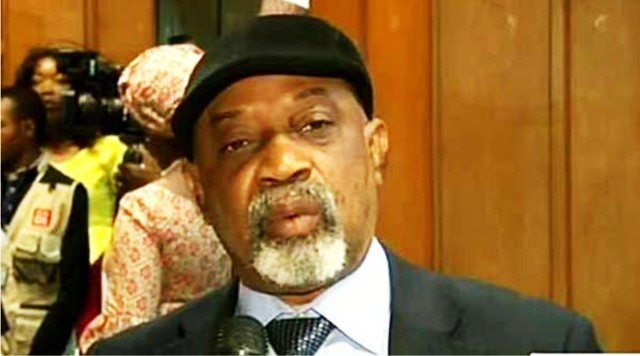
The Minister of Labour and Employment, Dr Chris Ngige, announced yesterday that the Federal Government would have to lay off workers to be able to meet a wage bill of N580 billion needed to meet labour’s demand on the new wage.
Ngige told labour leaders in Abuja that the sum was what would be needed by government to pay the consequential adjustments as demanded by labour.
Our correspondent reports that the minister’s announcement is the latest in the increasing drama over payment of the new wage.
A Bill for the new minimum wage was signed into law by President Muhammadu Buhari on April 18.
Ngige was speaking when the leadership of the United Labour Congress (ULC), paid him a courtesy visit in his office.
Government and labour have been locked in an endless tussle over modalities for the payment of the new wage, long expected by workers.
Ngige said that the Federal Government was avoiding a situation where it would have to lay off workers, noting that throwing workers into unemployment would add to their burden.
The minister pleaded with labour to accept the consequential adjustment from levels 7 to 17, adding that government had only three months left to implement the new wage.
He stated that government would not promise labour what it could not pay, noting that no worker deserved to be owed salary.
Ngige disclosed that the Federal Government had so far paid arrears of N500 billion to workers, including the Academic Staff Union of Universities.
Meanwhile, the organised labour has rejected the offer by the Federal Government on consequential adjustment for the new minimum wage for workers from Grade Level Seven to 17.
The organised labour also said that workers have exhausted their patience and demanded the reconvening of the meeting of the committee negotiating the consequential adjustment with a view to concluding the process within one week.
The rejection of the government offer was contained in a statement titled “Need for urgent intervention on the stalled negotiation of consequential adjustment of salaries arising from the new national minimum wage of N30, 000 per month to avert industrial crisis”.
The statement issued on Wednesday, after a meeting at the Labour House, Abuja, was signed by the President, Nigeria Labour Congress (NLC), Comrade Ayuba Wabba; President, Trade Union Congress (TUC), Comrade Quadri Olaleye, and Acting Chairman and Secretary of Joint National Public Service Negotiating Council (JNPSNC – Trade Union Side), Simon Anchaver and Alade Bashir Lawal, respectively.
The labour leaders warned that they would not be able to guarantee industrial harmony if their demands are not met at the close of work on Wednesday, 16th October, 2019.
They said the offer by government for salary adjustment of 11% for public workers on salary grade level 07-14 and 6.5% consequential increase for public workers on grade level 15 17 was not acceptable to Nigerian workers.
They described the position of government as “a show of insensitivity to the plight of workers and an attempt to collect with the left hand what government had offered with the right hand”.



Business
Jonathan, Diri, Others Laud Firm’s Milestone in Bayelsa …Says Project Will Drive Industrialisation, Create Jobs



-

 News2 days ago
RSG Targets Nine Million Residents in Mosquito Net Distribution Campaign
-

 Oil & Energy2 days ago
Aiyedatiwa Signs New Electricity Bill
-

 Maritime2 days ago
Marine Minister Commends President Tinubu On NPERA Bill Assent
-

 Oil & Energy2 days ago
NLNG Commissions Research And Innovation Centre In RSU
-

 News2 days ago
KenPoly Holds Eight Convocations, August 29
-

 News2 days ago
RSG Begins Another Phase of Projects Commissioning Today
-

 News2 days ago
RMAFC Completes Revenue Sharing Review, Proposes New Pay
-

 Maritime2 days ago
NAGAFF Petitions IGP Over Alleged Maritime Police Harassment